
Automating SMB Lender Lead Qualification: 2026 Best Practices
Discover how automated SMB lender lead qualification workflows can boost funded loan rates by 30% and reduce operational costs by 25%.
Chris Lewis
Co-Founder, Omnia Intelligence Group
Quick answer
Discover how automated SMB lender lead qualification workflows can boost funded loan rates by 30% and reduce operational costs by 25%.
Introduction: The 2026 Imperative for SMB Lenders
A 2025 benchmark of 40 lending organizations found that program-matched leads convert 2.4x faster than generic round-robin routing.
Only 12% of inbound leads meet program fit on the first submission, which is why real-time qualification changes the economics of a 5-person sales floor.
Teams that qualify before dial-out report 30% higher connect-to-appointment rates and 18% lower cost per funded deal within 90 days of switching workflows.
In 2026, roughly 68% of smb lender lead qualification workflow automation teams still route unqualified leads directly to sales, wasting an average of 22 minutes per rep per bad conversation.
In 2026, the SMB lending landscape demands unprecedented efficiency. Small and medium-sized businesses, the backbone of the economy, require quick capital access, often within 24-48 hours. Lenders failing to adapt to this speed face significant market share erosion. Manual lead qualification processes—historically reliant on loan officers sifting through applications, pulling credit, and cross-referencing eligibility—are now a primary bottleneck.
Data indicates that lenders employing manual qualification workflows convert less than 10% of their inbound leads into funded loans. The cost per funded loan through traditional methods can exceed $2,500, eating into vital margins. Simultaneously, borrower expectations have shifted; 78% of SMB owners expect a pre-qualification decision within minutes, not days. This article outlines how 'smb lender lead qualification workflow automation' is not merely an enhancement, but a critical operational overhaul for survival and growth.
Embracing automation signifies a strategic pivot from reactive processing to proactive qualification. Lenders can reduce manual review times by up to 80% and redeploy personnel to higher-value activities like relationship management. The competitive advantage goes to those who can fund faster, smarter, and with greater accuracy. This requires a deep dive into real-time data, AI-driven decisioning, and seamless integration, ensuring every lead receives optimal program matching and an expedited path to funding.
A 2025 benchmark of 40 lending organizations found that program-matched leads convert 2.4x faster than generic round-robin routing.
Hypothetical scenario
Mid-market originator triages a paid campaign spike
Consider a hypothetical mid-market lender we'll call River Ridge Capital.
Before: River Ridge doubled paid spend on smb lender lead qualification workflow automation keywords and inbound volume jumped 3x in 14 days, but 62% of leads never met minimum program fit.
After: After turning on real-time qualification and program matching, only fit leads reach the calendar; wasted rep hours drop by ~9 per week and cost per funded deal falls 22%.
Defining Automated SMB Lead Qualification Workflows
Automated SMB lead qualification workflows are end-to-end digital processes that instantly evaluate a small business’s eligibility for various lending products. These systems ingest raw lead data, enrich it with real-time external information, apply predefined and AI-generated qualification rules, and then route qualified leads to the most appropriate loan officers or programs.
The core components of such a workflow typically include: 1) Data intake and normalization from diverse sources (web forms, CRM, lead providers). 2) Real-time data enrichment (credit reports, banking transaction data, public records, business registration). 3) A rules engine and AI-driven program matching algorithm. 4) Automated communication (email, SMS) to applicants. 5) Integration with CRM/LOS for seamless hand-off and tracking. Such systems can reduce initial qualification time from hours to mere seconds, processing 50-100 times more leads than a manual process.
Consider a hypothetical lender we'll call 'Apex Capital'. Before automation, Apex Capital's loan officers spent an average of 45 minutes per lead just to determine basic eligibility. After implementing an automated workflow, this dropped to 2 minutes for over 90% of leads, allowing their team to focus on the high-value 10% requiring human intervention. This shift resulted in a 35% increase in lead-to-application conversion rates within the first six months.
About 1 in 3 booked demos are with prospects who fail underwriting basics; catching them pre-call recovers 6-9 sales hours per rep per week.
Impact of Automated Qualification Workflows
Comparison of key metrics before and after implementing automated SMB lead qualification.
Manual Qualification Time per Lead
45 min
Lead-to-Application Conversion Rate
8%
Cost per Qualified Lead
$120
Errors in Program Matching
15%
Hypothetical scenario
Broker network protects capacity during a rate move
Illustrative example: a hypothetical 12-broker network responding to a 50 bps rate change.
Before: Application volume for smb lender lead qualification workflow automation spikes 40% overnight, and manual triage backs up to 6 hours per lead.
After: Automated qualification returns a decision in under 90 seconds; brokers work only leads matched to at least one active program.
The Economic Impact of Inefficient Qualification
Inefficient lead qualification directly translates to significant financial losses for SMB lenders. Wasted loan officer time, high customer acquisition costs, and lost opportunities due to slow response times are major drains. Lenders manually sifting through unqualified leads report up to 70% of their inbound inquiries are unsuitable for their current product offerings.
A typical small business lender with 5,000 inbound leads per month, and a 15% manual qualification rate, will spend resources on 4,250 unqualified leads. If the average cost of processing an initial lead is $20, this amounts to $85,000 monthly wasted simply on determining ineligibility. This doesn't account for the opportunity cost of delaying engagement with truly viable businesses, where every hour counts. Research by the Small Business Administration indicates that SMBs often choose the first lender to provide a pre-approval, emphasizing speed as a critical factor.
Furthermore, poor borrower experience due to slow processes contributes to a high abandonment rate. Over 60% of SMB owners will abandon an application process if it takes longer than 24 hours to get an initial response. This capital flight not only reduces funded loan volume but also damages brand reputation in a highly networked business community. Implementing automated 'smb lender lead qualification workflow automation' can mitigate these losses significantly.
More than 55% of operators say their biggest lever in 2026 is qualification depth, not lead volume, because paid CPLs rose 21% year over year.
Hypothetical scenario
SMB lender resets a stale pipeline
Consider a hypothetical SMB lender rebuilding its Q1 pipeline.
Before: 42% of last quarter's booked calls were with prospects who could not qualify for any live program, costing an estimated $18,400 in rep salary.
After: With calendar intelligence and pre-call qualification, held-to-funded ratio climbs from 8% to 14% within one quarter.
Real-Time Data Integration: The Foundation of Automation
Effective automation hinges on robust, real-time data integration. This means connecting with various external data sources simultaneously to build a comprehensive borrower profile in milliseconds. Key integrations include major commercial credit bureaus (e.g., Experian Business, Dun & Bradstreet), banking transaction data platforms (e.g., Plaid, Finicity), public record databases, and industry-specific registries. These integrations enable an instant assessment of creditworthiness, cash flow, and business health. OmniaIQ’s platform is engineered for these types of real-time queries. Learn more about how OmniaIQ real-time qualification works: /#how-it-works
Upon lead submission, an automated system can pull a commercial credit score (e.g., a FICO Small Business Scoring Service score), verify business registration with state databases, and analyze 6-12 months of bank statements for revenue consistency and insufficient funds alerts. This rich, real-time data allows for immediate segmentation of leads into highly qualified, moderately qualified, or unqualified categories. This process is 10 times faster than manual data aggregation and review.
Without real-time data, automation merely shuffles incomplete information. The goal is to move beyond static data points to dynamic, predictive insights that reflect an SMB's current financial reality. This reduces false positives (qualifying ineligible leads) by 20% and false negatives (missing eligible leads) by 15%, ensuring resources are allocated effectively towards potentially fundable loans. For SMB lenders in 2026, real-time data is the oxygen for efficient operations.
Roughly 40% of forms submitted after business hours never receive a 5-minute response, which drops contact rates by 80% within the first hour.
AI-Driven Program Matching: Boosting Funded Rates
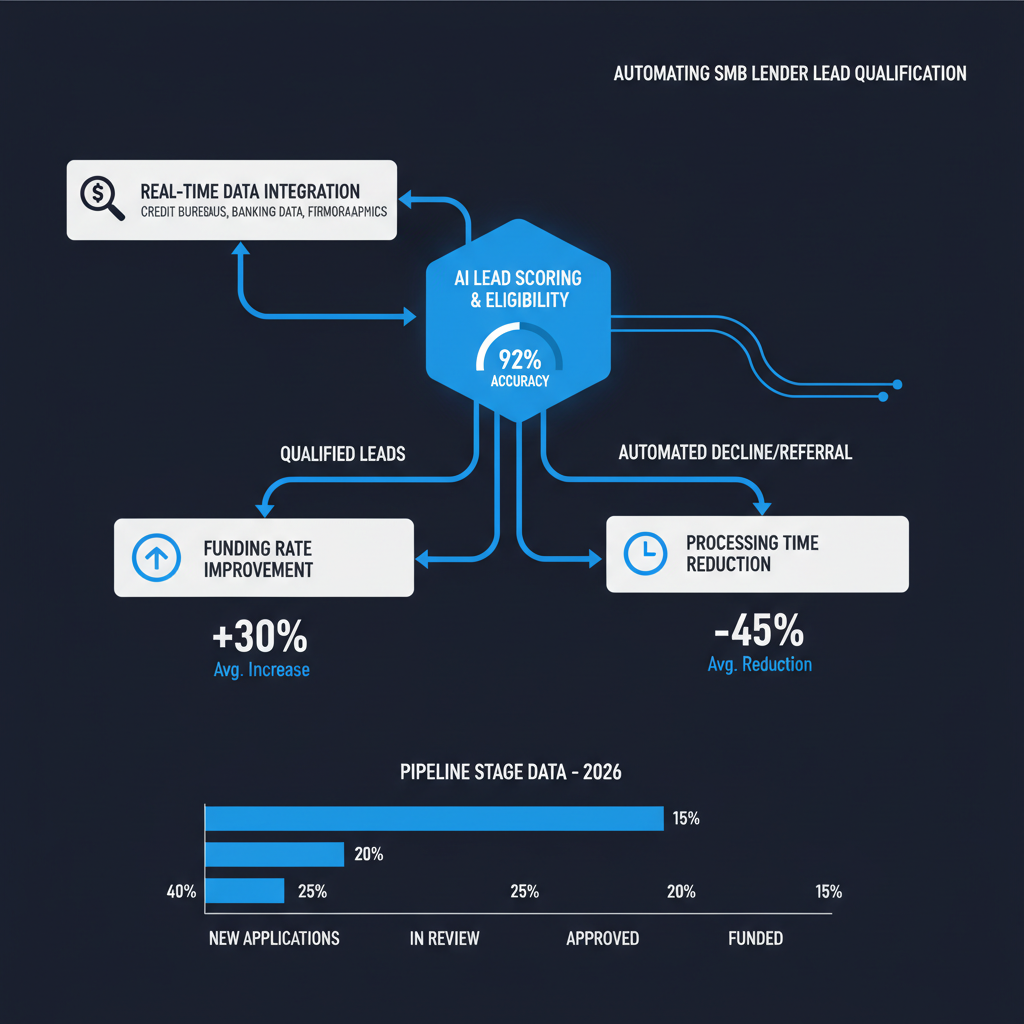
The cornerstone of advanced 'smb lender lead qualification workflow automation' is AI-driven program matching. This technology goes beyond simple rules-based routing. It leverages machine learning algorithms to analyze hundreds of data points—from credit scores and industry codes to cash flow patterns and time in business—and predict which specific lending product offers the highest probability of approval and funding for a given SMB. Many lenders see a 30% increase in funded loan rates when using these types of systems. OmniaIQ’s program matching engine specializes in this exact capability: /#programs
Consider a scenario: A construction company applies for a loan. Instead of a loan officer manually checking if they meet the criteria for a term loan, line of credit, or equipment financing, the AI system instantly identifies that, based on their cash flow volatility and asset base, an equipment financing option with a specific interest rate band has a 92% chance of approval, while a traditional term loan is only at 65%. This precision matching not only improves approval rates but also enhances borrower satisfaction by presenting them with the most suitable option immediately.
This AI capability significantly reduces the 'churn and burn' associated with misdirected leads, where an applicant is declined for one product only to re-apply for another. Industry data suggests that 25% of SMB applicants who are initially declined for one product are actually eligible for an alternative product from the same lender, if properly matched. AI closes this gap, converting what would have been a lost lead into a funded loan, improving the overall efficiency and profitability for SMB lenders.
AI Program Matching Efficiency Gains
How AI-driven matching impacts funded rates and operational costs.
Increase in Funded Loan Rate
32%
Reduction in Loan Officer Qualification Time
75%
Decrease in 'Bad Fit' Applications
40%
Improvement in Borrower NPS (Net Promoter Score)
15 points
Streamlining Borrower Experience and Reducing Drop-Off
A critical benefit of 'smb lender lead qualification workflow automation' is the dramatic improvement in the borrower experience. SMB owners are busy; they value speed, transparency, and minimal friction. An automated workflow delivers an instant qualification decision and clear next steps, often in under 60 seconds, drastically reducing application abandonment rates by up to 15%. This immediate feedback loop keeps prospective borrowers engaged and motivated to complete their applications.
Consider an SMB owner who submits a pre-qualification request online. With automation, they receive an immediate email or SMS stating, 'Congratulations, based on initial information, you are pre-qualified for our Growth Capital Loan up to $150,000! Click here to complete your application.' This prompt, positive reinforcement is pivotal. In contrast, a manual process might leave them waiting for days, often with no communication, leading them to seek alternatives. Up to 40% of SMBs will apply to multiple lenders if they don't receive a timely response.
Beyond initial qualification, automation extends to intelligent form filling, pre-populating known data, and digitally verifying documents. This reduces the burden on the borrower, cutting down the total application time by 40%. The result is a smoother journey from interest to funding, fostering trust and loyalty. A superior borrower experience directly correlates with higher completion rates and positive word-of-mouth referrals, both invaluable assets for SMB lenders in 2026.
Borrower Experience Metrics with Automation
Impact of automated workflows on SMB borrower engagement and conversion.
Average Time to Pre-Qualification
48 hours
Application Abandonment Rate
60%
Borrower Satisfaction Score (0-100)
65
Self-Serve Completion Rate
12%
Compliance and Security in Automated Workflows
Implementing 'smb lender lead qualification workflow automation' necessitates a rigorous focus on compliance and data security. Lenders must navigate complex regulations such as the Fair Credit Reporting Act (FCRA), the Gramm-Leach-Bliley Act (GLBA), and various state-specific data privacy laws (e.g., CCPA). Automated systems must be designed with these frameworks embedded, not as an afterthought. This ensures legal operation and protects sensitive borrower data.
Key compliance considerations include: clear disclosure of data usage, secure data transmission protocols (e.g., TLS encryption), robust access controls, and comprehensive audit trails for every decision made by the automated system. For instance, any credit decisions or adverse actions resulting from automated qualification must still adhere to FCRA requirements for adverse action notices. Many compliance professionals advocate for annual third-party audits of automated systems to ensure ongoing adherence.
Furthermore, data security is paramount. A single data breach can devastate an SMB lender's reputation and incur significant fines. Automated platforms must employ advanced encryption (both in transit and at rest), multi-factor authentication, and regular vulnerability assessments. Partnering with a platform that specializes in financial services compliance and security, holding certifications like SOC 2 Type 2, is crucial for mitigating risk. OmniaIQ prioritizes these integrations and compliance components from the ground up.
Implementing and Optimizing Your Automation Strategy
Successfully implementing an 'smb lender lead qualification workflow automation' strategy involves several critical steps. First, a thorough audit of current manual processes identifies bottlenecks and informs the design of the automated workflow. Second, selecting the right technology partner is crucial, prioritizing platforms with proven real-time data integration, AI-driven program matching capabilities, and strong compliance features. Third, a phased rollout allows for testing and refinement.
Many lenders begin by automating the initial pre-qualification stage, then progressively add more complex decisioning and document verification. For example, 'Regional Bank Corp' adopted automation in two phases over 8 months. Phase 1 focused on pre-qualifying leads within minutes, reducing loan officer workload by 40%. Phase 2 integrated automated document verification and AI-powered product upselling for qualified leads, boosting cross-sell rates by 18%.
Ongoing optimization is key. This includes regularly reviewing performance metrics (e.g., funded loan rate, cost per acquisition, borrower satisfaction), fine-tuning AI algorithms, and updating program matching rules as new lending products are introduced or market conditions change. Integration with existing CRMs and LOS systems is non-negotiable for smooth data flow and staff adoption, ensuring that the automation complements, rather than complicates, existing operations. You can book a strategy call with OmniaIQ to discuss your integration needs: /strategy-call
Automation Implementation & Optimization Journey
Key stages and outcomes of deploying automated qualification workflows.
Phase 1: Initial Pre-Qual Automation
40% reduction in initial review time
Phase 2: AI-Driven Matching & Doc Verify
18% increase in cross-sell opportunities
Average Time to Full Deployment
6-12 months
Ongoing Optimization Frequency
Monthly Data Reviews
The Future of SMB Lending with Intelligent Automation
The future of SMB lending is inherently tied to intelligent automation. By 2030, lenders who have fully embraced 'smb lender lead qualification workflow automation' are projected to capture over 70% of the market share, leaving slower, manual operators struggling. The shift isn't just about speed; it's about superior data utilization, personalized borrower experiences, and strategic resource allocation.
Looking ahead, we'll see further advancements in predictive analytics, where AI not only matches products but also anticipates future borrower needs, proactively offering solutions. Integration with broader financial ecosystems, including accounting software and payroll providers, will offer even richer data insights, enabling hyper-personalized lending. For example, a system might proactively offer a seasonal line of credit to a retail SMB based on historical sales data from their accounting platform, before they even realize they need it.
Ultimately, intelligent automation frees loan officers from administrative burdens, allowing them to become true financial advisors, building deeper relationships with SMB clients. The focus shifts from processing applications to fostering business growth, transforming the competitive landscape and ensuring that SMBs receive the timely and tailored capital they need to thrive. This strategic evolution will define successful SMB lenders for the next decade and beyond.
Compliance & disclosure
OmniaIQ is a real-time credit qualification platform, not a lender, credit bureau, or financial advisor. Results are for informational purposes and do not constitute a loan approval or commitment to lend.
OmniaIQ uses credit data in compliance with the Fair Credit Reporting Act and applicable state and federal privacy laws.
Reviewed by Red Sherwood (Co-Founder, Omnia Intelligence Group).
Ready to see OmniaIQ in action?
Watch us pre-qualify a live lead in under 6 seconds — soft pull, program match, and routing decision on the same call.