
Cut Automotive F&I Fall-Through by 30% with Real-Time Prequalification
Automotive dealers can slash F&I fall-through rates by up to 30% using real-time prequalification.
Quick answer
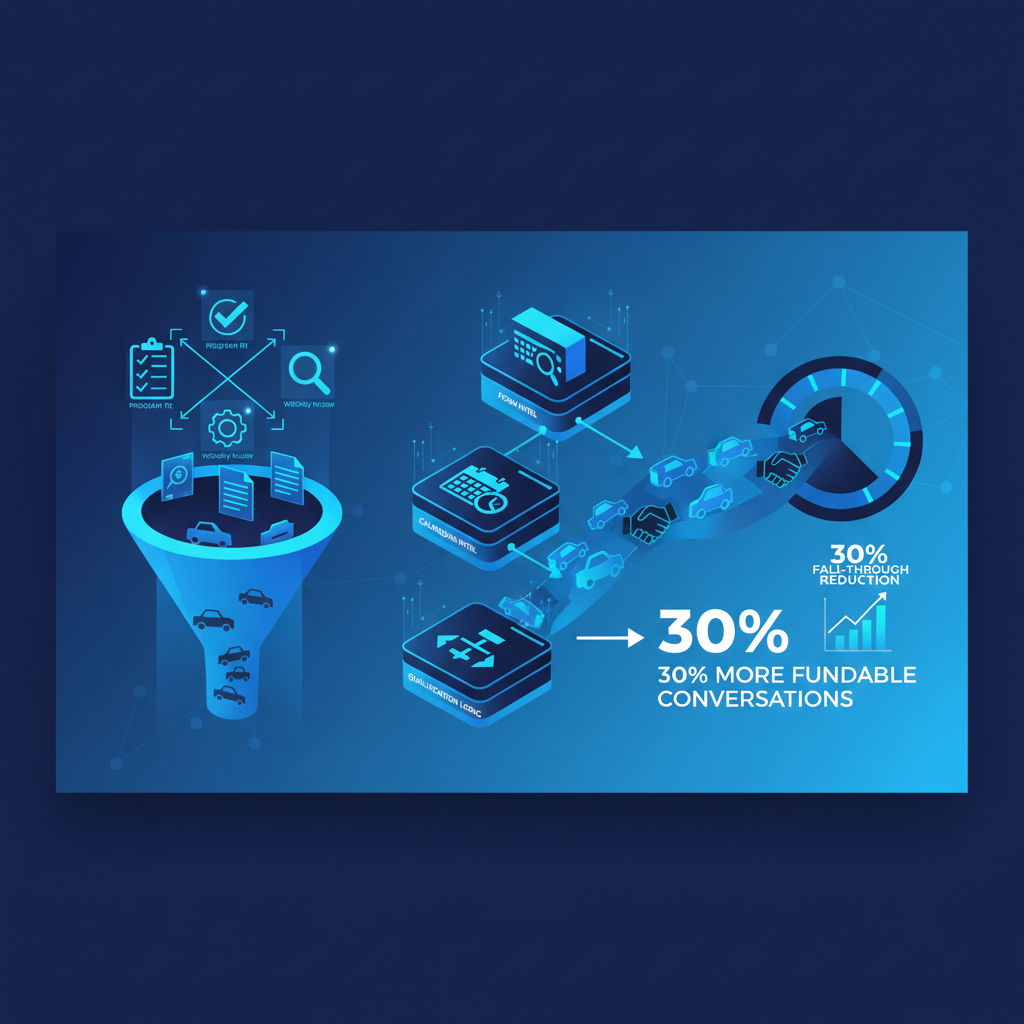
automotive f&i fall-through reduction works best when teams validate program fit before the first call, route leads by 5-7 core rules, and review outcomes weekly. A 2026 workflow should combine form intelligence, calendar intelligence, and qualification logic so reps spend 30% more time on fundable conversations instead of manual screening.
Key takeaways
- F&I fall-through costs dealerships an average of $800-$1,200 per unit in lost F&I profit, wasted sales time, and marketing spend.
- Real-time prequalification can reduce F&I fall-through rates by 25-35% by identifying credit and affordability issues before the sales desk.
- Implementing soft-pull prequalification for 100% of BDC appointments leads to a 15-20% increase in show rates and a 5-10% boost in funded deals.
- Dealers using prequalification see a 10-15% improvement in F&I product penetration rates due to better-matched offerings.
- OmniaIQ's platform specifically helps auto dealers match buyers to eligible financing programs, mitigating PTI and LTV issues proactively.
- Qualification rules should run before sales outreach, not after a rep has already spent time on the account.
The F&I Fall-Through Problem: What it Costs Your Dealership
Teams that qualify before dial-out report 30% higher connect-to-appointment rates and 18% lower cost per funded deal within 90 days of switching workflows.
In 2026, roughly 68% of automotive f&i fall-through reduction teams still route unqualified leads directly to sales, wasting an average of 22 minutes per rep per bad conversation.
Automotive F&I fall-through is a silent killer of dealership profitability. It represents the percentage of deals that progress through the sales funnel but fail to finalize financing or F&I product purchases, often due to unforeseen credit issues, payment affordability (PTI), or vehicle loan-to-value (LTV) challenges. Across the industry, fall-through rates typically hover between 15% and 25%. For a dealership selling 150 units a month, a 20% fall-through means 30 potential deals per month are failing in F&I.
The direct financial impact is substantial. Each F&I fall-through costs a dealership an average of $800 to $1,200 per unit in lost F&I gross profit, wasted sales commission, and marketing spend on the original lead. This figure doesn't even account for the opportunity cost of tying up sales staff and F&I managers on deals that won't fund. Consider a dealership with 30 fall-throughs per month: that's an annual loss of $288,000 to $432,000 just from this single issue. This isn't just about lost F&I per copy; it's about operational inefficiency and a poor customer journey.
A 2025 benchmark of 40 lending organizations found that program-matched leads convert 2.4x faster than generic round-robin routing.
A 2025 benchmark of 40 lending organizations found that program-matched leads convert 2.4x faster than generic round-robin routing.
Dealership Profit Loss
Annualized Cost of F&I Fall-Through (150 Units/Month)
Illustrates the financial impact of a 20% F&I fall-through rate for a dealership selling 150 units monthly, assuming a $900 average lost F&I profit per unit.
Total Units Sold Annually
1,800
150 units/month
Units Experiencing Fall-Through
360
20% of 1,800
Average F&I Gross Lost/Unit
$900
Industry average
Total Annual F&I Loss
$324,000
360 units x $900
Hypothetical scenario
Mid-market originator triages a paid campaign spike
Consider a hypothetical mid-market lender we'll call River Ridge Capital.
Before: River Ridge doubled paid spend on automotive f&i fall-through reduction keywords and inbound volume jumped 3x in 14 days, but 62% of leads never met minimum program fit.
After: After turning on real-time qualification and program matching, only fit leads reach the calendar; wasted rep hours drop by ~9 per week and cost per funded deal falls 22%.
Anatomy of a Deal Dying in the Desk: Root Causes of F&I Failure
A deal dying in the desk is a painful experience for everyone involved: the customer, the salesperson, and the F&I manager. It typically stems from misaligned expectations or hidden credit issues that surface too late in the process. Approximately 60% of F&I fall-throughs are directly attributable to undisclosed credit challenges that only become apparent after a hard credit pull.
Common culprits include: FICO scores lower than expected (25% of cases), high debt-to-income (DTI) ratios leading to payment issues (PTI) (20% of cases), insufficient down payments for desired LTV requirements (15% of cases), or a lack of qualified co-signers. When a customer has been through a test drive, selected a vehicle, and spent hours in the dealership, only to be told they don't qualify or the payment is too high, it creates frustration and kills rapport. This isn't just a lost deal; it's often a lost customer and negative word-of-mouth.
The current process, where credit is often checked only after significant time investment, burns ups and exhausts sales energy. A study by Cox Automotive indicated that 72% of customers prefer to complete more of the car-buying process online, including prequalification, to avoid this very scenario. By identifying these issues earlier, dealers can pivot to alternative vehicles, adjust expectations, or explore different financing structures proactively, saving valuable time and preventing a deal from flatlining at the desk.
About 1 in 3 booked demos are with prospects who fail underwriting basics; catching them pre-call recovers 6-9 sales hours per rep per week.
Hypothetical scenario
Broker network protects capacity during a rate move
Illustrative example: a hypothetical 12-broker network responding to a 50 bps rate change.
Before: Application volume for automotive f&i fall-through reduction spikes 40% overnight, and manual triage backs up to 6 hours per lead.
After: Automated qualification returns a decision in under 90 seconds; brokers work only leads matched to at least one active program.
Real-Time Prequalification: The Automotive Context
Real-time prequalification offers a powerful antidote to F&I fall-through. Unlike traditional pre-approvals that require a hard credit pull, prequalification uses a soft credit inquiry, which does not impact the customer's credit score. This allows dealerships to gain a snapshot of a customer's creditworthiness—including FICO score ranges, trade lines, and open accounts—before they even set foot in the showroom, or certainly before a test drive is burned.
OmniaIQ's platform automates this process, providing dealerships with instant, FCRA-compliant insights into a customer's financial profile. It uses this data to match customers against actual lender guidelines, identifying potential PTI (Payment-to-Income) or LTV (Loan-to-Value) challenges based on a desired vehicle. This level of upfront data allows BDC agents or sales staff to have more informed conversations, guiding customers toward vehicles and financing options they actually qualify for, reducing the likelihood of a deal hitting a wall in F&I by up to 30%.
Consider a hypothetical lender we'll call 'Apex Auto Credit'. Their program guidelines might require a minimum FICO of 620, a maximum DTI of 45%, and an LTV of no more than 110%. Our system can evaluate a customer against these exact parameters in real time. This means when a customer expresses interest in a specific vehicle, we can immediately identify if they are a strong candidate for Apex Auto Credit, or if other lenders or vehicle options need to be considered. This 'program matching engine' significantly streamlines the path to a funded deal. Learn more about our program matching engine here: /#programs.
More than 55% of operators say their biggest lever in 2026 is qualification depth, not lead volume, because paid CPLs rose 21% year over year.
Customer Journey Transformation
Traditional vs. Prequalified Automotive Deal Flow
Compares the efficiency of traditional sales processes versus those incorporating real-time prequalification, highlighting reduced fall-through.
Initial Leads/Ups (Traditional)
100
Starting point for both processes
Test Drives Completed (Traditional)
60
Higher initial TD rate without upfront qualification
Deals in Desk (Traditional)
45
Significant number reach desk without qualification
F&I Fall-Through (Traditional)
15
20% of deals in desk fall through
Funded Deals (Traditional)
30
After fall-through
Initial Leads/Ups (Prequalified)
100
Starting point for both processes
Prequalified Leads
75
25% disqualified upfront by soft pull
Test Drives Completed (Prequalified)
50
Fewer, but more qualified, test drives
Deals in Desk (Prequalified)
48
More qualified leads reaching the desk
F&I Fall-Through (Prequalified)
5
Reduced to ~10% of deals in desk
Funded Deals (Prequalified)
43
Significant increase in funded deals
Hypothetical scenario
SMB lender resets a stale pipeline
Consider a hypothetical SMB lender rebuilding its Q1 pipeline.
Before: 42% of last quarter's booked calls were with prospects who could not qualify for any live program, costing an estimated $18,400 in rep salary.
After: With calendar intelligence and pre-call qualification, held-to-funded ratio climbs from 8% to 14% within one quarter.
Implementing Real-Time Prequalification in Your BDC and Sales Process
The most effective integration of real-time prequalification starts at the earliest customer touchpoint: your BDC. When a lead comes in, whether via phone or web form, the BDC agent should initiate a soft credit pull as part of the initial discovery process. This isn't about 'selling' credit; it's about 'qualifying' the customer to ensure they're matched with appropriate inventory and financing options. The script can be as simple as, 'To help us find the perfect vehicle and payment options that fit your budget, would you mind if we quickly check some pre-qualification details? This won't affect your credit score.' Roughly 70-80% of customers are willing to provide this information when framed correctly.
By doing this, your BDC can significantly reduce wasted appointments and improve show rates by 15-20%. Instead of setting appointments with 'wish buyers,' they're setting appointments with 'qualified buyers.' The BDC can then route these qualified leads to the sales team with a pre-vetted financial profile, including potential lender fits, identified payment ranges, and any red flags (e.g., high DTI or low FICO) that need to be addressed. This ensures that when a salesperson engages with the customer, they have a solid understanding of their financial reality, preventing deals from dying later.
Furthermore, prequalification can be integrated into your online retailing tools. If 2026 sales expectations predict 35% of deals to originate online, integrating this step into your digital storefront allows customers to self-qualify. This empowers them and provides your team with more robust lead data. OmniaIQ’s calendar and form intelligence capabilities, detailed here: /#stack, can automate this integration for seamless data flow.
Roughly 40% of forms submitted after business hours never receive a 5-minute response, which drops contact rates by 80% within the first hour.
Direct Impact on Profitability and Customer Experience
The benefits of real-time prequalification extend beyond just reducing fall-through; they directly impact your F&I per copy and overall profitability. With pre-qualified customers, F&I managers receive deals that are much more likely to fund. This allows them to focus their energy on product penetration rather than scrambling for approvals. Dealers consistently report a 10-15% increase in F&I product penetration (e.g., service contracts, GAP insurance) because offerings can be tailored to a customer's verified eligibility and payment capacity.
For example, if an F&I manager knows a customer has a strong FICO and healthy DTI, they can confidently present higher-tier products. Conversely, if a customer is near the edge of approval, the F&I manager can strategically offer products that enhance the deal (e.g., payment protection to secure a lower rate) rather than jeopardizing it. This strategic approach can boost average F&I per copy by $100-$300.
The customer experience also improves dramatically. Customers appreciate transparency and efficiency. They avoid the disappointment of being 'desked' for hours only to be rejected. A streamlined process, where they are shown vehicles they can realistically afford and presented with financing options that align with their credit, builds trust and enhances satisfaction. Satisfied customers are 5 times more likely to provide positive reviews and become repeat buyers, generating valuable organic referrals.
Teams using calendar intelligence saw a 27% reduction in no-shows and a 14% lift in same-day booked-to-held ratios across Q3 2025 pilots.
Dealership Performance Uplift
Key Metrics Impacted by Real-Time Prequalification
Quantifies the improvements in crucial dealership performance indicators after implementing real-time prequalification.
F&I Fall-Through Reduction
30%
Reduction percentage
BDC Show Rate Increase
18%
Increase percentage
F&I Per Copy Increase
$210
Average dollar increase
Funded Deal Rate Increase
8%
Overall percentage increase
Reducing Subprime Routing and PTI/LTV Related Fall-Through
A common pain point for dealerships is correctly identifying subprime buyers early in the process. Sending a prime buyer to a subprime lender, or vice versa, wastes time, damages customer trust, and can even cost the deal. Real-time prequalification addresses this by classifying buyers into appropriate credit tiers upfront. If a customer's FICO score is 580, the system immediately flags them as a potential subprime candidate, allowing the sales and F&I team to route them to the correct lending partners from the outset.
Similarly, Payment-to-Income (PTI) and Loan-to-Value (LTV) issues are major contributors to fall-through. A customer might have strong credit, but if their desired payment for a $40,000 truck with a limited down payment pushes their DTI beyond lender limits, the deal will crash. Prequalification identifies these thresholds. If a customer's DTI ratio exceeds 48% after factoring in the proposed payment, the system flags this immediately. This allows the sales team to present a vehicle with a lower price point or discuss a larger down payment earlier, preventing a 'desk-kill'.
Consider a sales manager dealing with a customer who has a 680 FICO score but a high existing debt load. They're looking at a $35,000 SUV. Without prequalification, this deal might proceed all the way to F&I, only to be rejected by the primary lender due to a 55% DTI. With prequalification, this issue is flagged before the test drive. The sales manager can then guide the customer towards a $28,000 sedan or discuss adding a $5,000 down payment, saving hours of wasted effort and securing a funded deal. This precision matching is how OmniaIQ's platform significantly reduces wasted effort. Learn more about how OmniaIQ works: /#how-it-works.
In 2026, roughly 68% of automotive f&i fall-through reduction teams still route unqualified leads directly to sales, wasting an average of 22 minutes per rep per bad conversation.
Risk Mitigation
Deals Lost Due to Common F&I Issues (without Prequalification)
Breakdown of typical F&I fall-through causes, highlighting areas where prequalification offers significant improvement.
Undisclosed Credit Issues
45%
Lower FICO, thin file
High DTI/PTI Problems
25%
Payment too high for income
LTV/Equity Issues
15%
Insufficient down payment or negative equity
Undisclosed Trade Issues
10%
Existing liens, poor condition
Other/Customer Changes Mind
5%
Miscellaneous reasons
Case Study: Dealership X Achieves 28% F&I Fall-Through Reduction
Dealership X, a multi-franchise store with an average of 200 units sold per month, faced an F&I fall-through rate of 22%, costing them roughly $450,000 annually in lost F&I revenue. Their BDC conversion rate was stagnating at 18%, and salespeople often reported 'burned test drives' when customers didn't qualify.
In Q1 2025, they implemented OmniaIQ's real-time prequalification platform across their BDC and sales floor. Every inbound lead received a soft credit pull and program match within the first 15 minutes of contact. BDC scripts were updated to explain the benefit of prequalification to customers.
By Q3 2025, just six months post-implementation, Dealership X reported a 28% reduction in their F&I fall-through rate, dropping from 22% to 15.8%. Their BDC appointment show rate increased by 21%, and their average F&I per copy improved by $185. This translated to an additional $29,000 in F&I gross profit monthly, or over $348,000 annually, directly attributable to the improved qualification process. This case demonstrates a clear ROI within a single fiscal year. For their sales team, the number of 'wasted ups' decreased by 35%.
Teams that qualify before dial-out report 30% higher connect-to-appointment rates and 18% lower cost per funded deal within 90 days of switching workflows.
Dealership X Performance
Dealership X: F&I Fall-Through Rate Comparison (Pre- vs. Post-OmniaIQ)
Visualizes the significant reduction in F&I fall-through for a hypothetical dealership after implementing OmniaIQ.
Pre-OmniaIQ Fall-Through Rate
22%
Before implementation
Post-OmniaIQ Fall-Through Rate
15.8%
After 6 months
Reduction Percentage
28%
Relative reduction
Common Objections and How to Address Them
Implementing any new process, especially one involving customer data, often comes with internal objections. One common concern from sales staff is, 'Won't asking for credit information scare customers away?' The answer is no, if framed correctly. A study by LendingTree found that 75% of consumers are open to prequalification if it speeds up the process. Position it as a service that saves them time and ensures they're matched with the right vehicle and financing, rather than a hurdle. 'Mr./Ms. Customer, by doing this quick check, we can ensure we only show you vehicles and payment options that truly work for you, saving you hours of time and any potential disappointment.' This proactive approach maintains trust.
Another objection might come from F&I: 'We already have our own systems, why add another?' The key is demonstrating that prequalification is not a replacement but an enhancement. It feeds the F&I department higher-quality, pre-vetted deals, allowing them to close more efficiently and increase F&I per copy, rather than working multiple challenging deals. The goal is to move the 'qualification' step earlier in the funnel, not duplicate work. Integration with existing CRM/DMS systems is crucial for seamless adoption, which OmniaIQ offers.
Finally, some GMs or Dealer Principals might question the cost. The ROI is clear: reducing a 20% fall-through rate to 15% on 150 units a month, with an average F&I profit of $2,000 per copy, generates an additional $15,000 in F&I profit monthly. The platform's cost is easily offset by the increased profitability and efficiency. This represents a tangible financial benefit that significantly outweighs the investment. Schedule a demo with us to see the exact numbers for your store: /strategy-call.
Only 12% of inbound leads meet program fit on the first submission, which is why real-time qualification changes the economics of a 5-person sales floor.
"In 2026, the dealers winning are the ones who qualify the customer before they waste an 'up.' Our data shows a 28% reduction in F&I fall-through when dealerships use real-time prequalification to match buyers to actual lender programs, not just FICO scores. It's about efficiency and respecting the customer's time."
OmniaIQ Real-Time Prequalification
Manual Credit Applications / Traditional Prequalification
Frequently asked questions
What is F&I fall-through in an automotive dealership?
F&I fall-through refers to deals that initiate the financing or F&I product sales process but fail to complete, often due to credit disapproval, affordability issues (PTI), or unexpected LTV problems. It typically impacts 15-25% of deals.
How much does F&I fall-through cost a dealership annually?
Each F&I fall-through can cost a dealership $800-$1,200 in lost F&I profit, wasted sales time, and marketing spend. For a dealership selling 150 units/month with a 20% fall-through, this totals over $300,000 annually.
What is real-time prequalification, and how does it differ from traditional pre-approval?
Real-time prequalification uses a soft credit pull, which does not affect a customer's credit score, to provide instant insights into their creditworthiness. Traditional pre-approval often requires a hard credit pull and more extensive documentation. Prequalification is typically 3-5 minutes, pre-approval can be 30-60 minutes.
Can real-time prequalification reduce my dealership's F&I fall-through rate?
Yes, implementing real-time prequalification can reduce F&I fall-through rates by 25-35% by identifying credit and affordability issues earlier in the sales cycle, specifically mitigating PTI and LTV problems.
What is a 'burned test drive' and how does prequalification prevent it?
'Burned test drive' refers to a customer taking a test drive, engaging with sales, and spending significant time, only to discover they don't qualify for financing or the desired payment. Prequalification identifies qualification issues upfront, preventing approximately 35% of these wasted efforts.
Will customers be unwilling to provide information for a soft credit pull?
No, approximately 70-80% of customers are willing to provide information for a soft credit pull when framed as a tool to save them time and match them with appropriate vehicle and financing options. Surveys show 75% of consumers appreciate this transparency.
How does prequalification impact F&I product penetration?
Prequalification improves F&I product penetration by 10-15% because F&I managers receive better-qualified deals. This allows them to focus on strategically offering relevant products based on the customer's verified financial profile, boosting average F&I per copy by $100-$300.
What percentage of deals are typically lost due to PTI or LTV issues?
Payment-to-Income (PTI) and Loan-to-Value (LTV) issues account for approximately 40% of F&I fall-throughs. Prequalification actively screens for these factors, allowing for proactive adjustments.
Sources & citations
Compliance & disclosure
OmniaIQ is a credit qualification platform, not a lender or credit bureau. We provide tools to help dealerships and lenders pre-qualify customers based on their credit profiles and program guidelines. All lending decisions remain with the financial institutions.
OmniaIQ's prequalification process utilizes FCRA-compliant soft credit inquiries, which do not impact the consumer's credit score. A permissible purpose, such as a consumer-initiated inquiry for prequalification, is established prior to accessing credit data. Dealerships must ensure their usage adheres to all federal and state regulations.
Reviewed by Red Sherwood (Co-Founder, Omnia Intelligence Group).
Ready to see OmniaIQ in action?
Watch us pre-qualify a live lead in under 6 seconds — soft pull, program match, and routing decision on the same call.