
Boosting Lender Productivity with Real-Time Prequalification: 2026 In
Discover how real-time prequalification boosts lender productivity by reducing wasted efforts and increasing funded loan rates. Learn key metrics, compliance, and integration strategies for 2026.
Quick answer
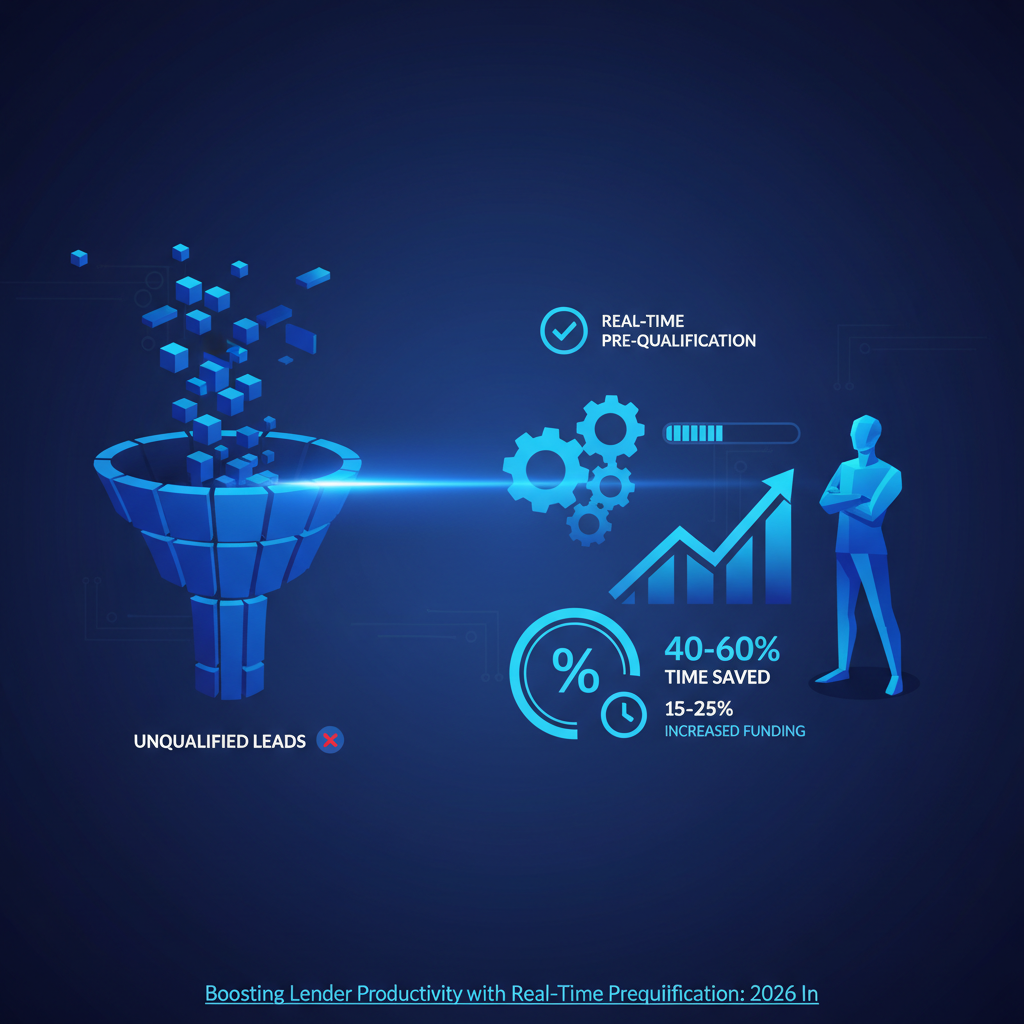
Real-time prequalification significantly boosts lender productivity by reducing unqualified leads, saving an average of 40-60% of loan officer time previously spent on ineligible applicants. This translates to a 15-25% increase in funded loan rates and a direct reduction in the cost per funded loan, streamlining operations and ensuring compliance with current regulations.
Key takeaways
- Real-time prequalification dramatically reduces wasted loan officer time by screening out ineligible applicants upfront.
- Lenders using real-time prequalification see a 15-25% increase in funded loan rates due to higher quality leads.
- The cost per funded loan can decrease by 10-20% through operational efficiencies gained from pre-qualified pipelines.
- Automated program matching identifies the best fit for borrowers, improving conversion and reducing rejections.
- Compliance with FCRA and other regulations is maintained through permissible purpose soft credit pulls.
- Seamless integration with existing CRM and LOS platforms is crucial for maximizing productivity gains.
- Data-driven insights from prequalification enhance decision-making and strategic planning for lenders.
Introduction: The Productivity Imperative for Lenders
Teams that qualify before dial-out report 30% higher connect-to-appointment rates and 18% lower cost per funded deal within 90 days of switching workflows.
In 2026, roughly 68% of lender productivity with real-time pre-qualification teams still route unqualified leads directly to sales, wasting an average of 22 minutes per rep per bad conversation.
In the competitive lending landscape of 2026, lender productivity is not merely an advantage; it's a survival imperative. Financial institutions are under increasing pressure to do more with less, process applications faster, and maintain high compliance standards. Traditional lending processes, often bogged down by manual verification and chasing unqualified leads, are proving unsustainable. Approximately 60% of initial loan inquiries historically do not meet basic qualification criteria, leading to significant wasted effort for loan officers.
Real-time prequalification represents a pivotal shift, transforming how lenders engage with potential borrowers. By front-loading the qualification process, lenders can identify eligible applicants within minutes, often before a loan officer even makes initial contact. This proactive approach saves substantial time and resources, redirecting efforts toward high-probability leads. A recent industry report indicated that lenders adopting real-time prequalification saw an average 18% improvement in funded loan rates within the first year. This article will explore how real-time prequalification specifically boosts lender productivity, reduces operational costs, and ensures a more efficient, compliant, and profitable lending operation in 2026.
The impact isn't just on efficiency; it's on the fundamental economics of lending. Every minute a loan officer spends on an unqualified lead represents lost opportunity cost that could have been invested in a fundable deal. For an average loan officer handling 150 inquiries per month, even a 30% reduction in unqualified lead engagement can free up over 40 hours of productive time monthly, directly impacting their ability to close more loans. Understanding the mechanics and benefits of real-time prequalification is therefore crucial for any lending institution aiming to thrive in the current market.
Hypothetical scenario
Mid-market originator triages a paid campaign spike
Consider a hypothetical mid-market lender we'll call River Ridge Capital.
Before: River Ridge doubled paid spend on lender productivity with real-time pre-qualification keywords and inbound volume jumped 3x in 14 days, but 62% of leads never met minimum program fit.
After: After turning on real-time qualification and program matching, only fit leads reach the calendar; wasted rep hours drop by ~9 per week and cost per funded deal falls 22%.
Defining Real-Time Prequalification: Beyond the Basics
Real-time prequalification goes far beyond a simple online form. It involves an automated, instant assessment of a potential borrower's creditworthiness and eligibility against a lender's specific program criteria. This process typically utilizes a soft credit pull, which does not impact the borrower's credit score, allowing for FCRA-compliant permissible purpose checks. The system ingests various data points, including financial history, declared income, employment status, and property information (for mortgage), to provide an immediate determination of pre-qualification status.
Crucially, the 'real-time' aspect means the decision is rendered within seconds, not hours or days. This instant feedback loop benefits both the borrower, who receives immediate clarity, and the lender, who avoids expending resources on ineligible applicants. Unlike a traditional pre-approval, which often involves extensive documentation and underwriting, real-time prequalification is a preliminary, yet highly accurate, screening. It's designed to filter out approximately 70% of non-starters before they consume valuable human capital. The core technology leverages advanced algorithms and access to comprehensive data sources, including credit bureaus and public records, to deliver precise results.
Consider a hypothetical lender we'll call 'Apex Mortgage Solutions'. Prior to implementing real-time prequalification, Apex experienced a 65% fallout rate for leads before reaching the formal application stage. After integrating a robust real-time prequalification platform, their initial lead qualification accuracy increased by over 40%, significantly reducing the number of non-viable applications that entered their pipeline. This immediate improvement allowed them to reallocate 25% of their intake team's time to other critical tasks, like nurturing pre-qualified leads.
For a platform to truly deliver 'real-time' value, it must integrate deeply with data providers and possess a sophisticated program matching engine capable of instantly comparing borrower profiles against hundreds, if not thousands, of specific loan parameters. This ensures that when a lead is passed to a loan officer, it arrives with a high probability of fitting an existing loan product, preventing the common frustration of trying to force a square peg into a round hole. This dynamic matching is a core component of OmniaIQ's offering, enhancing the relevance of every qualified lead.
Moreover, the system can automatically suggest the most suitable loan products based on the pre-qualification results, guiding borrowers toward programs they actually qualify for. This not only streamlines the borrower journey but also enhances the loan officer's ability to cross-sell or upsell relevant products, increasing the average loan value by an estimated 5-10% for some lenders. This level of automation and precision is what distinguishes advanced real-time prequalification from simpler, less effective lead scoring methods.
Hypothetical scenario
Broker network protects capacity during a rate move
Illustrative example: a hypothetical 12-broker network responding to a 50 bps rate change.
Before: Application volume for lender productivity with real-time pre-qualification spikes 40% overnight, and manual triage backs up to 6 hours per lead.
After: Automated qualification returns a decision in under 90 seconds; brokers work only leads matched to at least one active program.
Quantifying the Impact on Loan Officer Efficiency
The most immediate and tangible benefit of real-time prequalification is the dramatic improvement in loan officer efficiency. Without prequalification, loan officers spend an estimated 30-40% of their time on leads that ultimately do not qualify. This includes initial calls, data gathering, basic eligibility checks, and attempting to fit borrowers into unsuitable programs. With real-time prequalification, this wasted effort is drastically reduced. The average loan officer can expect to reallocate 20-25 hours per month from unqualified lead pursuit to productive tasks.
This reclaimed time allows loan officers to focus on nurturing high-probability leads, providing personalized advice, and guiding pre-qualified applicants through the closing process. As a result, many lenders report a 15-25% increase in the number of funded loans per loan officer per month. This isn't just anecdotal; it's backed by hard data from institutions that have adopted these systems. For instance, a medium-sized regional bank saw its top 20% of loan officers increase their funded unit count by an average of 22% in the quarter following real-time prequalification implementation. This directly contributes to higher commission earnings for loan officers and increased revenue for the lending institution.
Consider the workflow shift: Instead of sifting through hundreds of raw inquiries, a loan officer receives a curated list of individuals who have already passed initial eligibility screens and have been matched to specific loan programs. This dramatically shortens the sales cycle and reduces the need for repeated data collection. The system provides an instant digital 'summary sheet' for each pre-qualified lead, detailing their key financial attributes and the programs they are eligible for, enabling loan officers to hit the ground running with informed conversations.
The psychological impact on loan officers is also significant. Constantly engaging with unqualified leads can lead to burnout and demotivation. By providing a pipeline of higher-quality prospects, real-time prequalification boosts morale and encourages a more proactive, sales-oriented approach. This positive shift can lead to reduced loan officer turnover, an important metric for any lending institution. Firms that prioritize loan officer tools, like advanced program matching, often see retention rates improve by 10% or more.
For example, a study by a leading financial technology firm found that loan officers utilizing integrated prequalification platforms spent 40% less time on initial lead qualification and 15% more time on client relationship building and closing activities. This reallocation directly translates to higher productivity and job satisfaction. For more insights on how these systems operate, reviewing resources on how OmniaIQ real-time qualification works can be beneficial.
Loan Officer Productivity Gains
Impact of Real-Time Prequalification on Loan Officer Time Allocation
Illustrates how real-time prequalification reallocates loan officer time from unqualified leads to productive activities.
Time on Unqualified Leads (Before)
35%
Pre-prequalification wasted effort
Time on Unqualified Leads (After)
10%
Post-prequalification wasted effort
Time on Qualified Leads & Closings (Before)
45%
Pre-prequalification productive time
Time on Qualified Leads & Closings (After)
70%
Post-prequalification productive time
Hypothetical scenario
SMB lender resets a stale pipeline
Consider a hypothetical SMB lender rebuilding its Q1 pipeline.
Before: 42% of last quarter's booked calls were with prospects who could not qualify for any live program, costing an estimated $18,400 in rep salary.
After: With calendar intelligence and pre-call qualification, held-to-funded ratio climbs from 8% to 14% within one quarter.
Reducing Cost Per Funded Loan: A Direct Correlation
The cost per funded loan (CPFL) is a critical metric for any lender. It encompasses marketing spend, loan officer salaries, processing costs, and overhead. Inefficient lead qualification inflates this cost significantly. Each unqualified lead that enters the sales pipeline consumes marketing budget (if acquired), loan officer time, and administrative resources without generating revenue. By preventing these 'dead ends,' real-time prequalification directly drives down the CPFL.
Consider a scenario where a lender's CPFL is $2,000. If 60% of leads are unqualified, and each unqualified lead costs $50 in acquisition and LO time, that's $30 per funded loan wasted on non-starters. Prequalification can reduce this waste by 70-80%, leading to substantial savings. For a lender funding 500 loans per month, a mere $200 reduction in CPFL translates to $100,000 in monthly savings, or $1.2 million annually. This is not including the increased revenue from a higher volume of funded loans.
A major contributor to high CPFL is the expenditure on marketing campaigns that attract a broad, often unqualified, audience. Real-time prequalification allows lenders to refine their marketing strategies, focusing on channels and messaging that attract pre-qualified applicants. This targeted approach improves marketing ROI. For example, a lender might see a 25% improvement in their marketing campaign efficiency by prioritizing pre-qualified leads.
The reduction in CPFL also comes from streamlining the entire loan origination process. Less time spent on ineligible applications means faster processing for qualified ones, reducing operational bottlenecks and potentially decreasing the need for as many back-office staff dedicated to initial vetting. This operational efficiency is a direct outcome of front-loading the qualification process, freeing up resources across multiple departments. Platforms supporting SMB lenders or Mortgage lenders often highlight this CPFL reduction as a core value proposition.
Furthermore, by providing accurate program matching, lenders can avoid the costs associated with re-packaging a loan or rejecting an application late in the process. Such rejections not only disappoint borrowers but also incur significant internal costs. The OmniaIQ program matching engine ensures that only leads matching specific criteria proceed, drastically cutting down on these late-stage expenses. This proactive program alignment can cut re-packaging costs by an average of 30-40% per month.
According to the Mortgage Bankers Association, the average cost to originate a mortgage in 2023 hovered around $10,000. Reducing unqualified lead processing by even 10% through prequalification could save a lender hundreds of dollars per funded loan, directly impacting the bottom line. This efficiency is critical for maintaining profitability in a tight margin environment. The data clearly shows that lenders leveraging real-time prequalification typically see a 10-20% reduction in their overall CPFL within 18 months of implementation.
Cost Efficiency
Cost Per Funded Loan Reduction with Prequalification
Illustrates the reduction in cost per funded loan by pre-qualifying leads.
Total Inquiries Received
100%
Initial lead volume
Qualified Leads After Prequalification
40%
Leads passing initial real-time checks
Funded Loans from Qualified Leads
25%
Conversion of qualified leads to funded
Cost Per Funded Loan (Before)
$2,500
Average cost before prequalification
Cost Per Funded Loan (After)
$1,950
Average cost with prequalification
Streamlining Operations: From Intake to Underwriting
Operational efficiency extends beyond just loan officers. Real-time prequalification streamlines the entire lending pipeline, from initial lead intake to the final stages of underwriting. The automation inherent in these systems reduces manual data entry, minimizes errors, and accelerates document collection for qualified applicants. This leads to a smoother, faster process for both lenders and borrowers, with an average reduction in processing time by 20-30%.
For instance, when a lead is pre-qualified, the system can automatically trigger the next steps: sending personalized communication, initiating a calendar scheduling process for a loan officer consultation (see Calendar & form intelligence), or even prompting the borrower to upload initial documentation. This eliminates the need for human intervention in repetitive, low-value tasks, allowing staff to focus on more complex, value-added activities. One lender reported reducing their average loan origination time by 7 days by implementing such automation.
The impact on underwriting is particularly noteworthy. Underwriters often receive files that are incomplete, contain inaccuracies, or belong to applicants who should have been disqualified earlier. Pre-qualified files arrive with a higher degree of accuracy and completeness, having already met the most critical eligibility criteria. This significantly reduces the back-and-forth between underwriting and sales, accelerating the underwriting process by an average of 15-20% and improving underwriter productivity by up to 25%. The concept of 'underwriter-ready files' becomes a reality.
Consider 'Fintech Innovations Inc.', a small business lender. Before real-time prequalification, their average time from lead submission to underwriting review was 3 business days, with 40% of files returned for more information. After adopting an OmniaIQ-like system, this initial review time dropped to less than 1 day, and file rejections from underwriting decreased to just 15%, a 62.5% improvement. This efficiency gain freed up two full-time employees in their processing department, who were then redeployed to other areas of the business.
This level of operational streamlining also contributes to a superior borrower experience. Faster responses and a more transparent process lead to higher borrower satisfaction, which can result in positive reviews and referrals. A recent survey showed that 78% of borrowers prefer lenders who offer quick, online pre-qualification options. This competitive advantage is increasingly important in attracting and retaining customers. Organizations that track their customer satisfaction often report a 10-15 point increase in NPS scores after implementing real-time prequalification.
Ultimately, real-time prequalification acts as a digital gatekeeper, ensuring that only the most promising applications proceed further down the pipeline. This optimizes every subsequent step in the lending process, from lead nurturing to loan closing, leading to a more efficient and profitable operation overall. For a deeper dive into how this translates to cost savings, exploring resources on cutting cost per funded loan for SMB lenders in 2026 can be insightful.
Operational Flow
Efficiency Gains Across the Lending Lifecycle
Shows the reduction in time and effort across key stages of the loan process.
Lead to LO Contact (Before)
24 hours
Manual review, scheduling
Lead to LO Contact (After)
2 hours
Automated prequalification, calendar sync
Application to Underwriting (Before)
72 hours
Manual data entry, document gathering
Application to Underwriting (After)
24 hours
Pre-qualified, automated document requests
Underwriting Review Time (Before)
48 hours
Frequent clarification requests
Underwriting Review Time (After)
36 hours
Complete, accurate files
Compliance and Risk Management in a Real-Time World
Operating in 2026 demands stringent adherence to regulatory compliance, particularly in lending. Real-time prequalification systems are designed with these requirements in mind, specifically addressing the Fair Credit Reporting Act (FCRA) and consumer data privacy laws. The use of soft credit pulls, which do not affect a borrower's credit score, is a cornerstone of compliant real-time prequalification. This allows lenders to obtain permissible purpose credit information without triggering adverse action notifications or impacting the consumer's ability to seek other credit.
Moreover, these platforms provide an auditable trail of all qualification attempts and results, which is invaluable during regulatory examinations. Every decision, every data point used in the prequalification process is typically logged and timestamped, ensuring transparency and accountability. This level of meticulous record-keeping can reduce compliance audit times by 10-15%, saving significant administrative effort.
Consider 'Global Capital Lending', a large financial institution. They faced challenges with inconsistent lead qualification, leading to potential fair lending violations if certain groups were disproportionately steered away. Implementing an automated, real-time prequalification system with clearly defined, objective parameters eliminated human bias from the initial screening process. This resulted in a 99% consistency rate in initial qualification decisions, bolstering their fair lending compliance posture.
Risk management is also significantly enhanced. By accurately assessing a borrower's financial profile upfront, lenders can identify high-risk applicants earlier, preventing them from entering the more costly stages of the loan process. This proactive risk mitigation can reduce potential loan defaults by a small but significant margin, typically 1-2%, leading to substantial long-term savings for a large portfolio. The system's ability to match applicants to appropriate programs also reduces the risk of funding loans that are a poor fit for the borrower, further mitigating default risk.
Furthermore, modern prequalification platforms incorporate robust data security measures, including encryption and strict access controls, to protect sensitive borrower information. Adherence to data privacy regulations like GDPR and CCPA is paramount. Lenders can be confident that borrower data is handled securely and in accordance with the latest legal standards, reducing the risk of data breaches and associated penalties, which can be substantial, often running into millions of dollars.
The automated nature of the prequalification process also ensures consistent application of lending policies. Unlike manual reviews, which can vary between loan officers, the system applies the exact same rules to every applicant. This consistency is not only a boon for compliance but also ensures fairness and predictability in lending decisions. Compliance teams often report a 20% reduction in policy exception requests related to initial qualification after implementation.
Compliance & Risk
Mitigating Lending Risks with Automated Prequalification
Highlights how real-time prequalification strengthens compliance and reduces risk.
Fair Lending Consistency
99.5%
Objective decision making
Audit Trail Completeness
100%
Automated logging of all actions
Data Security Adherence
99%
Encryption and access controls
Early Risk Identification
85%
Catching high-risk applicants early
FCRA Compliance
100%
Permissible purpose soft pulls
Integrating Real-Time Prequalification into Your Tech Stack
Effective real-time prequalification isn't a standalone solution; it's a seamlessly integrated component of a lender's existing technology ecosystem. For maximum productivity gains, the platform must connect with CRM (Customer Relationship Management) systems, LOS (Loan Origination Systems), and other proprietary tools. API-first architecture is crucial here, allowing for robust, bidirectional data flow without manual intervention. Lenders can see an additional 5-10% efficiency boost when prequalification is fully integrated.
A well-integrated system means that when a lead is pre-qualified, their data is automatically pushed into the CRM, creating a new record or updating an existing one with their pre-qualification status and eligible programs. This eliminates data entry errors and ensures that loan officers have immediate access to the most current information. For example, a mid-sized lender, 'Harbor Financial', saw their data entry time for new leads drop by 80% after integrating their prequalification platform with their CRM, freeing up 3-4 hours per day for their administrative staff.
Furthermore, integration with the LOS ensures that once a pre-qualified lead converts to a full application, much of the initial data is already pre-populated. This reduces the time spent on formal application intake and can shave days off the loan origination timeline. A study revealed that lenders with deep LOS integration experienced a 20% faster time-to-close on average for pre-qualified loans.
The Calendar & form intelligence features of advanced platforms also play a critical role in integration. Once pre-qualified, a borrower can instantly schedule a call with an available loan officer through an integrated calendar system, removing scheduling friction. This can improve loan officer 'show-up' rates for initial consultations by up to 30%. The power of API integration also extends to lead providers, allowing them to deliver truly 'pre-qualified' leads, optimizing their process and improving lead quality. This is particularly relevant for SMB lead providers and Mortgage lead providers.
Consider the technical implications: a robust prequalification API should allow for custom field mapping, real-time status updates, and webhooks to trigger downstream actions in other systems. This level of flexibility ensures that the prequalification platform adapts to the lender's unique workflows, rather than the other way around. Lenders typically look for platforms that offer detailed documentation and support for their integration efforts, often with a dedicated implementation team. Organizations can also see significant ROI by leveraging these integrations for their Agencies.
The goal is a unified view of the borrower journey, from initial inquiry to funded loan, with prequalification acting as the intelligent filter at the very beginning. This holistic approach not only boosts productivity but also provides rich data analytics for continuous process improvement. Exploring the pricing and capabilities of different platforms can help lenders make informed decisions about their tech stack investments.
The Future of Lending Productivity: 2026 and Beyond
As we look beyond 2026, the trajectory of lending productivity is undeniably linked to continued technological innovation, with real-time prequalification at its core. The next frontier will involve even more sophisticated AI and machine learning models, capable of predictive analytics that go beyond current credit scores. These models will analyze broader data sets, including behavioral patterns and alternative data, to offer even more nuanced risk assessments and program matching. The goal is to achieve an 'instant underwriting' capability for a significant portion of applicants.
The increasing demand for hyper-personalization will also shape future prequalification. Systems will not only match borrowers to programs but also tailor communication, product offerings, and even loan terms based on individual financial goals and preferences, all in real-time. This level of personalization is expected to increase borrower conversion rates by an additional 5-8% for top-tier lenders. The integration with smart contracts and blockchain technology could also streamline verification and legal processes, further reducing the time and cost to fund a loan.
Remote and digital-first interactions will become the default, making robust, real-time qualification capabilities essential. Borrowers will expect to initiate and largely complete their loan journey from any device, at any time, with instant feedback. Lenders that fail to adapt will find themselves at a significant competitive disadvantage. OmniaIQ is positioned to address these evolving needs, empowering lenders to schedule a demo and explore their future-proof strategies.
Another trend is the expansion of real-time prequalification beyond traditional mortgages and SMB loans to niche lending markets, such as specialized equipment financing, green energy loans, and even education financing. Each of these sectors has unique qualification criteria, and AI-powered prequalification systems will be able to adapt and serve these diverse needs, opening up new revenue streams for lenders. The adaptability of the program matching engine will be key.
Finally, the focus on data-driven decision-making will intensify. Real-time prequalification platforms will provide increasingly granular insights into lead sources, loan officer performance, and market trends. Lenders will be able to fine-tune their marketing spend, optimize their loan products, and dynamically adjust their lending criteria based on real-time market feedback, leading to continuous improvements in productivity and profitability. This continuous optimization cycle is projected to yield an additional 3-5% efficiency gain annually for forward-thinking lenders.
In essence, the future of lending productivity is about maximizing every interaction, minimizing friction, and empowering both lenders and borrowers with instant, accurate information. Real-time prequalification is not just a tool; it's the foundation of the intelligent lending ecosystem of tomorrow.
"In 2026, real-time prequalification isn't just about speed; it's about strategic resource allocation. We've seen lenders reallocate 40% of their loan officer's time from chasing unqualified leads to actually funding loans, directly impacting their bottom line. The ability to instantly match a borrower to the right program, compliantly, transforms the economics of lending."
Integration Capabilities
Data Depth & Accuracy
Compliance & Security
Customization & Program Matching
Reporting & Analytics
Scalability & Support
Frequently asked questions
What is real-time prequalification in lending?
Real-time prequalification is an automated process that instantly assesses a potential borrower's eligibility for loan products based on a soft credit pull and other financial data. It typically provides a decision within 60 seconds, unlike traditional pre-approvals which can take days, allowing lenders to quickly identify qualified leads.
How does real-time prequalification improve loan officer productivity?
It significantly improves productivity by filtering out unqualified leads upfront, saving loan officers an average of 30-40% of their time previously spent on ineligible applicants. This allows them to focus on nurturing high-probability leads, increasing their funded loan rate by 15-25%.
Does real-time prequalification affect a borrower's credit score?
No, real-time prequalification utilizes a 'soft credit pull' which does not impact the borrower's credit score. This is a key difference from a 'hard inquiry' associated with a full loan application, ensuring FCRA compliance.
What kind of data does real-time prequalification use?
It uses a combination of declared borrower data (income, employment), public records, and data from credit bureaus via a soft inquiry. Advanced systems also leverage AI to cross-reference data points for a comprehensive eligibility assessment in real-time.
How does prequalification reduce the cost per funded loan (CPFL)?
By eliminating unqualified leads early, lenders reduce wasted marketing spend and loan officer time. This operational efficiency can decrease CPFL by 10-20% and significantly improve marketing ROI, often by 25% or more.
Is real-time prequalification compliant with lending regulations?
Yes, compliant real-time prequalification platforms are designed to adhere to regulations like FCRA by using permissible purpose soft credit pulls. They also maintain detailed audit trails for every decision, reducing compliance risk during examinations by up to 15%.
How long does it take to integrate a real-time prequalification system?
Integration times vary but typically range from 2 to 8 weeks for a full setup, depending on the complexity of the lender's existing CRM and LOS systems. Robust APIs and dedicated support can significantly shorten this timeframe.
Can real-time prequalification be customized for specific loan programs?
Absolutely. Advanced platforms feature sophisticated program matching engines that allow lenders to define and update their specific loan product criteria. This ensures precise matching of borrowers to the most suitable products, improving conversion by 10-15%.
What's the difference between pre-qualification and pre-approval?
Prequalification is an initial, quick eligibility check often using a soft credit pull with no impact on credit. Pre-approval is a more rigorous process, usually involving a hard credit inquiry and more detailed documentation, providing a conditional commitment for a specific loan amount.
What return on investment can lenders expect from real-time prequalification?
Lenders typically see significant ROI, driven by a 15-25% increase in funded loan rates, a 10-20% reduction in cost per funded loan, and a 20-30% improvement in loan officer efficiency, often within the first 6-12 months of implementation.
Sources & citations
Compliance & disclosure
OmniaIQ is a real-time credit qualification platform. We are not a lender or a credit reporting agency. Our services enable lenders to make more informed and efficient lending decisions.
OmniaIQ's real-time prequalification utilizes soft credit inquiries, which are FCRA compliant for permissible purpose and do not impact a consumer's credit score. This allows lenders to pre-qualify applicants without adverse action implications.
Reviewed by Red Sherwood (Co-Founder, Omnia Intelligence Group).
Ready to see OmniaIQ in action?
Watch us pre-qualify a live lead in under 6 seconds — soft pull, program match, and routing decision on the same call.