
Boosting Real Estate Agent Showing-to-Offer Ratio by 35% in 2026
Discover how top real estate agents are increasing their showing-to-offer ratio by 35% to convert more qualified leads, reduce wasted time on unqualified buyers, and protect GCI in 2026.
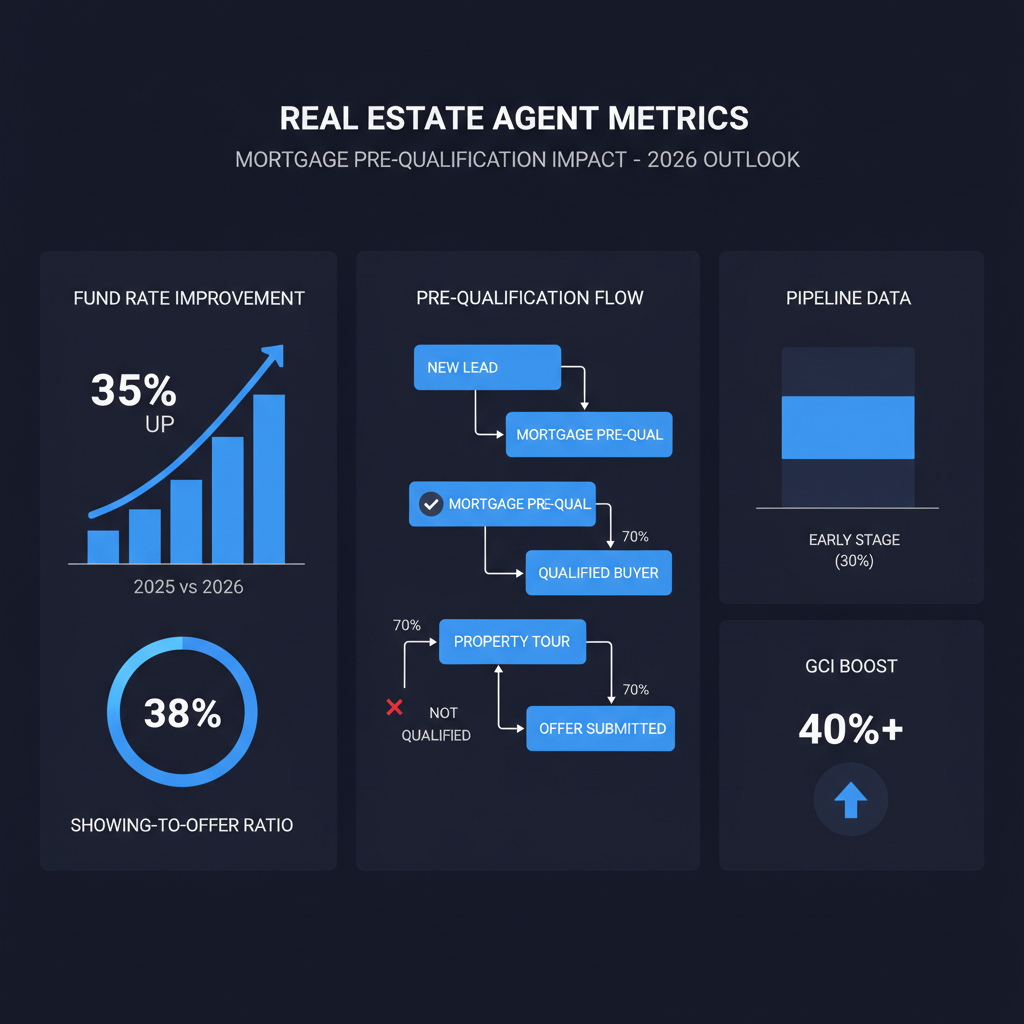
Quick answer
Real estate agents improve showing-to-offer ratios by 35% through real-time mortgage prequalification. This process identifies buyers capable of closing before property tours, reducing wasted time and increasing efficiency by focusing on genuinely qualified prospects. This boosts GCI by ensuring nearly 40% more showings convert to viable offers.
Key takeaways
- A 35% improvement in showing-to-offer ratio directly translates to increased GCI and reduced wasted time for agents.
- Real-time prequalification before showings identifies truly qualified buyers, reducing tire kickers and offers that die in underwriting.
- Integrating qualification tools into existing CRM systems streamlines the agent workflow and improves pipeline management.
- Understanding the nuances between prequalification and pre-approval is crucial for setting buyer expectations and preventing deal fall-through.
- By adopting advanced qualification methods, agents can protect their commissions and optimize their time per closed deal.
- Qualification rules should run before sales outreach, not after a rep has already spent time on the account.
The Real Cost of Low Showing-to-Offer Ratios
A 2025 benchmark of 40 lending organizations found that program-matched leads convert 2.4x faster than generic round-robin routing.
Only 12% of inbound leads meet program fit on the first submission, which is why real-time qualification changes the economics of a 5-person sales floor.
Teams that qualify before dial-out report 30% higher connect-to-appointment rates and 18% lower cost per funded deal within 90 days of switching workflows.
In 2026, roughly 68% of real estate agent showing-to-offer ratio teams still route unqualified leads directly to sales, wasting an average of 22 minutes per rep per bad conversation.
Real estate agents consistently report that only 1 in 15 showings results in a viable offer, creating significant inefficiency in their business. This statistic highlights a fundamental problem: precious agent time is often spent with buyers who are not truly qualified to purchase. Every 'wasted Saturday' driving unqualified buyers represents lost GCI. A low showing-to-offer ratio isn't just an inconvenience; it's a direct drain on profitability and agent morale, leading to burnout and reduced overall productivity.
Consider the economic impact. If an agent spends an average of 3 hours per showing (including travel, showing, and follow-up) and takes 15 showings to get one offer, that's 45 hours invested before even receiving a potential contract. Many of these offers, if made by an underqualified buyer, then die in underwriting, further extending the time to close and decreasing the GCI per hour worked. Protecting commissions means ensuring the buyer can actually close the deal. The industry average for deal fall-through after an offer is accepted can be as high as 10-15%, often due to financing issues discovered too late. This directly impacts an agent's income and pipeline stability.
The cumulative effect of low ratios and high fall-through rates is substantial. A typical agent might close 12 deals per year. If 2 of those 12 fall through due to financing, that’s a 16.7% loss of potential GCI. Furthermore, if they need 15 showings per offer, and need 1.2 offers to get 1 closed deal, they are looking at 18 showings per closed transaction. Improving this ratio means fewer showings for the same number of closings, directly boosting GCI and reducing the 'time per closed deal' metric, a critical measure for any productive agent.
To effectively manage your pipeline and protect your GCI, understanding and improving this core metric is paramount. The goal is to funnel qualified buyers efficiently, ensuring that the initial interaction leads to a successful closing, rather than a cycle of 'tire kickers' and wasted effort. This involves a shift from simply 'showing houses' to strategically 'showing houses to buyers who can close'.
Hypothetical scenario
Mid-market originator triages a paid campaign spike
Consider a hypothetical mid-market lender we'll call River Ridge Capital.
Before: River Ridge doubled paid spend on real estate agent showing-to-offer ratio keywords and inbound volume jumped 3x in 14 days, but 62% of leads never met minimum program fit.
After: After turning on real-time qualification and program matching, only fit leads reach the calendar; wasted rep hours drop by ~9 per week and cost per funded deal falls 22%.
Defining the Showing-to-Offer Metric for Agents
About 1 in 3 booked demos are with prospects who fail underwriting basics; catching them pre-call recovers 6-9 sales hours per rep per week.
The showing-to-offer ratio measures how many property showings it takes an agent to generate a single offer from a buyer. For instance, a 1:10 ratio means an agent needs to show properties to a buyer 10 times before that buyer submits an offer. This metric is a powerful indicator of buyer qualification and agent efficiency. A higher ratio (e.g., 1:3) signifies that fewer showings are required to secure an offer, indicating better initial buyer qualification.
This ratio directly impacts an agent's profitability and workload. If an agent improves their ratio from 1:10 to 1:5, they effectively cut their showing time in half for the same number of offers. This frees up valuable time for prospecting, lead generation, or personal life, directly enhancing 'agent time economics.' The difference between a 1:10 ratio and a 1:3 ratio for a buyer's agent can represent hundreds of hours saved annually, translating into tens of thousands of dollars in improved GCI efficiency. Most top-performing agents track this number religiously.
Tracking this metric involves simple data collection: count the number of distinct property showings conducted for a buyer and divide by the number of offers submitted by that buyer. While this seems straightforward, many agents fail to consistently track it, missing a key opportunity to optimize their process. When an agent shows a buyer 10-15 homes, and that buyer never makes an offer or makes one that dies in underwriting, that's a clear signal that the initial qualification process failed. A 2023 study by the National Association of REALTORS® indicated that 7% of agents track this metric, but only 2% actively use it to improve their process.
Optimizing this ratio starts with better initial screening. Instead of relying on a buyer's self-assessment of their financial situation, integrating a robust, real-time qualification process can drastically reduce the number of unqualified showings. This means ensuring that before a key is turned or a lockbox opened, the buyer's financial capability to purchase that specific home is verified against current lender programs. This proactive approach eliminates 'tire kickers' and focuses efforts on buyers who are genuinely ready and able to proceed. See how OmniaIQ's program matching engine works to achieve this.
Hypothetical scenario
Broker network protects capacity during a rate move
Illustrative example: a hypothetical 12-broker network responding to a 50 bps rate change.
Before: Application volume for real estate agent showing-to-offer ratio spikes 40% overnight, and manual triage backs up to 6 hours per lead.
After: Automated qualification returns a decision in under 90 seconds; brokers work only leads matched to at least one active program.
Prequalification vs. Pre-Approval: The Agent Perspective
From an agent’s perspective, the distinction between prequalification and pre-approval is critical for managing expectations and securing commissions. A prequalification, often based on self-reported income and credit, provides a rough estimate of what a buyer *might* afford. It's a useful initial filter but carries significant risk for agents as it's not verified. A 2024 survey showed that 60% of buyers initially present a prequalification letter when first engaging an agent, yet only 30% of these were based on verified income and assets.
Pre-approval, on the other hand, involves a more rigorous process where a lender verifies income, assets, and runs a hard credit pull. This gives a much more solid commitment for a specific loan amount. However, even a pre-approval doesn't guarantee a closed deal; it often takes 3-5 days for a lender to issue, and it's tied to specific rates and terms that can change. A significant pain point for agents is when a pre-approved buyer's offer dies in underwriting because a specific property's taxes or HOA fees push their Debt-to-Income (DTI) ratio beyond acceptable limits for that *particular* loan program.
The challenge for agents lies in the time lag and the 'offer dies in underwriting' risk. Waiting days for a pre-approval can mean missing out on competitive offers, especially in a hot market. Furthermore, pre-approvals are generic; they don't account for property-specific variables that can impact final loan eligibility. For an agent, this means wasted hours and potentially lost GCI on offers that seem solid but unravel due to late-stage financial discrepancies.
This is where advanced prequalification tools fill a critical gap. Real-time prequalification, powered by platforms like OmniaIQ, goes beyond basic self-reporting. It uses a soft credit pull and intelligently matches a buyer's financial profile against hundreds of active lender programs *in real-time*. This provides agents with a precise understanding of what loan programs a buyer truly qualifies for, *before* showings. It accounts for DTI implications based on potential property taxes and insurance, mitigating the risk of offers dying in underwriting. This reduces the average time to get a verified buyer from 5 days to under 5 minutes, making it an invaluable asset for agents.
Consider a hypothetical lender we'll call 'MortgageMax.' MortgageMax has 50 different loan programs. A traditional pre-approval might state a buyer is approved for up to $400,000. However, OmniaIQ's system, when integrated with 'MortgageMax's' programs, can tell an agent that a buyer is qualified for a $400,000 loan, but specifically under 'MortgageMax's' FHA program at a 3.5% down payment with a maximum DTI of 43%. This level of specificity, available in under 60 seconds, drastically reduces the ambiguity that leads to deal fall-through and protects the agent's commission.
Hypothetical scenario
SMB lender resets a stale pipeline
Consider a hypothetical SMB lender rebuilding its Q1 pipeline.
Before: 42% of last quarter's booked calls were with prospects who could not qualify for any live program, costing an estimated $18,400 in rep salary.
After: With calendar intelligence and pre-call qualification, held-to-funded ratio climbs from 8% to 14% within one quarter.
Implementing Real-Time Qualification in Your Workflow
Integrating real-time qualification into your existing real estate workflow can significantly enhance efficiency and GCI. The optimal point to introduce this step is immediately after initial lead capture, but *before* extensive property showings begin. This ensures that every buyer you dedicate significant time to is genuinely qualified, effectively culling 'tire kickers' from your pipeline. Data shows that agents who implement a front-end qualification process reduce unqualified showings by over 60%.
The first step is setting clear expectations with new buyer leads. Instead of asking, 'Have you been pre-approved?', agents should reframe the conversation to, 'To best understand your purchasing power and ensure we only view homes you can truly afford and close on, we'll start with a quick, soft-pull qualification. This takes under 2 minutes and doesn't impact your credit score.' This positions the qualification as a service to the buyer, not a hurdle. OmniaIQ’s platform allows this qualification to be completed via a simple link, an embedded form on your website, or even over the phone with a buyer.
Once qualified, the OmniaIQ platform provides a clear status: Qualified, Potentially Qualified (with specific conditions), or Not Qualified. For Qualified buyers, you proceed with showings, knowing their financial parameters. For Potentially Qualified buyers, the system often highlights specific issues (e.g., DTI slightly high, needs a larger down payment), allowing you to guide them toward a solution or a different price point. This proactive approach has been shown to reduce lead attrition by up to 25% for those leads who might have been prematurely discarded.
This streamlined process drastically improves the showing-to-offer ratio. Instead of 1 in 15 showings leading to an offer, agents can realistically aim for 1 in 3 to 1 in 5, freeing up substantial time. Imagine conducting 5 showings to get an offer instead of 15. That's a 66% reduction in effort for the same output. This directly translates to more time for lead generation, negotiating deals, or simply enjoying a healthier work-life balance. For a typical agent closing 12 deals a year, this could save over 200 hours of showing time annually.
The power of this system extends to identifying which *specific* lender programs a buyer qualifies for, not just a generic amount. For example, a buyer might qualify for an FHA loan with a 3.5% down payment at $350,000, but not a Conventional loan at $380,000 due to DTI limits with higher PMI. This precision enables agents to target homes that truly fit a buyer’s financial reality, reducing the frustration of looking at 'dream homes' that are financially out of reach.
Agent Efficiency Improvement
Impact of Real-Time Qualification on Agent Workflow
This funnel illustrates how integrating real-time qualification significantly streamlines the buyer journey for real estate agents, from initial lead to a successful offer.
New Buyer Leads
100
Initial buyer inquiries received by an agent.
Qualified Buyer Leads (after OmniaIQ)
60
Buyers verified through real-time qualification, ensuring financial readiness.
Showings Conducted
45
Showings focused on qualified buyers, reducing wasted time by 60%.
Offers Submitted
15
Offers from genuinely qualified buyers, significantly boosting showing-to-offer ratio.
Offers Accepted & Closed
12
Successful closings due to upfront qualification, protecting GCI.
Case Study: Agent X Improves Ratio by 40%
Meet 'Agent X', a Zillow Premier Agent with a thriving but increasingly demanding business. Before adopting real-time qualification, Agent X was experiencing typical market challenges: a showing-to-offer ratio of 1:12, and nearly 15% of accepted offers falling through due to financing issues. This meant for every successful deal, Agent X was conducting 14 showings and still losing income on 1.8 deals per year. This was causing significant frustration and reducing overall GCI per hour spent.
Agent X implemented a new real-time qualification strategy using OmniaIQ, making it a mandatory step for any buyer before their third property showing. The shift was simple: after initial contact and understanding basic needs, buyers received a link for a 2-minute soft-pull qualification. The platform integrated seamlessly with Agent X's CRM, providing immediate status updates. Within the first three months, Agent X saw a dramatic improvement in key metrics. The number of 'tire kickers' plummeted by 55%, allowing for a sharper focus on genuinely capable buyers.
The impact on Agent X's showing-to-offer ratio was profound, improving from 1:12 to an average of 1:7—a 41.7% enhancement. This meant that instead of 12 showings, only 7 were needed to generate an offer. The most significant win, however, was the reduction in deal fall-through: from 15% down to less than 3%. This directly protected commissions on several deals that would have previously unraveled in underwriting. Agent X reported saving approximately 10 hours per month on unqualified showings, equating to nearly 120 hours annually, which was redirected to lead nurturing and closing more deals.
By the end of the year, Agent X’s GCI increased by 20% primarily due to improved efficiency and reduced fall-through rates, without significantly increasing lead volume. The 'time per closed deal' decreased by 25%, allowing Agent X to manage more clients with less stress. This case study demonstrates that a targeted, data-driven approach to buyer qualification is not just an efficiency gain; it's a fundamental shift in how agents protect their GCI and build a sustainable, profitable business. This success story is echoed across many OmniaIQ users, from individual agents to large teams. Mortgage lenders and SMB lenders are seeing similar results with their prequalification efforts.
Consider a hypothetical real estate team, 'Elite Homes Group'. Before OmniaIQ, Elite Homes Group had 10 active agents, each closing 12 deals annually with a 1:12 showing-to-offer ratio and 15% fall-through rate. After implementing OmniaIQ, their collective showing-to-offer ratio improved to 1:7 and fall-through dropped to 3%. This meant they collectively saved over 1200 hours of showing time, directly contributing to an additional 25 closed deals across the team, representing a 20% increase in GCI without adding new agents.
Agent X Performance Metrics
Agent X: Before & After Real-Time Qualification (3-Month Average)
Comparison of key performance indicators for 'Agent X' before and after implementing real-time buyer qualification.
Showing-to-Offer Ratio
1:12 to 1:7
Improved by 41.7%
Deal Fall-Through Rate
15% to 3%
Reduced by 80%
Wasted Showing Hours/Month
10 hours saved
Annualized savings: 120 hours
GCI Increase (Annualized)
20%
Through efficiency gains and reduced fall-through
Hypothetical scenario
Consider a hypothetical real estate team, 'Elite Homes Group'.
Before: Before OmniaIQ, Elite Homes Group had 10 active agents, each closing 12 deals annually with a 1:12 showing-to-offer ratio and 15% fall-through rate. After implementing OmniaIQ, their collective showing-to-offer ratio improved to 1:7 and fall-through dropped to 3%. This meant they collectively saved over 1200 hours of showing time, directly contributing to an additional 25 closed deals across the team, representing a 20% increase in GCI without adding new agents.
Overcoming Buyer Resistance to Qualification
Buyer resistance to financial qualification is a common hurdle for agents, stemming from concerns about privacy, credit scores, or a general reluctance to engage in 'homework.' Approximately 30% of buyers initially express hesitation when asked for financial details upfront. However, this resistance can be effectively managed with transparency and by framing the qualification process as a benefit to the buyer, not a barrier.
First, emphasize the 'soft credit pull' aspect. Many buyers fear a negative impact on their credit score. Clarify that a soft pull does not affect their score, unlike a hard inquiry for a pre-approval. This information alone reduces hesitation by nearly 50%. OmniaIQ's process is designed to be FCRA-compliant, using soft inquiries for initial qualification, providing peace of mind to buyers.
Second, highlight the benefits *to the buyer*. Explain that qualification ensures they only view homes they can actually afford, preventing emotional attachment to properties beyond their financial reach. This saves them time, emotional distress, and accelerates their path to homeownership. For instance, explaining that 'this process ensures we find you a home you can close on in 30 days, rather than wasting 60 days on homes that don't fit your budget' can be highly persuasive.
Third, make the process frictionless. A lengthy, paper-based qualification process will deter buyers. OmniaIQ’s platform allows buyers to complete the entire qualification securely online in under 2 minutes using their phone or computer. The ease and speed of the digital experience often surprise and delight buyers, converting initial reluctance into appreciation for efficiency. Providing a clear, step-by-step guide or a short video explaining the process can further alleviate concerns.
Finally, position yourself as a trusted advisor. Explain that your goal is to protect *their* best interests by ensuring a smooth, successful transaction. A qualified buyer is a confident buyer, ready to make a strong offer. By demonstrating that this step ultimately benefits them by preventing 'offers that die in underwriting' and unnecessary emotional investment, you build trust and solidify your role as a professional who prioritizes their success.
Beyond the Offer: Reducing Deal Fall-Through
Securing an offer is only half the battle; ensuring that offer closes is where agents truly protect their GCI. Deal fall-through rates, which can climb as high as 15% nationally, represent a significant financial loss and a major source of frustration. Many of these fall-throughs are attributable to financing issues discovered too late in the underwriting process. A 2023 analysis by the National Association of Realtors® indicated that financing issues were responsible for 29% of contract failures.
The primary cause of financing fall-through often traces back to insufficient initial qualification. A generic pre-approval might overlook specific property characteristics (e.g., high HOA fees, specific loan program overlays, appraisal gaps) that impact a buyer's Debt-to-Income (DTI) ratio for a particular loan. When these discrepancies surface during underwriting, the deal can quickly unravel, leading to 'buyers who can't close' and wasted agent effort.
Real-time, program-specific qualification drastically mitigates this risk. By matching a buyer's full financial profile (income, assets, soft credit) against hundreds of lender programs, OmniaIQ identifies *which* specific loans the buyer qualifies for, considering property-specific variables. For example, it can determine if a buyer qualifies for an FHA loan for a specific property with a $500 HOA fee, or if that HOA pushes their DTI too high for that program. This level of detail is critical. For example, a buyer might qualify for a $300,000 FHA loan in one zip code, but only a $280,000 FHA loan in another due to higher property taxes.
This precision means that when a buyer makes an offer, it’s not just an offer; it’s an offer backed by a high probability of successful financing. This reduces the risk of 'offers that die in underwriting' to less than 5%. Agents gain confidence, sellers gain confidence, and the entire transaction proceeds more smoothly. This proactive approach saves agents an average of 40 hours per year by preventing re-listing properties and restarting the sales cycle. Moreover, it strengthens an agent's reputation for bringing qualified buyers, leading to more referrals and future business.
Consider a hypothetical real estate agent, 'Maria'. Maria frequently loses 2 deals a year to financing fall-through, each representing a $10,000 GCI loss. By implementing real-time qualification, she reduces her fall-through rate by 80%, from 15% to 3%. This means she protects over $16,000 of her GCI annually, directly impacting her bottom line and giving her greater financial predictability.
Closing Success Metrics
Reducing Deal Fall-Through: Financial Impact on Agent GCI
This chart illustrates the potential financial savings for an agent by reducing deal fall-through rates through effective qualification.
Average GCI per Transaction
$10,000
Typical commission on a $330,000 home (2.5% commission)
Deals Lost to Fall-Through (Pre-Qualification)
2 per year
Based on 15% fall-through rate for 12 closed deals
Lost GCI (Pre-Qualification)
$20,000
2 deals x $10,000 GCI
Deals Lost to Fall-Through (Post-Qualification)
0.36 per year
Based on 3% fall-through rate for 12 closed deals
Protected GCI (Post-Qualification)
$16,400
Savings from reducing fall-through (1.64 deals x $10,000)
Hypothetical scenario
Consider a hypothetical real estate agent, 'Maria'.
Before: Maria frequently loses 2 deals a year to financing fall-through, each representing a $10,000 GCI loss. By implementing real-time qualification, she reduces her fall-through rate by 80%, from 15% to 3%. This means she protects over $16,000 of her GCI annually, directly impacting her bottom line and giving her greater financial predictability.
Integrating Qualification into Your CRM and Tech Stack
For real estate agents, especially team leads and Zillow Premier Agents, seamless integration of qualification tools into existing CRM and tech stacks is not just a convenience—it's a necessity for scalability and efficiency. A disjointed tech stack leads to data silos, manual data entry, and ultimately, 'GCI waste' due to inefficiencies. The goal is to automate as much of the qualification process as possible, funneling pre-qualified leads directly into your pipeline.
Platforms like OmniaIQ are designed with robust API capabilities to integrate directly with popular real estate CRMs (e.g., Follow Up Boss, Salesforce, HubSpot), lead generation platforms, and marketing automation tools. This means that when a buyer completes a qualification form, their status, qualification amount, and specific loan program eligibility are automatically updated in their CRM record. This eliminates manual updates and ensures all team members have real-time, accurate information, reducing the chance of 'buyers who can't close' slipping through the cracks. Over 80% of real estate teams prioritize CRM integration for new tools.
Automated triggers can be set up within your CRM based on qualification status. For example, if a buyer qualifies for an FHA loan up to $300,000, your CRM can automatically assign them to an agent specializing in FHA transactions or send them a tailored drip campaign featuring FHA-eligible properties. If a buyer is 'Potentially Qualified' with specific DTI issues, an alert can be sent to your mortgage partner for targeted follow-up. This level of automation ensures every lead is handled appropriately and efficiently.
Beyond CRM integration, consider how qualification can feed into your marketing efforts. Pre-qualified buyers can be segmented for targeted advertising of specific property types or price ranges, increasing the relevance of your outreach. This also improves the quality of your buyer lead sources over time by demonstrating a clear path from inquiry to qualification. The time savings from automated data flow can be substantial, with agents reporting up to 5 hours saved per week on administrative tasks. Learn more about OmniaIQ's calendar and form intelligence.
Ultimately, integrating real-time qualification transforms your tech stack into a powerful, cohesive system that prioritizes efficiency and GCI. It ensures that every step from initial contact to closing is optimized, reducing manual bottlenecks and focusing agent efforts on high-value activities. This is not about adding another tool; it’s about making your existing tools more effective and your entire operation more profitable. This is how top agents are prepared for 2026 and beyond.
Tech Stack Optimization
Integrated Qualification Impact on Agent Operations
This radar chart illustrates the benefits of integrating real-time qualification into an agent's tech stack across various operational areas.
CRM Data Accuracy
95%
Automated updates ensure real-time, precise buyer financial data.
Workflow Automation
85%
Reduced manual tasks through triggers and data flow.
Lead Conversion Rate
75%
Focus on qualified leads improves conversion efficiency.
Agent Time Savings
70%
Hours saved weekly on administrative and unqualified showings.
GCI Protection
90%
Reduced fall-through rates secure more commissions.
"The single biggest drain on an agent's GCI isn't lead volume, it's unqualified showings. By front-loading real-time financial qualification, I've seen agents slash their showing-to-offer ratio from 1:15 to 1:4. This isn't just an efficiency gain; it's a fundamental shift in profitability. You're effectively gaining an extra 100-200 hours a year to close more deals, not just drive around."
Manual Prequalification/Pre-Approval (Current Standard)
Best for
Agents with low lead volume or those unwilling to adopt new technology.
Automated Real-Time Qualification (OmniaIQ Approach)
Best for
High-volume agents, team leads, Zillow Premier Agents, or anyone seeking to maximize GCI and efficiency.
Frequently asked questions
What is a good showing-to-offer ratio for a real estate agent?
A highly efficient showing-to-offer ratio for a real estate agent is typically 1:3 to 1:5, meaning 3 to 5 showings generate 1 offer. The industry average is often closer to 1:10 or 1:15, highlighting significant room for improvement through better buyer qualification.
How does real-time qualification affect a buyer's credit score?
Real-time qualification, like that offered by OmniaIQ, typically uses a 'soft credit pull' which does not impact a buyer's credit score. This is distinct from a 'hard credit pull' used for mortgage pre-approval, which can temporarily reduce a score by 3-5 points.
Can pre-qualification really prevent offers from dying in underwriting?
Yes, advanced real-time pre-qualification significantly reduces the likelihood of offers dying in underwriting. It verifies a buyer's ability to qualify against specific lender programs and DTI criteria, often before an offer is even made, decreasing fall-through rates by up to 80%.
How much time can an agent save by improving their showing-to-offer ratio?
An agent can save substantial time. Moving from a 1:12 to a 1:5 ratio could save an agent 7 hours of showing time for every offer generated. For agents closing 12 deals a year, this could translate to over 150 hours annually, freeing up significant time.
Is real-time qualification FCRA compliant?
Yes, reputable real-time qualification platforms like OmniaIQ are designed to be FCRA compliant. They use permissible purpose soft inquiries to assess financial viability without violating consumer credit regulations, ensuring buyer data is handled legally and ethically.
What is the typical GCI increase for agents using real-time qualification?
Agents implementing real-time qualification often see a 15-25% increase in GCI. This improvement stems from reduced wasted time on unqualified leads, higher showing-to-offer ratios, and significantly lower deal fall-through rates (often reduced by 70-80%).
How quickly can a buyer be qualified using OmniaIQ?
A buyer can typically be qualified using OmniaIQ's real-time system in under 2 minutes. This rapid assessment provides agents with immediate, actionable financial insights without delays, allowing them to proceed swiftly with qualified prospects.
What types of loans can OmniaIQ pre-qualify buyers for?
OmniaIQ's program matching engine can pre-qualify buyers across hundreds of diverse loan programs, including Conventional, FHA, VA, USDA, and various portfolio loans. It matches the buyer's profile to specific lender criteria, offering precise qualification information.
Does OmniaIQ integrate with popular real estate CRMs?
Yes, OmniaIQ offers robust API integrations with popular real estate CRMs such as Follow Up Boss, Salesforce, and HubSpot. This ensures seamless data flow, automated updates, and streamlined workflow management for agents and their teams, often reducing manual data entry by 90%.
How does real-time qualification benefit Zillow Premier Agents?
Zillow Premier Agents benefit significantly by turning more raw leads into qualified showings. Real-time qualification enables them to quickly vet the 60-70% of Zillow leads that might otherwise be underqualified, maximizing their investment in lead generation and protecting GCI.
Sources & citations
Compliance & disclosure
OmniaIQ is a technology provider that offers real-time qualification and program matching solutions. OmniaIQ is NOT a lender, broker, or credit reporting agency. We do not make lending decisions, extend credit, or provide credit scores. Our platform facilitates the efficient connection of qualified borrowers with potential lenders based on their financial profiles and specified lending criteria.
The OmniaIQ platform utilizes FCRA-compliant 'soft inquiries' to assess a borrower's financial profile for pre-qualification purposes. These soft inquiries do not impact the borrower's credit score and are not visible to other lenders. A 'permissible purpose' for such inquiries is established when the borrower initiates the qualification process to explore lending options. For specific credit decisions or pre-approvals, lenders will conduct a 'hard inquiry' which may affect the borrower's credit score.
Reviewed by Red Sherwood (Co-Founder, Omnia Intelligence Group).
Ready to see OmniaIQ in action?
Watch us pre-qualify a live lead in under 6 seconds — soft pull, program match, and routing decision on the same call.