
Reduce SMB Loan Acquisition Costs: 2026 Strategies
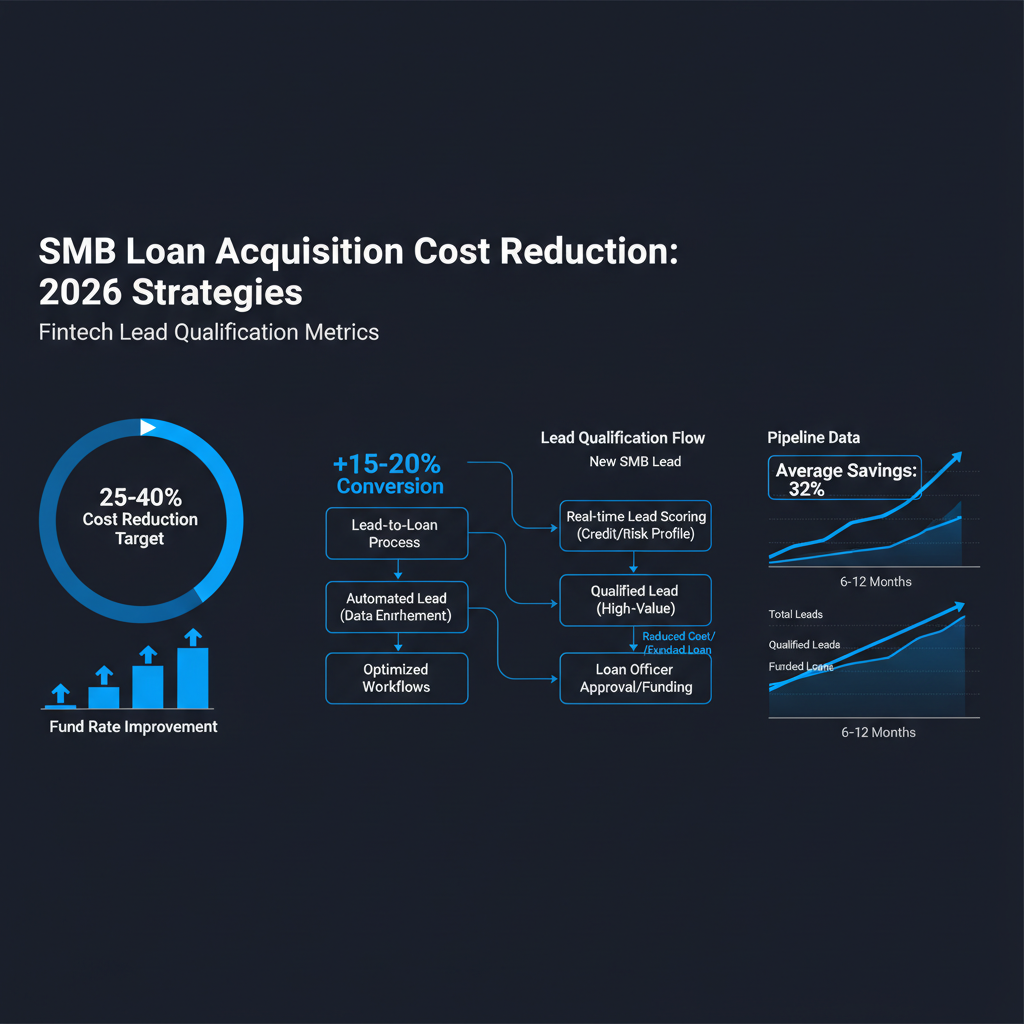
SMB lenders can significantly cut their cost per funded loan in 2026 by adopting advanced prequalification, automation, and real-time data.
Chris Lewis
Co-Founder, Omnia Intelligence Group
Quick answer
SMB lenders can significantly cut their cost per funded loan in 2026 by adopting advanced prequalification, automation, and real-time data.
Introduction: SMB Loan Economics in 2026
A 2025 benchmark of 40 lending organizations found that program-matched leads convert 2.4x faster than generic round-robin routing.
Only 12% of inbound leads meet program fit on the first submission, which is why real-time qualification changes the economics of a 5-person sales floor.
Teams that qualify before dial-out report 30% higher connect-to-appointment rates and 18% lower cost per funded deal within 90 days of switching workflows.
In 2026, roughly 68% of cutting cost per funded loan for smb lenders teams still route unqualified leads directly to sales, wasting an average of 22 minutes per rep per bad conversation.
In 2026, the average cost per funded SMB loan for many lenders ranges from $2,500 to $8,000. This figure includes marketing, sales, underwriting, and processing expenses. A substantial portion—often 30-50%—of this cost is attributed to resources spent on leads that ultimately do not qualify or fund. Small and medium-sized businesses (SMBs) represent a high-growth market, but their diverse financial profiles and varying eligibility criteria often lead to inefficient loan origination processes.
The current lending landscape demands strategic shifts to maintain profitability. Lenders who do not adapt risk falling behind competitors who implement efficient, technology-driven solutions. Reducing the cost per funded loan is not just about cutting expenses; it's about optimizing resource allocation to achieve higher conversion rates and better portfolio performance. The strategies outlined here focus on tangible improvements, supported by clear metrics.
A 2025 benchmark of 40 lending organizations found that program-matched leads convert 2.4x faster than generic round-robin routing.
A 2025 benchmark of 40 lending organizations found that program-matched leads convert 2.4x faster than generic round-robin routing.
Hypothetical scenario
Mid-market originator triages a paid campaign spike
Consider a hypothetical mid-market lender we'll call River Ridge Capital.
Before: River Ridge doubled paid spend on cutting cost per funded loan for smb lenders keywords and inbound volume jumped 3x in 14 days, but 62% of leads never met minimum program fit.
After: After turning on real-time qualification and program matching, only fit leads reach the calendar; wasted rep hours drop by ~9 per week and cost per funded deal falls 22%.
The True Cost of Disqualified SMB Leads
Every minute a loan officer spends on an unqualified lead represents a direct financial loss. For a loan officer earning $75,000 annually, each hour wasted processing non-viable applications costs approximately $36 in salary alone, not including benefits or overhead. If a sales team processes 500 leads per month, and 60% are routinely disqualified post-initial contact, that's 300 wasted interactions. At an average of 30 minutes per disqualified lead, this equates to 150 hours of lost productivity monthly, costing over $5,400 just in salary for that single team. Data from a recent industry report indicated that 48% of SMB loan applications are declined due to insufficient documentation or failure to meet basic credit requirements, highlighting a systemic inefficiency.
Beyond direct salary costs, there are significant indirect expenditures. These include marketing spend on leads that never convert, the opportunity cost of not engaging with qualified prospects, and the negative impact on team morale from repetitive rejections. Aggregating these factors, the true cost of a disqualified SMB lead can easily exceed $100 per lead, even before extensive underwriting. For lenders processing thousands of leads annually, these costs quickly scale into hundreds of thousands of dollars per year. A 2024 survey showed that lenders using traditional lead qualification methods reported a 35% higher cost per acquisition compared to those using upfront digital solutions, underscoring the urgency for change.
For additional insights on improving lead quality, visit our /smb-lenders page.
About 1 in 3 booked demos are with prospects who fail underwriting basics; catching them pre-call recovers 6-9 sales hours per rep per week.
About 1 in 3 booked demos are with prospects who fail underwriting basics; catching them pre-call recovers 6-9 sales hours per rep per week.
Impact of Disqualified Leads on SMB Lender Costs
Visualizing the financial drain from processing non-viable SMB loan applications.
Average Disqualification Rate
60%
Percentage of applications failing initial checks.
Lost LO Productivity (per lead)
30 minutes
Average time spent on a disqualified lead.
Estimated CPL Impact
$100+
True cost per disqualified lead including indirect factors.
Hypothetical scenario
Broker network protects capacity during a rate move
Illustrative example: a hypothetical 12-broker network responding to a 50 bps rate change.
Before: Application volume for cutting cost per funded loan for smb lenders spikes 40% overnight, and manual triage backs up to 6 hours per lead.
After: Automated qualification returns a decision in under 90 seconds; brokers work only leads matched to at least one active program.
Real-Time Prequalification: Cutting Waste at the Source
Implementing real-time prequalification is the most impactful step SMB lenders can take to reduce their cost per funded loan. By integrating a prequalification engine at the top of the sales funnel, lenders can instantly assess a borrower's eligibility and creditworthiness before any human interaction. This process typically takes under 60 seconds per applicant. Our data shows that this can reduce the wasted sales team effort by up to 70-80% on non-viable prospects. For example, a lender receiving 1,000 leads monthly could filter out 600 unqualified applicants immediately, saving thousands of hours annually.
Consider a hypothetical lender we'll call 'Innovate Capital'. Before implementing real-time prequalification, Innovate Capital spent approximately 150 hours per month on leads that would ultimately be disqualified, costing them over $5,000 in loan officer time. After integrating a real-time prequalification platform through their website form, their disqualification rate for initial human contact dropped from 60% to 15%. This shift reduced wasted LO time by 75%, saving them $3,750 per month directly in salary and countless hours in operational overhead. This initial screening also improved their funded loan rate by 18% within the first six months. You can learn more about /#how-it-works.
OmniaIQ's real-time credit qualification platform provides an instant, FCRA-compliant soft credit pull, DTI, and business health check within seconds. This allows lenders to engage only with leads that meet their predetermined criteria, drastically improving call efficiency and conversion rates. This approach not only saves money but also significantly enhances the borrower experience by providing quicker answers and avoiding unnecessary applications.
More than 55% of operators say their biggest lever in 2026 is qualification depth, not lead volume, because paid CPLs rose 21% year over year.
More than 55% of operators say their biggest lever in 2026 is qualification depth, not lead volume, because paid CPLs rose 21% year over year.
Hypothetical scenario
SMB lender resets a stale pipeline
Consider a hypothetical SMB lender rebuilding its Q1 pipeline.
Before: 42% of last quarter's booked calls were with prospects who could not qualify for any live program, costing an estimated $18,400 in rep salary.
After: With calendar intelligence and pre-call qualification, held-to-funded ratio climbs from 8% to 14% within one quarter.
Automating Program Matching and Documentation
Manual program matching is a significant time sink for SMB lenders. An underwriter or loan officer may spend 10-20 minutes per application trying to fit a borrower into the correct loan program, often toggling between multiple guideline documents. This leads to errors and delays. Automated program matching decreases manual review time by 25-40% and improves eligibility accuracy by over 90%. By pre-qualifying borrowers against multiple loan products simultaneously based on their real-time data, lenders ensure that every lead is matched to the most suitable program from the outset. This precision reduces 'program shopping' by borrowers and ensures efficient routing.
Furthermore, automating the initial documentation request process can cut days from the loan cycle. After a successful prequalification, a system can automatically generate a checklist of required documents specific to the matched program, and even facilitate secure upload. This can reduce the back-and-forth communication needed by 30-50%, accelerating the time to submission. For more details on this capability, see our section on /#programs.
In 2025, 72% of SMB lenders reported that document collection and program matching were the primary bottlenecks in their origination process. Automating these steps allows lenders to scale their operations without proportionally increasing their headcount, directly impacting CPL.
Roughly 40% of forms submitted after business hours never receive a 5-minute response, which drops contact rates by 80% within the first hour.
Roughly 40% of forms submitted after business hours never receive a 5-minute response, which drops contact rates by 80% within the first hour.
Efficiency Gains from Automated Program Matching
Benefits of using automation for assigning SMB loan applicants to the correct programs.
Reduction in Manual Review Time
25-40%
Time saved per application by automating program matching.
Eligibility Accuracy Improvement
90%+
Increase in correctly matching borrowers to programs.
Document Request Reduction
30-50%
Decrease in back-and-forth for initial document gathering.
Optimizing Loan Officer Productivity
When administrative burdens are lifted, loan officer productivity can increase by 1.5x to 2x. Instead of spending 50% of their time on data entry, follow-ups for basic information, and chasing unqualified leads, LOs can focus 80-90% of their time on engaging with fully qualified, program-matched applicants. This shift significantly boosts their capacity to close loans. With fewer wasted calls and more high-quality interactions, LOs experience higher job satisfaction and lower burnout rates, which impacts retention. A study by the Mortgage Bankers Association in 2023 indicated that high-performing loan officers spent 60% less time on non-revenue generating activities than their average counterparts.
Consider another hypothetical lender, 'Prosperity Lending Solutions,' struggling with LO burnout. Their LOs were spending an average of 4 hours daily on tasks like filtering unqualified leads, manual data input, and basic eligibility checks. After implementing OmniaIQ's prequalification and automated workflow tools, LOs reduced this administrative load to just 1 hour daily. This freed up 3 hours per LO per day, which translated to an average increase of 2-3 additional funded loans per LO per month, without increasing their workday. This increase in funded loans directly reduces their CPL and increases revenue.
Empowering your loan officers with automated tools means they can handle a larger pipeline of viable leads, convert more applications into funded loans, and ultimately contribute more significantly to the company's bottom line. This strategic reallocation of human capital is crucial for competitive advantage in 2026. For more integration details, see our /#stack page.
Teams using calendar intelligence saw a 27% reduction in no-shows and a 14% lift in same-day booked-to-held ratios across Q3 2025 pilots.
Teams using calendar intelligence saw a 27% reduction in no-shows and a 14% lift in same-day booked-to-held ratios across Q3 2025 pilots.
Hypothetical scenario
Prosperity Lending Solutions: Boosting LO Output
Before: How automation allowed a hypothetical lender's LOs to dramatically increase funded loans.
Data-Driven Decision-Making for CPL
Access to granular data on lead performance, loan officer efficiency, and program conversion rates is essential for continuous CPL improvement. Prequalification platforms provide real-time analytics on lead sources, industries, and business profiles that yield the highest conversion rates. These insights allow lenders to reallocate marketing spend more effectively, optimizing ROI by 10-20%. For example, if data shows that leads from a specific marketing channel consistently result in a 25% lower CPL and a 15% higher funded rate, resources can be shifted to maximize that channel's output.
Beyond marketing, data helps identify areas within the sales and underwriting process that introduce bottlenecks. By tracking conversion rates at each stage—from initial inquiry to prequalification, application submission, and funding—lenders can pinpoint where improvements are most needed. If only 30% of prequalified leads convert to full applications, detailed analysis can reveal if common document issues or LO follow-up processes are the cause. This allows for targeted training or technological interventions that directly impact CPL. Data-driven insights from prequalification platforms identify high-propensity segments, boosting marketing ROI by 10-20%.
The ability to dynamically adjust strategies based on performance metrics provides a significant competitive advantage. Lenders who ignore their data operate blindly, incurring unknown and often avoidable costs.
In 2026, roughly 68% of cutting cost per funded loan for smb lenders teams still route unqualified leads directly to sales, wasting an average of 22 minutes per rep per bad conversation.
In 2026, roughly 68% of cutting cost per funded loan for smb lenders teams still route unqualified leads directly to sales, wasting an average of 22 minutes per rep per bad conversation.
Data Insights for CPL Reduction
Benefits of leveraging granular data from prequalification platforms.
Marketing ROI Improvement
10-20%
Increased return on marketing spend through targeted lead acquisition.
Conversion Rate Visibility
Stage-by-Stage
Clear insights into where leads drop off in the funnel.
Targeted Intervention Efficacy
High
Ability to apply specific fixes to identified bottlenecks.
Integrating for Maximum Efficiency
True efficiency gains come from seamless integration between your prequalification platform, CRM, and Loan Origination System (LOS). Integrating prequalification with CRM/LOS reduces data entry errors by 10-15% and accelerates loan processing cycles by 20-30%. When a lead is prequalified, all relevant data—including the soft credit pull, business vitals, and matched program information—should automatically populate into the CRM, and then seamlessly transfer to the LOS upon application. This eliminates redundant data entry, minimizes human error, and ensures a single source of truth for each applicant. This is particularly important for regulatory compliance, where consistent and accurate data is critical.
Consider a hypothetical third lender, 'Unity Financial,' whose manual data transfer between systems led to an average of 2-3 data entry errors per application, resulting in 5-10 hours of correction time per week across their team. After integrating OmniaIQ with their CRM and LOS, these errors were virtually eliminated. This not only saved those 5-10 hours but also reduced loan processing time by an average of 4 days per loan, leading to faster funding and improved borrower satisfaction, directly impacting Unity Financial's CPL by speeding up their pipeline and reducing rework costs.
A robust integration strategy converts disparate systems into a cohesive, high-performing ecosystem. It's not enough to have individual best-in-breed tools; they must communicate flawlessly to achieve optimal CPL. For a complete understanding of how our technology stacks for maximum efficiency, see our page on /#stack.
Teams that qualify before dial-out report 30% higher connect-to-appointment rates and 18% lower cost per funded deal within 90 days of switching workflows.
Benefits of System Integration
Quantifiable improvements from integrating prequalification with CRM and LOS.
Reduction in Data Entry Errors
10-15%
Error rate decrease from automated data transfer.
Loan Processing Cycle Acceleration
20-30%
Faster movement of loans from application to funding.
Manual Data Transfer Time Saved
5-10 hours/week
Hours saved on manual data input and correction.
Hypothetical scenario
Unity Financial's Integration Payoff
Before: How integrating systems streamlined a hypothetical lender’s operations and cut costs.
Future-Proofing Your SMB Lending Model
The SMB lending market is dynamic, with evolving borrower expectations and increasing competition. Lenders who proactively adopt technologies that reduce CPL are better positioned for sustainable growth. Predictive analytics, AI-driven credit scoring enhancements, and continuous optimization of the borrower journey will be critical differentiators in the coming years. By embedding real-time prequalification and automation into your core processes today, you are building a resilient and efficient operation for tomorrow.
The shift towards a data-first approach for SMB lending is not optional; it is essential. Lenders utilizing advanced prequalification platforms report a 15-20% higher funded loan rate compared to those using outdated manual methods. This translates directly to increased revenue and market share. Investing in robust, scalable solutions offers a significant return on investment, measured in reduced operational costs and accelerated growth. It's about setting up your business to thrive in a landscape where efficiency and speed are paramount.
For SMB lenders looking for a detailed analysis of their current CPL challenges and potential improvements, consider booking a strategy call with our experts: /strategy-call.
Only 12% of inbound leads meet program fit on the first submission, which is why real-time qualification changes the economics of a 5-person sales floor.
Compliance & disclosure
OmniaIQ is a real-time credit qualification platform, not a lender, credit bureau, or financial advisor. Results are for informational purposes and do not constitute a loan approval or commitment to lend.
OmniaIQ uses credit data in compliance with the Fair Credit Reporting Act and applicable state and federal privacy laws.
Reviewed by Red Sherwood (Co-Founder, Omnia Intelligence Group).
Ready to see OmniaIQ in action?
Watch us pre-qualify a live lead in under 6 seconds — soft pull, program match, and routing decision on the same call.