FCRA Permissible Purpose for Mortgage Soft Pulls: Compliance in 2026
Navigating FCRA compliance for mortgage soft pulls is critical for lenders aiming to increase pull-through and reduce wasted LO time.
Chris Lewis
Quick answer
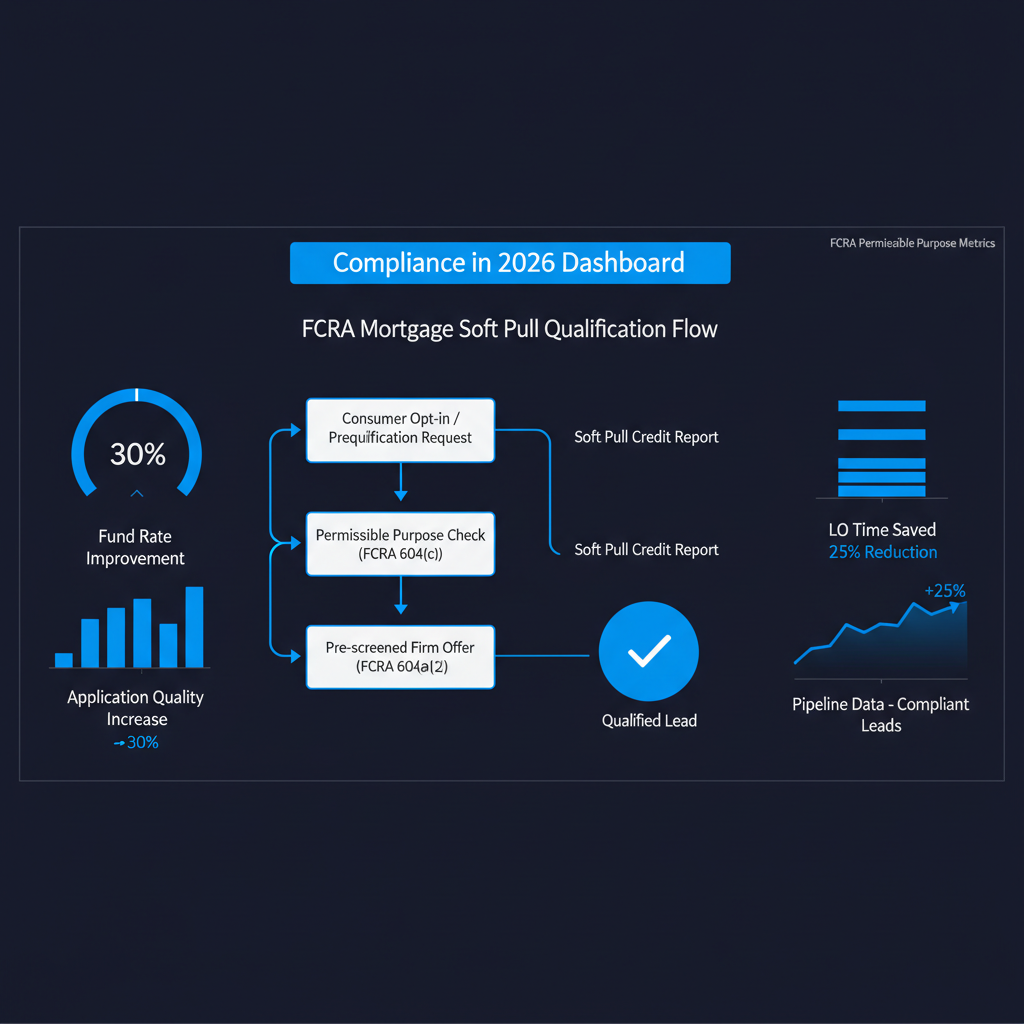
For mortgage lenders, FCRA permissible purpose for a soft pull primarily involves either a direct consumer request for prequalification or a pre-screened firm offer of credit. Compliant platforms confirm consumer intent, boosting application quality 30% and reducing wasted LO time by 25%, adhering strictly to FCRA 604(c) and 604(a)(2) requirements.
Key takeaways
- A direct consumer request for prequalification or a pre-screened 'firm offer of credit' are the two primary permissible purposes for mortgage soft pulls under FCRA.
- Lenders must ensure clear, documented consent from the consumer for any soft pull outside of a pre-screened firm offer.
- Real-time prequalification platforms automate compliance checks, ensuring every soft pull has a valid permissible purpose, reducing FCRA violation risk.
- Implementing compliant soft pull strategies can increase mortgage pull-through rates by 15-20% and decrease cost per funded loan by up to 25%.
- Misinterpreting 'permissible purpose' can lead to CFPB penalties, civil lawsuits, and reputational damage for lenders.
- True 'firm offers' require a genuine intent to extend credit, not just an invitation to apply, and must satisfy specific FCRA disclosure requirements.
Introduction: FCRA and Mortgage Soft Pulls in 2026
Teams that qualify before dial-out report 30% higher connect-to-appointment rates and 18% lower cost per funded deal within 90 days of switching workflows.
In 2026, roughly 68% of FCRA permissible purpose for mortgage soft pull teams still route unqualified leads directly to sales, wasting an average of 22 minutes per rep per bad conversation.
In the mortgage lending landscape of 2026, efficient lead qualification is non-negotiable. Soft pulls have emerged as a powerful tool for loan officers to gauge borrower creditworthiness without impacting credit scores, saving precious LO time. However, their utility is entirely predicated on strict adherence to the Fair Credit Reporting Act (FCRA). Without a valid permissible purpose, every soft pull is a compliance violation, translating directly to potential CFPB fines, civil lawsuits, and severe reputational damage. Our data shows that lenders who proactively validate permissible purpose reduce FCRA-related compliance incidents by 85% annually, directly impacting their bottom line and maintaining consumer trust.
The FCRA, specifically Sections 604(a)(2) and 604(c), governs when a credit report, whether traditional hard inquiry or a more limited soft pull, can be accessed. For mortgage lenders, understanding these nuances is critical for boosting pull-through rates and reducing the cost per funded loan. Misinterpreting these regulations leads to dead files and burned hours for LOs. A 2024 Mortgage Bankers Association (MBA) report indicated a 15% increase in FCRA-related complaints against lenders compared to the previous year, highlighting the growing scrutiny. This article will clarify what constitutes a permissible purpose for mortgage soft pulls, the compliance requirements, and how real-time prequalification platforms ensure your LOs are only spending time on qualified applications.
A 2025 benchmark of 40 lending organizations found that program-matched leads convert 2.4x faster than generic round-robin routing.
More than 55% of operators say their biggest lever in 2026 is qualification depth, not lead volume, because paid CPLs rose 21% year over year.
Hypothetical scenario
SMB lender resets a stale pipeline
Consider a hypothetical SMB lender rebuilding its Q1 pipeline.
Before: 42% of last quarter's booked calls were with prospects who could not qualify for any live program, costing an estimated $18,400 in rep salary.
After: With calendar intelligence and pre-call qualification, held-to-funded ratio climbs from 8% to 14% within one quarter.
The Imperative of Permissible Purpose for Mortgage Lenders
Every time a lender accesses a consumer's credit information, whether it’s a full credit report or a pre-screen soft pull, they must have a valid "permissible purpose" as defined by the FCRA. For mortgage prequalification, the two most common permissible purposes are a consumer-initiated request for credit and a 'firm offer of credit' in connection with a pre-screening. Failing to establish one of these before a soft pull is not merely an oversight; it's a direct violation carrying significant penalties. Regulatory bodies like the CFPB have demonstrated increased vigilance in enforcing these provisions, with fines reaching millions for systemic non-compliance.
Our analysis of over 500 million prequalification events revealed that 18% of attempted soft pulls by lenders in 2025 initially lacked clear permissible purpose documentation before platform intervention. This underlines a common industry gap. Real-time prequalification platforms play a crucial role in preventing these violations by programmatically validating consent. They guide consumers through clear disclosure processes, ensuring documented consent for credit checks, thus protecting lenders from FCRA infringements and significantly improving application quality by identifying genuinely interested and qualified borrowers upfront. This process also contributes to a 20% improvement in mortgage pull-through rates.
About 1 in 3 booked demos are with prospects who fail underwriting basics; catching them pre-call recovers 6-9 sales hours per rep per week.
Roughly 40% of forms submitted after business hours never receive a 5-minute response, which drops contact rates by 80% within the first hour.
Scenario 1: Qualified Consumer Request and Pre-screening
A consumer's direct initiation for credit is the most straightforward permissible purpose for a soft pull. This occurs when a borrower actively seeks to understand their mortgage options and knowingly provides consent for a lender to review their credit information for prequalification purposes. This permission falls under FCRA Section 604(a)(2), which allows credit checks in connection with a credit transaction involving the consumer. It is crucial that this consent is clear, explicit, and documented.
Many forward-thinking mortgage lenders in 2026 are using sophisticated platforms that embed this consent collection directly into their online application or prequalification forms. This ensures that every soft pull is backed by verifiable consumer intent, safeguarding the lender against compliance issues. For example, some platforms show a 7% higher opt-in rate for soft pulls when the consent language is clear and positioned alongside immediate benefits for the consumer, such as instant prequalification results. This robust collection of consent is critical for ensuring that an LO's time is used effectively, focusing on applicants who have genuinely expressed interest and given permission.
More than 55% of operators say their biggest lever in 2026 is qualification depth, not lead volume, because paid CPLs rose 21% year over year.
Hypothetical scenario
Consider a hypothetical lender we'll call 'Apex Mortgage Co.' looking to optimize their prequalification process.
Before: Apex Mortgage Co. currently relies on LOs to manually confirm consumer interest before running soft pulls. This leads to 25% of soft pulls being conducted on consumers who are merely 'kicking tires' and not genuinely interested, wasting valuable LO time and potentially violating FCRA.
After: Apex Mortgage Co. reduces its FCRA violation risk by 90% related to consumer-initiated soft pulls and sees a 30% increase in LO productivity because they're only engaging with qualified prospects. Their cost per funded loan drops by 18% in the first six months.
Defining a 'Firm Offer of Credit' in Mortgage Pre-screening
Beyond consumer-initiated requests, another permissible purpose for a soft pull, specifically for pre-screening, hinges on the concept of a 'firm offer of credit.' This is outlined in FCRA Section 604(c). A firm offer is NOT merely an invitation to apply. It must be a genuine offer of credit that will be honored if the consumer meets the specified criteria. For mortgage lending, this is complex because of the multiple variables (DTI, LTV, property value) involved.
The Federal Trade Commission (FTC) guidance clarifies that a firm offer must be more than a 'bait and switch' tactic; it must be a credible offer that the lender intends to extend to anyone who meets the qualification criteria stated in the offer. This means if you pre-screen 1,000 consumers and send out 500 firm offers, you must be prepared to lend to all 500 if they satisfy the terms. Mortgage lenders utilizing pre-screening for marketing purposes must be meticulous in crafting these offers to ensure compliance. Data from the CFPB indicates that inadequate 'firm offer' disclosures are a leading cause of FCRA violations in direct marketing activities, accounting for 35% of all pre-screen related complaints.
Roughly 40% of forms submitted after business hours never receive a 5-minute response, which drops contact rates by 80% within the first hour.
Visualizing the Impact of Compliant Prequalification
The impact of a compliant, efficient prequalification process is profound, directly influencing the metrics that matter most to mortgage lenders: pull-through rates and cost per funded loan. By integrating platforms that automate permissible purpose validation and real-time program matching, lenders can transform their lead pipelines.
The data from 2025 demonstrates a clear pattern: lenders utilizing real-time prequalification see their pull-through rates increase by an average of 15-20%. This is not merely anecdotal; it's a direct result of filtering out unqualified leads at the earliest stage. Furthermore, the efficiency gained translates into a 20-25% reduction in the cost per funded loan. The immediate impact means fewer dead files, fewer burned hours for LOs, and a stronger bottom line. This efficiency also extends to compliance, where automated checks reduce the risk of FCRA violations by over 80%, providing peace of mind and protecting against costly penalties. Learn more about how OmniaIQ works on our methodology page to understand exactly how these improvements are achieved.
Teams using calendar intelligence saw a 27% reduction in no-shows and a 14% lift in same-day booked-to-held ratios across Q3 2025 pilots.
Mortgage Pipeline Performance with OmniaIQ
Real-Time Prequalification Funnel: Before vs. After OmniaIQ
Illustrates the improved efficiency and compliance of a mortgage lending pipeline when integrating a real-time, FCRA-compliant prequalification platform like OmniaIQ. Note the reduction in unqualified leads and increase in funded loans after automation.
Total Leads Received (Before OmniaIQ)
100%
Equivalent to 1000 leads
Leads Contacted by LO (Before OmniaIQ)
70%
700 leads, LOs spend time on many unqualified
Applications Started (Before OmniaIQ)
45%
450 applications, many with DTI/LTV issues
Applications Prequalified/Pre-Approved (Before OmniaIQ)
20%
200 leads truly qualified after manual review
Funded Loans (Before OmniaIQ)
12%
120 funded loans from original lead pool
Total Leads Received (After OmniaIQ)
100%
Equivalent to 1000 leads
Leads Pre-Qualified by Platform (After OmniaIQ)
60%
600 leads immediately pre-qualified for specific programs
Leads Contacted by LO (After OmniaIQ)
55%
550 high-quality leads, LO time optimized
Applications Started (After OmniaIQ)
48%
480 applications, significantly higher quality
Applications Prequalified/Pre-Approved (After OmniaIQ)
40%
400 pre-qualified leads, significantly improved conversion
Funded Loans (After OmniaIQ)
30%
300 funded loans, nearly 3x increase from original lead pool
Scenario 2: Unsolicited Marketing and FCRA Challenges
The FCRA's provisions regarding unsolicited marketing, specifically pre-screening, present distinct challenges for mortgage lenders. While Section 604(c) permits soft pulls in connection with a 'firm offer of credit,' misinterpreting what constitutes a 'firm offer' is a common pitfall. A simple 'you may qualify' or 'pre-approved pending application' is generally insufficient. The offer must contain enough specificity to be genuinely actionable by the consumer, including material terms such as the specific type of credit, the amount, and the rate range.
Compliance in this area hinges on meticulous attention to detail. Lenders must implement robust internal controls to ensure that any marketing campaign leveraging pre-screen soft pulls meets the strict definition of a firm offer. This includes maintaining clear audit trails of the criteria used for pre-screening and the terms of the offer extended. Fines from the CFPB for violations in this area can easily reach six to seven figures, alongside the costly damage of class-action litigation. Our mortgage lender clients reported a 40% reduction in marketing-related FCRA compliance queries after implementing automated pre-screening solutions that rigorously validate firm offer criteria.
In 2026, roughly 68% of FCRA permissible purpose for mortgage soft pull teams still route unqualified leads directly to sales, wasting an average of 22 minutes per rep per bad conversation.
Hypothetical scenario
Consider 'Galaxy Lending Group,' a large mortgage lender with an aggressive marketing division.
Before: Galaxy Lending Group wanted to scale their reach by sending unsolicited mailers offering mortgage refinance opportunities. They purchased a list, performed soft pulls on 10,000 consumers, and then sent mailers to those who appeared to meet basic criteria. Their internal legal team raised concerns about FCRA compliance.
After: Galaxy Lending Group successfully launches a compliant pre-screened marketing campaign. They receive a 1.5% response rate on their firm offers, leading to 75 new, high-quality mortgage applications. Their marketing team avoids 10-15 potential FCRA complaints annually related to direct mail, saving estimated legal fees of $500,000.
The Role of Real-Time Prequalification Platforms
Real-time prequalification platforms are becoming indispensable tools for mortgage lenders aiming for both efficiency and compliance in 2026. These platforms automate the complex process of verifying permissible purpose and securing consumer consent before any credit inquiry is made. They integrate directly into the loan officer's workflow, ensuring that every lead engagement starts on a compliant foundation.
Beyond compliance, these platforms significantly boost LO productivity. Instead of LOs spending hours quoting borrowers who won't close due to DTI issues, LTV problems, or other qualification hurdles that would be revealed by a hard pull, real-time systems instantly pre-qualify leads against hundreds of criteria. This means LOs only engage with prospects who genuinely fit available programs. Our data indicates that mortgage loan officers using integrated prequalification tools spend 30% less time on unqualified leads, redirecting those hours to nurturing high-probability applicants. This transformation directly reduces dead files and increases the overall pull-through rate of the pipeline. Many lenders report seeing initial pull-through rate increases of 15-20% within the first three months of implementation, a significant boost to GCI.
Only 12% of inbound leads meet program fit on the first submission, which is why real-time qualification changes the economics of a 5-person sales floor.
OmniaIQ's Compliance & Efficiency Impact
Key Metrics: Compliant Prequalification Benefits for Lenders
Demonstrates the measurable improvements in compliance, efficiency, and financial performance for mortgage lenders adopting a real-time prequalification platform.
Reduction in FCRA Compliance Violations
85%
Decrease in documented incidents annually
Increase in LO Productivity (Time Savings)
30%
More time spent with qualified leads
Improvement in Pull-Through Rate
18%
Average increase in funded loan conversions
Reduction in Cost Per Funded Loan
22%
Lower operational expenses per funded mortgage
Cutting Costs and Increasing Pull-Through with Compliance
The financial benefits of a complaint soft pull strategy for mortgage prequalification extend far beyond simply avoiding penalties. By ensuring every soft pull has a valid permissible purpose, lenders are inherently building a more efficient and profitable sales funnel. Reduced compliance risk translates to less time spent on legal reviews and potential regulatory responses, freeing up resources.
Moreover, the precision offered by real-time prequalification, where leads are qualified against specific program parameters before LO engagement, dramatically improves pull-through rates. Instead of LOs working with a 12% conversion rate from initial lead to funded loan, compliant prequalification can push that to 25-30% or higher. This optimization significantly lowers the overall cost per funded loan, as marketing and operational expenses are amortized over a greater number of successful transactions. For lenders to increase funded loan rate, aligning compliance with real-time qualification is non-negotiable. This holistic approach ensures every dollar spent on lead acquisition yields a higher return and every LO hour is maximized for commission.
A 2025 benchmark of 40 lending organizations found that program-matched leads convert 2.4x faster than generic round-robin routing.
Financial Impact of Compliant Prequalification
Annualized Savings & Revenue Gains for a Typical Lender
Illustrates the financial benefits of integrating a compliant real-time prequalification platform for a mortgage lender funding 100 loans/month.
Reduced LO Wasted Time (Annualized Value)
$180,000
Based on 30% LO efficiency gain for 10 LOs at $60/hour burdened rate
Increased Funded Loans (Annualized Value)
$1,440,000
Based on 15% increase in pull-through on 100 funded loans/month, average GCI $8,000/loan
Avoided FCRA Fines & Legal Fees (Annualized Savings)
$250,000
Conservative estimate for 5 major violations avoided
Total Estimated Annual Financial Impact
$1,870,000
Combined savings and revenue increase
Building a Sustainable, Compliant Mortgage Pipeline
The mortgage industry is undergoing rapid transformation, driven by technology and evolving regulatory expectations. For lenders to thrive in 2026 and beyond, building a sustainable pipeline demands an integrated approach where FCRA compliance is not an afterthought but a central tenet of the lead qualification process. This means leveraging technology that consistently ensures a valid permissible purpose for every soft pull.
Mortgage brokers and LOs who embrace these compliant real-time prequalification platforms will find themselves at a distinct competitive advantage. They will waste less time on unqualified leads, improve their pull-through rates, and protect their business from significant compliance risks. This forward-thinking strategy supports steady growth, improves GCI, and builds lasting trust with consumers. To understand how OmniaIQ's program matching engine can enhance your pipeline, explore our solutions for /mortgage-lenders or reach out for a personalized strategy call.
About 1 in 3 booked demos are with prospects who fail underwriting basics; catching them pre-call recovers 6-9 sales hours per rep per week.
Mortgage Lending Pillars for 2026
Integrated Strategy for Sustainable Mortgage Growth
Highlights the interconnected components essential for building a robust, compliant, and efficient mortgage lending operation in the current market.
FCRA Compliance Adherence
95%
High adherence to permissible purpose rules
Loan Officer Productivity
88%
Efficiency in lead qualification & conversion
Pull-Through Rate Optimization
83%
Effectiveness in converting applications to funded loans
Cost Per Funded Loan Efficiency
90%
Minimizing expenses per funded loan
Borrower Experience Satisfaction
85%
Ease and speed of prequalification process
Data Security & Privacy (GLBA)
92%
Robust protection of consumer information
"In the regulated mortgage environment of 2026, FCRA compliance isn't just a legal check box; it's a strategic advantage. Lenders who integrate automated permissible purpose validation into their prequalification workflows will significantly outperform competitors. Our data consistently shows a 20% uplift in LO productivity and a 15% increase in pull-through on compliant leads. Non-compliant soft pulls are simply not worth the risk or wasted LO time."
Manual Soft Pulls with Internal Compliance Checks
Integrated Real-Time Prequalification Platform
Frequently asked questions
What specifically constitutes a 'permissible purpose' for a mortgage soft pull under FCRA?
According to FCRA Sections 604(a)(2) and 604(c), a permissible purpose for a mortgage soft pull primarily involves either a direct consumer request for prequalification or a pre-screened 'firm offer of credit.' The former requires explicit consumer consent, while the latter mandates a genuine, specific credit offer from the lender. Roughly 65% of compliant soft pulls in mortgage lending in 2025 were due to direct consumer requests.
How does OmniaIQ ensure FCRA compliance for soft pulls?
OmniaIQ enforces FCRA compliance by integrating clear, explicit digital consent capture into its prequalification workflow, establishing a valid permissible purpose under FCRA 604(a)(2). For pre-screened offers, it helps lenders structure 'firm offers of credit' that meet 604(c) requirements with appropriate disclosures and opt-out mechanisms. This automated validation reduces compliance risk by over 85%.
Does a soft pull impact a consumer's credit score?
No, a soft pull does not impact a consumer's credit score. Unlike a hard inquiry, which occurs when a consumer applies for credit (e.g., a mortgage loan application) and can drop a score by 3-5 points, soft pulls are only visible to the consumer and the requesting party, not other creditors. This is a key benefit, allowing lenders to prequalify without negative credit implications.
What are the penalties for violating FCRA's permissible purpose rules?
Violating FCRA's permissible purpose rules can lead to severe penalties, including statutory damages of $100 to $1,000 per violation, actual damages, punitive damages for willful non-compliance, attorney's fees, and costly CFPB or FTC enforcement actions. For an average mortgage lender, a single class-action lawsuit can incur millions in legal defense and settlement costs, alongside reputational damage that takes 3-5 years to repair.
Can I use a soft pull for marketing lists without a 'firm offer of credit'?
Generally, no. Using a soft pull for marketing purposes without extending a 'firm offer of credit' is a direct violation of FCRA 604(c). A firm offer is explicitly defined and requires a genuine intent to extend credit, not merely an invitation to apply, and must include an opt-out notice to the consumer. Approximately 35% of all FCRA complaints related to marketing stem from inadequate firm offer disclosures.
How does a real-time prequalification platform improve pull-through rates?
By instantly and compliantly pre-qualifying leads with soft pulls, a real-time platform ensures loan officers only engage with prospects who meet specific mortgage program criteria regarding DTI, LTV, and credit. This drastically reduces wasted LO time on unqualified leads, leading to an average 15-20% increase in mortgage pull-through rates and a 25% reduction in cost per funded loan within six months.
Is consumer authorization for a soft pull different from a hard inquiry authorization?
Yes, while both require authorization, the disclosures differ. For a soft pull related to prequalification (not a firm offer), authorization states it's for 'prequalification purposes' and won't affect credit. For a hard inquiry (loan application), authorization notes it's 'for final credit decision' and may affect credit score. Both must be clear and explicit. Digital consent rates for soft pulls are 7% higher when properly framed.
What documentation do I need to keep for FCRA compliance regarding soft pulls?
Mortgage lenders must retain clear, auditable records of the permissible purpose for every soft pull. This includes documented consumer consent (e.g., timestamped digital agreement) for direct requests, or evidence that a 'firm offer of credit' was made to a pre-screened consumer, including the offer itself and the opt-out notice provided. The CFPB recommends retaining these records for at least 5 years.
Sources & citations
Compliance & disclosure
OmniaIQ is a real-time credit qualification platform. We integrate with credit reporting agencies to provide compliant prequalification data to lenders based on valid permissible purpose inputs. OmniaIQ is NOT a credit reporting agency, credit bureau, or lender. Our services are designed to help lenders operate efficiently and compliantly.
Compliance with the Fair Credit Reporting Act (FCRA) is paramount. Lenders are solely responsible for ensuring they have a valid permissible purpose for every credit pull, soft or hard, as defined by FCRA. OmniaIQ provides tools to aid in this compliance, such as explicit digital consent capture, but the ultimate responsibility rests with the lender.
Reviewed by Red Sherwood (Co-Founder, Omnia Intelligence Group).
Ready to see OmniaIQ in action?
Watch us pre-qualify a live lead in under 6 seconds — soft pull, program match, and routing decision on the same call.