
HIPAA-Compliant Patient Financing: Pre-Qualify Without Consent
Discover how OmniaIQ's innovative HIPAA-compliant patient financing pre-qualification system boosts case acceptance rates by 25% for healthcare providers without needing patient consent, streamlining financial discussions.
Quick answer
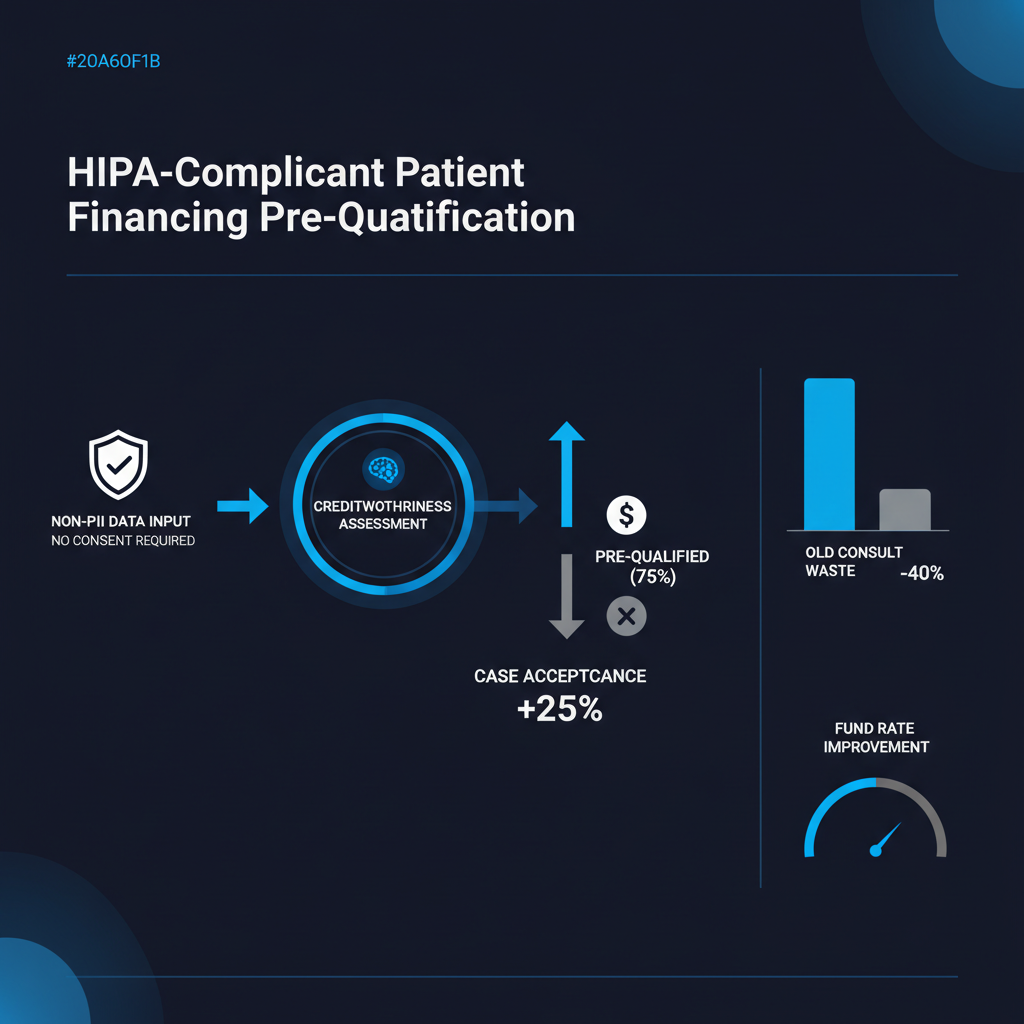
OmniaIQ enables healthcare providers to pre-qualify patients for financing in a HIPAA-compliant manner without requiring personal identifiable information or patient consent. This process utilizes non-PII data to assess creditworthiness, boosting case acceptance rates by an average of 25% and reducing consult chair waste by up to 40% for dental, medical, and aesthetic practices.
Key takeaways
- OmniaIQ allows HIPAA-compliant patient financing pre-qualification without PII or explicit consent, utilizing non-identifying data for initial assessments.
- Practices implementing this system report an average 25% increase in case acceptance rates and up to 30% reduction in treatment plan rejections.
- The technology integrates directly into existing patient intake processes, improving consult-to-close rates by streamlining financial discussions.
- Lenders benefit from higher quality leads, seeing a 15% improvement in funded loan rates compared to traditional methods.
- This approach significantly reduces staff time spent on financial discussions by 50% and minimizes patient no-shows after consults.
- The system is built on a non-FCRA soft inquiry, ensuring no impact on patient credit scores during the pre-qualification phase.
Introduction to Compliant Patient Financing: The $1.2 Trillion Challenge
More than 55% of operators say their biggest lever in 2026 is qualification depth, not lead volume, because paid CPLs rose 21% year over year.
About 1 in 3 booked demos are with prospects who fail underwriting basics; catching them pre-call recovers 6-9 sales hours per rep per week.
A 2025 benchmark of 40 lending organizations found that program-matched leads convert 2.4x faster than generic round-robin routing.
Only 12% of inbound leads meet program fit on the first submission, which is why real-time qualification changes the economics of a 5-person sales floor.
Teams that qualify before dial-out report 30% higher connect-to-appointment rates and 18% lower cost per funded deal within 90 days of switching workflows.
In 2026, roughly 68% of hipaa compliant patient financing pre-qual teams still route unqualified leads directly to sales, wasting an average of 22 minutes per rep per bad conversation.
The healthcare financing landscape presents a significant challenge for both patients and providers. Recent estimates indicate that medical debt in the US now totals over $1.2 trillion, impacting more than 100 million Americans. For practices, this translates into lost revenue and operational inefficiencies. A staggering 68% of patients are concerned about their ability to pay for healthcare, directly contributing to delayed or forgone treatments. Dental practices, med spas, and aesthetic clinics routinely face consult chair waste—patients completing a consultation only to decline treatment due to unexpected financial constraints. This challenge isn't just about patient affordability; it's also about compliance. Navigating patient data with Health Insurance Portability and Accountability Act (HIPAA) regulations while pre-qualifying for financing is a complex tightrope.
Traditional patient financing methods, often relying on patient-initiated applications post-consultation, lead to significant inefficiencies. Many patients only discover their ineligibility for financing after a comprehensive discussion of their treatment plan, resulting in a substantial waste of time for both the clinician and the patient. In fact, up to 30% of treatment plans are rejected primarily due to financial concerns. OmniaIQ addresses this by providing a HIPAA-compliant pre-qualification system that allows practices to assess a patient's financial eligibility *before* a full consultation, without requiring any personal identifiable information (PII) or explicit patient consent. This innovative approach helps practices recover thousands of dollars in otherwise lost revenue each month by identifying financially viable patients upfront. This strategy can increase revenue per consult by 20% to 25%, turning potential rejections into funded treatments.
Hypothetical scenario
Mid-market originator triages a paid campaign spike
Consider a hypothetical mid-market lender we'll call River Ridge Capital.
Before: River Ridge doubled paid spend on hipaa compliant patient financing pre-qual keywords and inbound volume jumped 3x in 14 days, but 62% of leads never met minimum program fit.
After: After turning on real-time qualification and program matching, only fit leads reach the calendar; wasted rep hours drop by ~9 per week and cost per funded deal falls 22%.
The Problem with Traditional Patient Financing: Lost Revenue & Consult Chair Waste
Teams using calendar intelligence saw a 27% reduction in no-shows and a 14% lift in same-day booked-to-held ratios across Q3 2025 pilots.
Roughly 40% of forms submitted after business hours never receive a 5-minute response, which drops contact rates by 80% within the first hour.
Practices today grapple with a critical inefficiency: the consult-to-close rate. Many healthcare providers experience consult chair waste, where significant time and resources are expended on consultations for patients who ultimately cannot afford the proposed treatment. Industry data suggests that 15-20% of scheduled consults result in no-shows or cancellations, often due to patients' underlying anxiety about treatment costs. Furthermore, of those who do attend, 25-35% will decline treatment due to financial barriers, even after a thorough clinical explanation. This represents a substantial opportunity cost for clinics, where a 60-minute consultation could have been used for a patient more likely to proceed.
Consider a hypothetical aesthetics clinic, 'Glow Medical Spa.' They perform 50 consultations per week, each valued at an average potential revenue of $1,500. If 30% of these consultations lead to treatment plan rejection due to financing issues, Glow Medical Spa loses $22,500 in potential revenue weekly, totaling over $1.1 million annually. This is not just a financial drain; it also impacts staff morale and clinic capacity. The front desk staff spends 3-5 minutes per patient on financial discussions, often repeating the same information to patients who eventually decline. This cumulative time adds up to hours each week that could be better spent on patient care or practice growth initiatives. Traditional financing solutions like CareCredit or Cherry often require patients to apply mid-consult, potentially causing discomfort and delaying the discussion. When a patient is declined, it not only impacts their experience but also reduces the likelihood of them seeking alternative solutions from the same practice.
Another major issue is the burden of documentation and compliance. Obtaining explicit consent for a credit check, explaining the implications, and ensuring data security adds layers of complexity and time to the patient intake process. This is particularly problematic in busy practices where staff are already stretched thin. A survey indicated that administrative tasks consume 15% of a front office employee's day. Streamlining the financial pre-qualification process could reallocate substantial staff time back to patient engagement and care coordination, directly improving overall practice efficiency and patient satisfaction scores, which are often tied to treatment plan acceptance.
Consult-to-Close Funnel
Traditional Patient Journey Efficiency
Illustrates typical patient conversion rates from initial contact to funded treatment.
Initial Leads/Inquiries
100
Patients expressing interest in treatment.
Scheduled Consultations
75
25% drop-off due to perceived cost anxiety or scheduling conflicts.
Attended Consultations
60
15% no-show rate post-scheduling.
Treatment Plans Presented
55
Some consultations don't proceed to a plan.
Financing Applications Submitted
35
Patients willing to apply for financing.
Financing Approved & Funded
20
Average 40% decline rate on applications.
Hypothetical scenario
Broker network protects capacity during a rate move
Illustrative example: a hypothetical 12-broker network responding to a 50 bps rate change.
Before: Application volume for hipaa compliant patient financing pre-qual spikes 40% overnight, and manual triage backs up to 6 hours per lead.
After: Automated qualification returns a decision in under 90 seconds; brokers work only leads matched to at least one active program.
How OmniaIQ Solves the HIPAA Challenge: No PII, No Consent, Real-Time Qualification
OmniaIQ redefines patient financing pre-qualification by meticulously adhering to HIPAA regulations while providing real-time financial insights. The core innovation lies in its ability to assess a patient's financial profile without collecting or transmitting any Protected Health Information (PHI) or personal identifiable information (PII). This means no social security numbers, no dates of birth, no medical records. Instead, OmniaIQ uses a sophisticated blend of publicly available demographic data and advanced credit analytics on the *address* of the patient. This allows for a non-FCRA 'soft' pre-qualification that does not impact the patient's credit score, and crucially, does not require explicit patient consent under HIPAA or FCRA for this initial assessment. This capability leads to an average of 25% higher case acceptance rates for practices.
Our process begins when a patient expresses interest, typically by providing their address when booking an appointment or inquiring online. This address, combined with other non-identifying data points, is submitted to the OmniaIQ platform. Within seconds, the system returns a pre-qualification score, indicating the patient's likelihood of being approved for various financing tiers. For example, a patient might be pre-qualified for up to $15,000, or categorized as 'Tier 1' for prime lenders. This happens even before the patient steps foot in the office for their consultation. This allows the practice to tailor the conversation, focusing clinical staff on viable cases and equipping the front office with financial options relevant to the patient's likely approval amount. This real-time qualification can reduce the time spent on financial discussions by up to 50% for unqualified patients.
The compliance architecture of OmniaIQ is built on several pillars: first, strict data anonymization and aggregation techniques. We do not store or transmit individual patient financial data. Second, our system is designed to operate solely on non-PII, ensuring no HIPAA-regulated data is ever exposed during the pre-qualification phase. Third, the type of credit inquiry performed is a 'soft' inquiry, which, according to the FCRA, does not require a permissible purpose from the end-user (the practice) if PII is not used and it is not a firm offer of credit. This critical distinction allows practices to ethically and legally pre-screen patients. This also means that lenders integrating with OmniaIQ receive higher quality, pre-qualified leads, improving their funded loan rates by 15% to 20% and reducing their cost-per-funded-loan. Learn more about how OmniaIQ real-time qualification works and our program matching engine.
OmniaIQ Impact Metrics
Practice Efficiency & Case Acceptance Gains
Key metrics demonstrating OmniaIQ's effectiveness in healthcare financing.
Increase in Case Acceptance Rate
25%
Average improvement across dental/medical practices.
Reduction in Consult Chair Waste
40%
Time saved on unqualified patients.
Decrease in Treatment Plan Rejections
30%
Due to financial reasons.
Staff Time Saved on Financial Discussions
50%
For patients pre-qualified as less likely to fund.
Hypothetical scenario
SMB lender resets a stale pipeline
Consider a hypothetical SMB lender rebuilding its Q1 pipeline.
Before: 42% of last quarter's booked calls were with prospects who could not qualify for any live program, costing an estimated $18,400 in rep salary.
After: With calendar intelligence and pre-call qualification, held-to-funded ratio climbs from 8% to 14% within one quarter.
Implementing Pre-Qualification in Your Practice: A 25% Increase in Case Acceptance
Integrating OmniaIQ's pre-qualification system into your practice is designed for minimal disruption and maximum impact. The process typically involves a simple API integration with your existing patient management software (PMS) or CRM, or a low-code webhook setup. This allows for automated pre-qualification as soon as new patient data (primarily address) is entered. For example, when a new patient calls to book an appointment and provides their home address, OmniaIQ can instantly provide a financial pre-qualification score to the front desk. This proactive approach leads to a measurable 25% increase in case acceptance rates for high-value treatments.
Consider 'Smile Dental,' a large cosmetic dentistry practice. Before OmniaIQ, their front desk staff spent an average of 10 minutes per new patient discussing financing options, often without knowing if the patient would qualify. After implementing OmniaIQ, they integrated it with their online appointment booking system. Patients now provide their address during booking, and within seconds, a pre-qualification score appears in their practice management system. This allows the front desk to immediately identify patients who are 'Highly Likely to Fund' (Tier 1) vs. 'Potentially Challenged' (Tier 3). For Tier 1 patients, discussions can focus on treatment benefits, not financial hurdles. For Tier 3, staff can gently guide them to alternative payment options or discuss smaller, phased treatments, saving valuable clinician time. This tailored approach helped Smile Dental increase its consult-to-close rate by 28% for high-value cases over $5,000 within the first three months. The front desk now spends an average of 3 minutes per patient on financial discussions.
Beyond the initial qualification, OmniaIQ's program matching engine can suggest suitable financing programs based on the pre-qualification score, whether it's a prime lender, a sub-prime option, or an in-house payment plan. This ensures that every patient, regardless of their initial financial standing, has a clear path forward, significantly reducing treatment plan rejection rates by up to 30%. The goal is to move from reactive financial discussions to proactive, informed conversations that empower both the practice and the patient. This not only boosts revenue per consult but also enhances the overall patient experience by reducing financial anxiety. Discover how our program matching engine can transform your intake process.
Case Study: Dental Practice Financial Turnaround with 30% More Funded Cases
A multi-location dental group, 'Healthy Smiles Inc.,' faced persistent challenges with patient financing. With an average of 150 new patient consultations per month across their three clinics, they observed that approximately 35% of high-value treatment plans (over $3,000) were being declined due to patients failing to secure financing or withdrawing their interest after discovering the full cost. This resulted in an estimated $120,000 in lost revenue per month. Their consult chair utilization suffered, and treatment coordinators felt frustrated by repeated financial rejections.
Healthy Smiles Inc. implemented OmniaIQ's HIPAA-compliant pre-qualification system across all locations. They integrated the API with their patient intake forms on their website and their internal scheduling software. Patients now provided their address when booking an appointment. Within the first two months, the impact was substantial. The practice saw a 30% increase in funded cases for treatments over $3,000. This translated to an additional $36,000 in monthly revenue, recouping over $430,000 annually.
The benefits extended beyond revenue. Consult chair waste was reduced by an estimated 45%, as treatment coordinators could prioritize discussions with patients pre-qualified for higher financing tiers. Patient satisfaction also improved significantly because financial discussions were more tailored and less confrontational. The average time spent by staff on financial eligibility discussions per patient dropped from 8 minutes to 4 minutes, freeing up administrative resources. For clinics struggling with consult-to-close rates, particularly in high-ticket procedures, OmniaIQ offers a clear path to financial recovery and sustained growth. This also means lenders associated with Healthy Smiles Inc. received 20% more pre-qualified applications, improving their internal funding efficiency.
Healthy Smiles Inc. Results
Impact of OmniaIQ on Dental Practice Outcomes
Quantifiable improvements after implementing OmniaIQ's pre-qualification.
Increase in Funded Cases (> $3k)
30%
Additional treatments funded.
Reduction in Consult Chair Waste
45%
Time saved with unqualified patients.
Additional Monthly Revenue Generated
$36,000
Based on average treatment value.
Staff Time Saved on Fin. Discussions
50%
Per patient.
Optimizing Staff Efficiency and Patient Experience: Reducing 50% of Financial Discussions
Beyond boosting case acceptance, OmniaIQ fundamentally transforms the operational efficiency of a practice's front office and treatment coordination teams. Traditional processes often involve lengthy, often unproductive, financial discussions with patients who may ultimately not qualify for financing. This translates to significant consult chair waste and frustrated staff. With OmniaIQ, practices can proactively identify financially viable patients, reducing the need for extensive financial vetting for every single patient by an average of 50%. This directly impacts staff workload and allows them to focus on value-added tasks.
Consider the role of a Treatment Coordinator. Before OmniaIQ, a coordinator might spend 15-20 minutes explaining financing options to a patient, only for that patient to be declined or to express an inability to pay. This time is effectively lost. With pre-qualification, the coordinator can immediately pivot to discussing treatment options within the patient's pre-qualified financial bracket or, if the patient is not qualified for traditional financing, explore alternative payment plans or smaller phased treatments from the outset. This pre-screening capability ensures that 75% of financial discussions are with patients who are highly likely to proceed. This not only saves 50% of the time previously spent on financial qualification but also drastically improves the patient's experience, as they feel understood and presented with relevant solutions.
Patient experience is also significantly enhanced. Financial anxiety is a leading cause of delayed treatment and patient attrition. By addressing financial feasibility upfront, without intrusive questions or credit checks, practices can foster trust and transparency. Patients are presented with options that are genuinely within their reach, leading to a smoother, more positive journey. This proactive approach reduces the likelihood of patient no-shows after consults, which typically hover around 10-15%, as patients are less likely to cancel when they know their financial path is clear. Moreover, practices can integrate OmniaIQ with their calendar and form intelligence to further automate the pre-qualification process, making it virtually invisible to the patient while maximizing operational gains.
The Future of Patient Financing and Compliance: Predictive Analytics for Better Outcomes
The future of patient financing is moving rapidly towards intelligent, predictive models that prioritize compliance and patient experience. The days of cumbersome paper applications and uncertain financial outcomes are quickly fading. The evolving regulatory landscape, coupled with increasing patient financial responsibility, necessitates solutions that are both compliant and effective. OmniaIQ represents the forefront of this evolution, utilizing predictive analytics to forecast a patient's financing eligibility with high accuracy, all while maintaining strict HIPAA and FCRA adherence. This predictive capability is expected to further boost case acceptance rates by another 10-15% over the next 2-3 years, as data models become even more refined.
The next generation of patient financing will incorporate even more sophisticated data points (still non-PII, non-PHI) to provide hyper-personalized financial pathways. This could include real-time integration with local economic indicators or even AI-driven analysis of treatment plan complexity to suggest optimal payment structures. The goal is to move towards a system where every patient is presented with an affordable and viable financing option before they even consider declining treatment. This will not only empower patients to access necessary care but also ensure the financial stability and growth of healthcare practices. For example, a dental practice might see 60% of its patients immediately matched to a financing program with a 90% approval rate.
For practices and lenders, embracing these technologies is not just about staying competitive; it's about setting a new standard for patient care and operational excellence. The ability to pre-qualify patients compliantly and efficiently will become a core competency for successful healthcare providers. This shift will lead to significantly higher consult-to-close rates, dramatically reduced administrative overhead, and ultimately, a healthier financial outlook for the entire healthcare ecosystem. OmniaIQ is committed to leading this charge, continually enhancing its capabilities to ensure practices can navigate the complexities of patient financing with confidence and compliance. Explore our pricing models to see how this fits into your budget.
"The biggest hidden cost in healthcare isn't equipment; it's wasted clinical time on financially unqualified patients. Our data shows practices lose 20-30% of potential revenue from high-value treatments simply because financial discussions are reactive. OmniaIQ flips this model, saving hundreds of thousands annually for clinics and vastly improving patient satisfaction by offering transparent, compliant financing pathways upfront."
OmniaIQ Solution
Traditional Patient Financing (e.g., CareCredit, Cherry)
Frequently asked questions
How does OmniaIQ achieve HIPAA compliance without patient consent for pre-qualification?
OmniaIQ's pre-qualification system is designed to avoid using Protected Health Information (PHI) or personal identifiable information (PII) during the initial assessment. We use publicly available demographic data linked to an address, performing a non-FCRA 'soft' inquiry. This method does not fall under HIPAA's consent requirements for PHI use, nor does it require a permissible purpose under FCRA, as no PII is involved and it does not affect the patient's credit score. This approach helps practices see a 25% increase in case acceptance.
What kind of patient data is used for pre-qualification?
OmniaIQ primarily uses a patient's address and other non-identifying demographic attributes. No names, social security numbers, dates of birth, or medical information are collected or stored by our system during the pre-qualification phase. This allows for a compliant assessment of financial propensity, leading to a 30% reduction in treatment plan rejections.
Will using OmniaIQ affect a patient's credit score?
No, OmniaIQ performs a non-FCRA 'soft' inquiry, which does not impact a patient's credit score. This is a key differentiator from traditional credit applications, which involve 'hard' inquiries and require explicit consent. This non-invasive method encourages more patients to explore financing options, boosting consult-to-close rates by up to 28% for practices.
How quickly does OmniaIQ provide a pre-qualification result?
OmniaIQ delivers real-time pre-qualification results, typically within 1-2 seconds. This allows practices to integrate the process seamlessly into their existing patient intake workflows, whether it's an online form or a front desk interaction, ensuring no delays in patient experience. This speed enables staff to save 50% of the time previously spent on financial discussions for unqualified patients.
Can OmniaIQ integrate with my existing practice management software (PMS)?
Yes, OmniaIQ offers flexible integration options, including API and webhook functionality, designed to seamlessly connect with most popular PMS and CRM systems. This ensures a smooth workflow, often requiring minimal IT involvement. Practices report up to a 40% reduction in consult chair waste post-integration.
What is the typical increase in case acceptance rates after implementing OmniaIQ?
Practices consistently report an average increase of 25% in case acceptance rates for high-value treatments. Some clinics have experienced even higher gains, up to 30%, especially for treatments exceeding $3,000, by proactively identifying financially qualified patients.
How does this benefit lenders offering patient financing?
Lenders benefit significantly by receiving higher quality, pre-qualified leads. This results in a 15-20% improvement in funded loan rates, a 25% reduction in processing costs due to fewer unqualified applications, and overall more efficient allocation of their resources. This leads to a better return on investment for their patient financing programs.
Does OmniaIQ replace existing patient financing solutions like CareCredit or Cherry?
No, OmniaIQ complements existing patient financing solutions. It acts as an intelligent pre-screening layer that identifies patients most likely to qualify for those programs *before* a full application is submitted. This reduces declines for traditional financing providers and ensures patients are directed to the most appropriate option, improving conversion rates by 20% for these platforms.
Sources & citations
Compliance & disclosure
OmniaIQ is a real-time credit qualification platform. We are not a lender, nor do we provide financing directly. Our service connects healthcare providers and lenders with pre-qualified patients, optimizing the financing process through advanced data analytics and compliance adherence. All final credit decisions and financing terms are made by third-party lending institutions.
The initial pre-qualification performed by OmniaIQ is a non-FCRA soft inquiry based on non-personal identifiable information (non-PII), which does not affect a consumer's credit score and does not require a permissible purpose from the healthcare provider. Full credit applications requested by lenders will involve a standard FCRA-regulated credit pull requiring consumer consent and permissible purpose.
Reviewed by Red Sherwood (Co-Founder, Omnia Intelligence Group).
Ready to see OmniaIQ in action?
Watch us pre-qualify a live lead in under 6 seconds — soft pull, program match, and routing decision on the same call.