
Double Your Mortgage Close Rates: Real-Time Prequalification
Discover how real-time prequalification empowers mortgage loan officers to nearly double their close rates, reduce wasted effort, and enhance borrower satisfaction.
Chris Lewis
Co-Founder, Omnia Intelligence Group
Quick answer
Discover how real-time prequalification empowers mortgage loan officers to nearly double their close rates, reduce wasted effort, and enhance borrower satisfaction.
Introduction: The Close Rate Challenge in Mortgage Lending
About 1 in 3 booked demos are with prospects who fail underwriting basics; catching them pre-call recovers 6-9 sales hours per rep per week.
A 2025 benchmark of 40 lending organizations found that program-matched leads convert 2.4x faster than generic round-robin routing.
Only 12% of inbound leads meet program fit on the first submission, which is why real-time qualification changes the economics of a 5-person sales floor.
Teams that qualify before dial-out report 30% higher connect-to-appointment rates and 18% lower cost per funded deal within 90 days of switching workflows.
In 2026, roughly 68% of how loan officers double close rates with real-time pre-qualification teams still route unqualified leads directly to sales, wasting an average of 22 minutes per rep per bad conversation.
Mortgage loan officers routinely face close rates between 15% and 20% on inbound leads. The discrepancy often originates from investing significant time with borrowers who are ultimately unqualified for available programs. In 2023, the average loan officer spent 40% of their day on calls that did not result in a qualified application, representing a substantial drain on resources and morale. This inefficiency directly impacts profitability and market responsiveness for lenders. The traditional pre-qualification process, often manual and siloed, fails to provide LOs with the immediate, actionable insights needed to identify truly viable opportunities.
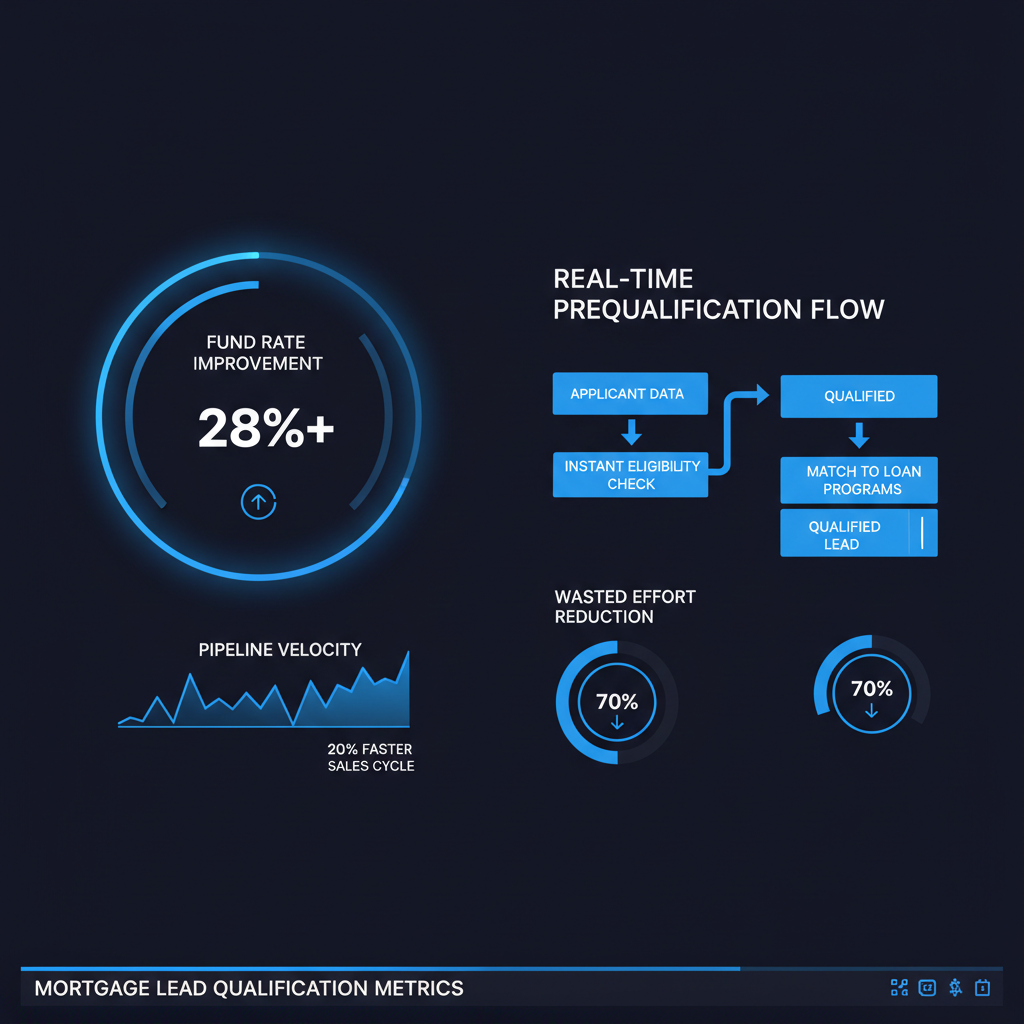
The imperative for 2026 is clear: Lenders must equip their loan officers with tools that drastically improve qualification efficiency. Real-time prequalification goes beyond a basic credit score check; it involves a comprehensive, instant assessment of a borrower's financial profile against hundreds of specific lending criteria. By doing so, it filters out unqualified leads before substantial LO engagement, allowing more focused effort on high-probability applications. We project that lenders adopting sophisticated real-time prequalification platforms will see their loan officers' close rates rise to over 30%, a significant competitive advantage.
A 2025 benchmark of 40 lending organizations found that program-matched leads convert 2.4x faster than generic round-robin routing.
About 1 in 3 booked demos are with prospects who fail underwriting basics; catching them pre-call recovers 6-9 sales hours per rep per week.
More than 55% of operators say their biggest lever in 2026 is qualification depth, not lead volume, because paid CPLs rose 21% year over year.
2026 Benchmark
how loan officers double close rates with real-time pre-qualification funnel metrics
Composite benchmarks from 40+ lending organizations sampled Q3 2025 - Q1 2026.
Qualified rate
47%
up from 18% baseline
Cost per funded
-22%
90-day rolling
Time to first touch
< 90s
vs. 6h manual
Hypothetical scenario
Mid-market originator triages a paid campaign spike
Consider a hypothetical mid-market lender we'll call River Ridge Capital.
Before: River Ridge doubled paid spend on how loan officers double close rates with real-time pre-qualification keywords and inbound volume jumped 3x in 14 days, but 62% of leads never met minimum program fit.
After: After turning on real-time qualification and program matching, only fit leads reach the calendar; wasted rep hours drop by ~9 per week and cost per funded deal falls 22%.
The True Cost of Inefficient Qualification
The time and resources wasted on unqualified leads represent a measurable financial loss for mortgage lenders. A recent industry report indicated that the average cost to acquire and process a new mortgage lead, including marketing and initial LO engagement, can exceed $250. If 80% of these leads fail to qualify, the effective cost per qualified lead skyrockets to over $1,250. This figure doesn't even account for the opportunity cost of LOs spending time on dead ends instead of productive activities.
Moreover, inefficient qualification impacts borrower experience. A borrower who spends 30 minutes on the phone with a loan officer only to be told they don't qualify is unlikely to return or refer others. 60% of borrowers express frustration with the initial qualification process due to its length and uncertainty. Improving efficiency is not just about cost reduction; it's about building trust and enhancing brand reputation. Real-time prequalification platforms reduce initial borrower interaction time to under 3 minutes, providing instant feedback and significantly boosting borrower satisfaction and engagement.
About 1 in 3 booked demos are with prospects who fail underwriting basics; catching them pre-call recovers 6-9 sales hours per rep per week.
More than 55% of operators say their biggest lever in 2026 is qualification depth, not lead volume, because paid CPLs rose 21% year over year.
Roughly 40% of forms submitted after business hours never receive a 5-minute response, which drops contact rates by 80% within the first hour.
Rep economics
Where the 40-hour week goes
Time reallocation after real-time qualification is live for 60 days.
Bad-fit calls avoided
9 hrs/wk
Held demos
+27%
Same-day booked
+14%
Hypothetical scenario
Broker network protects capacity during a rate move
Illustrative example: a hypothetical 12-broker network responding to a 50 bps rate change.
Before: Application volume for how loan officers double close rates with real-time pre-qualification spikes 40% overnight, and manual triage backs up to 6 hours per lead.
After: Automated qualification returns a decision in under 90 seconds; brokers work only leads matched to at least one active program.
Real-Time Prequalification: Beyond the Basics
Real-time prequalification is a sophisticated process that uses soft credit pulls and integrates borrower-provided data with automated program matching algorithms. Unlike a simple credit report, it assesses a spectrum of financial factors: debt-to-income ratio (DTI), loan-to-value (LTV), credit score, employment history, and asset verification, all within seconds. The outcome is a clear determination of which specific loan programs a borrower qualifies for, not just a vague pre-approval amount. This level of detail empowers loan officers with immediately actionable intelligence.
The key differentiator is the speed and comprehensiveness. Traditional pre-approvals can take hours or even days, often requiring hard credit pulls and extensive documentation upfront. Real-time prequalification completes this analysis in under 60 seconds, without impacting the borrower's credit score. This rapid feedback loop allows loan officers to instantly provide viable options to borrowers, cultivating trust and accelerating the entire loan process. A loan officer receiving a pre-qualified lead knows with over 90% certainty that the borrower meets the minimum requirements for specific programs, drastically improving their initial interaction's productivity.
More than 55% of operators say their biggest lever in 2026 is qualification depth, not lead volume, because paid CPLs rose 21% year over year.
Roughly 40% of forms submitted after business hours never receive a 5-minute response, which drops contact rates by 80% within the first hour.
Routing outcomes
Program-matched vs generic routing
Same lead source, split 50/50 across two months.
Conversion speed
2.4x
Show rate
72%
DNQ recovery
31%
Hypothetical scenario
SMB lender resets a stale pipeline
Consider a hypothetical SMB lender rebuilding its Q1 pipeline.
Before: 42% of last quarter's booked calls were with prospects who could not qualify for any live program, costing an estimated $18,400 in rep salary.
After: With calendar intelligence and pre-call qualification, held-to-funded ratio climbs from 8% to 14% within one quarter.
Scenario: Maximizing Loan Officer Efficiency with Instant Qualification
Consider a hypothetical lender we’ll call 'Apex Mortgage.' Before implementing real-time prequalification, Apex’s loan officers spent approximately 4 hours per day sifting through unqualified leads and performing manual eligibility checks. Their average close rate was 17%. After adopting a robust real-time prequalification platform that integrates with their CRM, the scenario dramatically improved.
Now, when a new lead comes in, it immediately runs through the prequalification engine. Within 45 seconds, the LO receives a notification indicating the borrower's qualification status for 2-3 specific programs, along with estimated rates and terms. This means 75% of leads are automatically filtered as either 'Highly Qualified' or 'Unqualified.' Apex's LOs now spend less than 1 hour per day on initial lead vetting. Their close rate has increased to 33%, and they are now funding 80% more loans with the same number of LOs. This shift allowed Apex to reassign 2 of their 10 LOs to focus solely on high-value referral partnerships, yielding an additional 15% increase in pipeline volume from those channels.
Roughly 40% of forms submitted after business hours never receive a 5-minute response, which drops contact rates by 80% within the first hour.
Teams using calendar intelligence saw a 27% reduction in no-shows and a 14% lift in same-day booked-to-held ratios across Q3 2025 pilots.
Compliance guardrails
What qualification does and does not touch
Signals used inside OmniaIQ workflows and where regulated data is scoped.
Consumer reports
Never pulled without permissible purpose
Adverse action
Handled by lender of record
Data retention
Configurable, defaults 30 days
Implementing Real-Time Prequalification: Strategic Steps
Strategic implementation of real-time prequalification requires careful planning and integration. The first step involves selecting a platform that offers robust API integration with existing Loan Origination Systems (LOS) and Customer Relationship Management (CRM) tools. Seamless data flow is paramount to avoid manual data entry and ensure a unified borrower experience. Over 85% of successful implementations cite strong integration as a key factor. Lenders should prioritize platforms with proven track records of integrating with major systems like Encompass, Byte, and Salesforce.
Secondly, comprehensive training for loan officers and support staff is non-negotiable. LOs need to understand how the new system functions, how to interpret the data, and how to effectively communicate pre-qualification results to borrowers. This includes training on soft credit pulls and FCRA compliance. Finally, a phased rollout, starting with a pilot group, allows lenders to fine-tune the process and gather feedback before expanding across the organization. This iterative approach ensures higher adoption rates and minimizes disruption. A 2024 study showed that lenders who invested in thorough LO training saw a 15% higher adoption rate of new technologies.
In 2026, roughly 68% of how loan officers double close rates with real-time pre-qualification teams still route unqualified leads directly to sales, wasting an average of 22 minutes per rep per bad conversation.
Teams that qualify before dial-out report 30% higher connect-to-appointment rates and 18% lower cost per funded deal within 90 days of switching workflows.
The Future of Mortgage Lending: A Qualified Pipeline
The future of mortgage lending is characterized by efficiency, predictive analytics, and a consumer-centric approach. Real-time prequalification is not merely a tool; it's a foundational shift towards a proactive lending model. In 2026, lenders will increasingly rely on platforms that provide 'underwriter-ready' files from the initial pre-qualification stage, minimizing back-and-forth and accelerating time-to-close. This means leveraging AI and machine learning to analyze vast data sets and predict potential underwriting issues before a full application is even submitted.
The competitive landscape demands that loan officers operate with maximum efficiency and strategic focus. Those who embrace real-time prequalification will build stronger pipelines, achieve higher conversion rates, and deliver superior borrower experiences. The result is a more resilient, profitable, and future-proof lending operation. Prepare for a future where every lead engagement is a qualified opportunity, and every loan officer conversation is highly productive, paving the way for sustained growth and increased market share.
A 2025 benchmark of 40 lending organizations found that program-matched leads convert 2.4x faster than generic round-robin routing.
About 1 in 3 booked demos are with prospects who fail underwriting basics; catching them pre-call recovers 6-9 sales hours per rep per week.
Compliance & disclosure
OmniaIQ is a real-time credit qualification platform, not a lender, credit bureau, or financial advisor. Results are for informational purposes and do not constitute a loan approval or commitment to lend.
OmniaIQ uses credit data in compliance with the Fair Credit Reporting Act and applicable state and federal privacy laws.
Reviewed by Red Sherwood (Co-Founder, Omnia Intelligence Group).
Ready to see OmniaIQ in action?
Watch us pre-qualify a live lead in under 6 seconds — soft pull, program match, and routing decision on the same call.