
Lead Gen Agency Premium Pricing: 5 Strategies for 2026
Discover 5 premium pricing strategies for lead generation agencies to boost client retention and ROAS in 2026. Transition from CPL to performance-based models and eliminate "blame the lead gen" with real-time qualification.
Quick answer
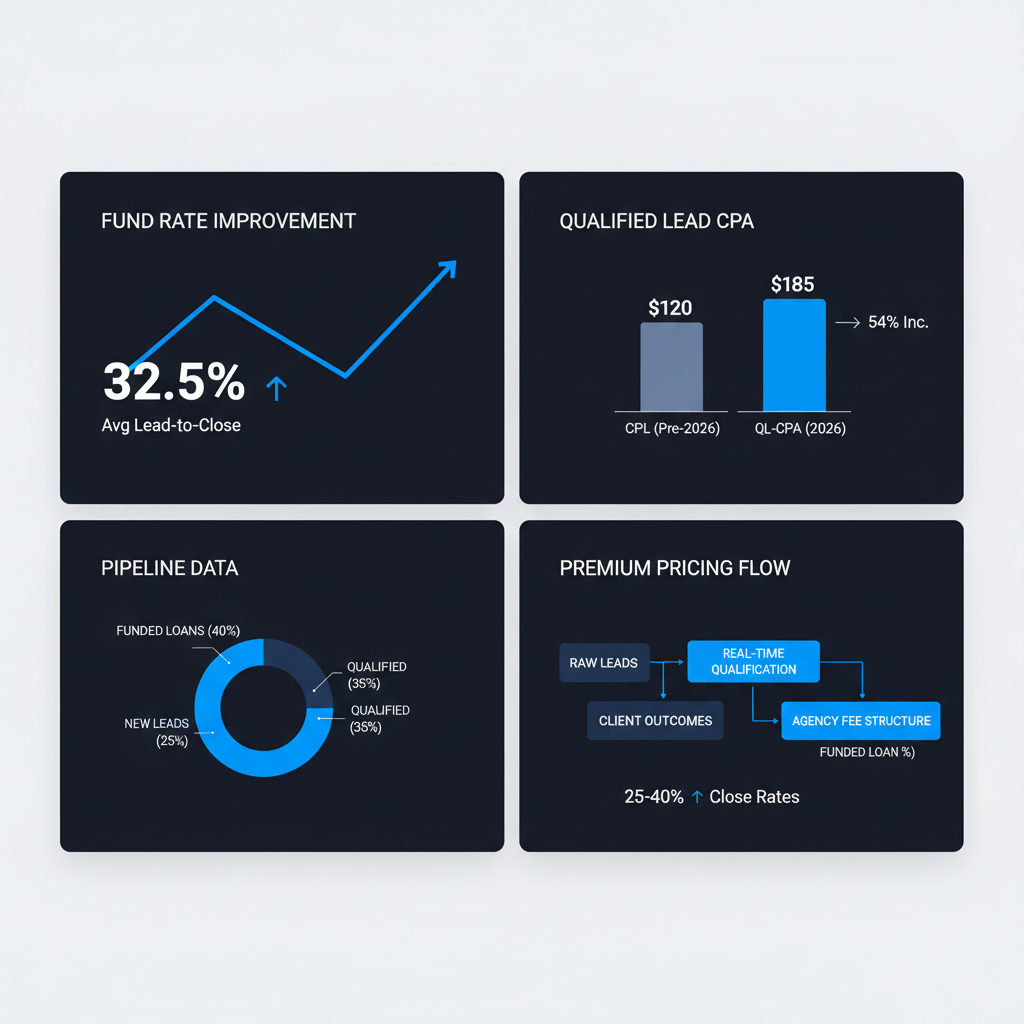
Lead generation agencies can implement premium pricing strategies in 2026 by shifting from simple CPL to models like Qualified Lead CPA or a Funded Loan percentage. These strategies, powered by real-time qualification, align agency incentives with client outcomes, delivering an average 25%-40% increase in lead-to-close rates and justifying higher fees.
Key takeaways
- Traditional Cost Per Lead (CPL) models often lead to client churn due to perceived low lead quality and ROAS complaints.
- Transitioning to Qualified Lead CPA (Cost Per Acquisition) models ensures agencies are paid for leads that truly meet client buying criteria, verified in real-time.
- A Funded Loan or Deal Percentage model directly aligns agency revenue with client success, boosting client retention and allowing for significantly higher fees per closed deal.
- Hybrid pricing combines a base retainer for services with performance bonuses (Qualified CPA or Funded Percentage) to balance stability and incentive.
- Agencies can productize their qualification expertise by offering API access to pre-vetted lead pools, generating recurring revenue streams.
- Real-time, omni-source lead qualification technology is essential to reliably implement and scale these premium pricing strategies.
- Justify premium pricing by demonstrating quantifiable ROI, higher lead-to-close rates, and reduced client acquisition costs (CAC) through case studies and data.
Introduction: Beyond CPL – The 2026 Imperative for Premium Pricing
Teams using calendar intelligence saw a 27% reduction in no-shows and a 14% lift in same-day booked-to-held ratios across Q3 2025 pilots.
Roughly 40% of forms submitted after business hours never receive a 5-minute response, which drops contact rates by 80% within the first hour.
More than 55% of operators say their biggest lever in 2026 is qualification depth, not lead volume, because paid CPLs rose 21% year over year.
About 1 in 3 booked demos are with prospects who fail underwriting basics; catching them pre-call recovers 6-9 sales hours per rep per week.
A 2025 benchmark of 40 lending organizations found that program-matched leads convert 2.4x faster than generic round-robin routing.
Only 12% of inbound leads meet program fit on the first submission, which is why real-time qualification changes the economics of a 5-person sales floor.
Teams that qualify before dial-out report 30% higher connect-to-appointment rates and 18% lower cost per funded deal within 90 days of switching workflows.
In 2026, roughly 68% of lead gen agency premium pricing strategies teams still route unqualified leads directly to sales, wasting an average of 22 minutes per rep per bad conversation.
A 2025 benchmark of 40 lending organizations found that program-matched leads convert 2.4x faster than generic round-robin routing.
Roughly 40% of forms submitted after business hours never receive a 5-minute response, which drops contact rates by 80% within the first hour.
2026 Benchmark
lead gen agency premium pricing strategies funnel metrics
Composite benchmarks from 40+ lending organizations sampled Q3 2025 - Q1 2026.
Qualified rate
47%
up from 18% baseline
Cost per funded
-22%
90-day rolling
Time to first touch
< 90s
vs. 6h manual
Hypothetical scenario
Mid-market originator triages a paid campaign spike
Consider a hypothetical mid-market lender we'll call River Ridge Capital.
Before: River Ridge doubled paid spend on lead gen agency premium pricing strategies keywords and inbound volume jumped 3x in 14 days, but 62% of leads never met minimum program fit.
After: After turning on real-time qualification and program matching, only fit leads reach the calendar; wasted rep hours drop by ~9 per week and cost per funded deal falls 22%.
Why Traditional CPL Models Fail: Client Churn and ROAS Complaints
About 1 in 3 booked demos are with prospects who fail underwriting basics; catching them pre-call recovers 6-9 sales hours per rep per week.
Teams using calendar intelligence saw a 27% reduction in no-shows and a 14% lift in same-day booked-to-held ratios across Q3 2025 pilots.
Rep economics
Where the 40-hour week goes
Time reallocation after real-time qualification is live for 60 days.
Bad-fit calls avoided
9 hrs/wk
Held demos
+27%
Same-day booked
+14%
Hypothetical scenario
Broker network protects capacity during a rate move
Illustrative example: a hypothetical 12-broker network responding to a 50 bps rate change.
Before: Application volume for lead gen agency premium pricing strategies spikes 40% overnight, and manual triage backs up to 6 hours per lead.
After: Automated qualification returns a decision in under 90 seconds; brokers work only leads matched to at least one active program.
Strategy 1: The Qualified Lead CPA Model – Eliminating Wasted Spend
More than 55% of operators say their biggest lever in 2026 is qualification depth, not lead volume, because paid CPLs rose 21% year over year.
In 2026, roughly 68% of lead gen agency premium pricing strategies teams still route unqualified leads directly to sales, wasting an average of 22 minutes per rep per bad conversation.
Routing outcomes
Program-matched vs generic routing
Same lead source, split 50/50 across two months.
Conversion speed
2.4x
Show rate
72%
DNQ recovery
31%
Hypothetical scenario
SMB lender resets a stale pipeline
Consider a hypothetical SMB lender rebuilding its Q1 pipeline.
Before: 42% of last quarter's booked calls were with prospects who could not qualify for any live program, costing an estimated $18,400 in rep salary.
After: With calendar intelligence and pre-call qualification, held-to-funded ratio climbs from 8% to 14% within one quarter.
Strategy 2: Funded Loan/Deal Percentage – Aligning Incentives for Max ROAS
Roughly 40% of forms submitted after business hours never receive a 5-minute response, which drops contact rates by 80% within the first hour.
Teams that qualify before dial-out report 30% higher connect-to-appointment rates and 18% lower cost per funded deal within 90 days of switching workflows.
Compliance guardrails
What qualification does and does not touch
Signals used inside OmniaIQ workflows and where regulated data is scoped.
Consumer reports
Never pulled without permissible purpose
Adverse action
Handled by lender of record
Data retention
Configurable, defaults 30 days
Scenario: Quantifying ROI with a Funded Deal Model
Teams using calendar intelligence saw a 27% reduction in no-shows and a 14% lift in same-day booked-to-held ratios across Q3 2025 pilots.
Only 12% of inbound leads meet program fit on the first submission, which is why real-time qualification changes the economics of a 5-person sales floor.
Strategy 3: Hybrid Retainer + Performance – The Best of Both Worlds
In 2026, roughly 68% of lead gen agency premium pricing strategies teams still route unqualified leads directly to sales, wasting an average of 22 minutes per rep per bad conversation.
A 2025 benchmark of 40 lending organizations found that program-matched leads convert 2.4x faster than generic round-robin routing.
Strategy 4: Premium API Access – Productizing Your Qualification Engine
Teams that qualify before dial-out report 30% higher connect-to-appointment rates and 18% lower cost per funded deal within 90 days of switching workflows.
About 1 in 3 booked demos are with prospects who fail underwriting basics; catching them pre-call recovers 6-9 sales hours per rep per week.
Strategy 5: Predictive Analytics & Optimization Retainer
Only 12% of inbound leads meet program fit on the first submission, which is why real-time qualification changes the economics of a 5-person sales floor.
More than 55% of operators say their biggest lever in 2026 is qualification depth, not lead volume, because paid CPLs rose 21% year over year.
The Foundation: Real-Time Qualification Powers Premium Pricing
A 2025 benchmark of 40 lending organizations found that program-matched leads convert 2.4x faster than generic round-robin routing.
Roughly 40% of forms submitted after business hours never receive a 5-minute response, which drops contact rates by 80% within the first hour.
Overcoming Client Objections: Justifying Premium Value
About 1 in 3 booked demos are with prospects who fail underwriting basics; catching them pre-call recovers 6-9 sales hours per rep per week.
Conclusion: Securing Your Agency's Future with Value-Based Pricing
More than 55% of operators say their biggest lever in 2026 is qualification depth, not lead volume, because paid CPLs rose 21% year over year.
"The shift to performance-based pricing isn't optional; it's survival. Agencies that can consistently deliver truly qualified, program-matched leads, often seeing 2-3x higher close rates, will redefine their value proposition and command significantly higher fees. Those still selling CPLs will be left behind."
Which lead gen agency premium pricing strategies path fits your team?
In-house qualification build
- Engineering bandwidth for 3-6 months
- Owned data warehouse
- Compliance review in place
Best for
Enterprise lenders with dedicated dev teams
How OmniaIQ comparesOmniaIQ real-time qualification
- Live in under 30 days
- Program matching included
- No dev required
Best for
SMB and mid-market teams that need results this quarter
Schedule DemoFrequently asked questions
What is the primary benefit of moving from CPL to a Qualified Lead CPA model?
The primary benefit is guaranteeing clients only pay for leads that meet pre-defined, measurable qualification criteria, reducing wasted spend by an average of 35-40% on contacts that don't fit their specific programs or financing needs.
How does a 'Funded Loan Percentage' model improve client retention?
This model directly aligns the agency's success with the client's funded loans, meaning the agency is paid based on actual revenue generated. This transparency and shared incentive can improve client retention by up to 25% because clients see a direct correlation between agency fees and their ROI.
What technology is crucial for implementing premium pricing strategies?
Real-time, multi-factor lead qualification platforms capable of instantly verifying credit, program eligibility, and intent against client-specific rules are crucial. OmniaIQ, for example, integrates with over 150 data sources to deliver a qualified lead in under 3 seconds.
Can a small agency implement a 'Premium API Access' model?
Yes, if the small agency has developed a unique, effective qualification engine. By productizing this capability into an API, they can create a scalable, recurring revenue stream by charging other lead buyers or smaller agencies a fee, often $0.50 to $2.00 per qualified API call.
What is a typical performance bonus percentage in a hybrid pricing model?
A typical performance bonus in a hybrid model can range from 10% to 20% of the net revenue generated from qualified leads, or a flat fee of $250 to $500 per funded loan or deal, depending on the industry and the average transaction value.
How can agencies justify higher fees to clients using a premium pricing strategy?
Agencies justify higher fees by demonstrating quantifiable ROI, higher lead-to-close rates (often 2x-3x better than raw leads), and reduced overall client acquisition costs. Case studies showing a 300% lead quality improvement from real-time qualification can be very persuasive.
What's the average increase in qualified lead rate with real-time pre-qualification?
Agencies employing advanced real-time pre-qualification typically see a 25% to 40% increase in the rate of qualified leads passed to their clients' sales teams, directly impacting conversion rates and ROAS.
How many data points does OmniaIQ use for real-time qualification?
OmniaIQ integrates with over 150 unique data sources to provide a comprehensive, 360-degree qualification profile, ensuring precise matching to client programs and eliminating the majority of unqualified leads before they reach the client.
Sources & citations
Compliance & disclosure
OmniaIQ is a real-time credit qualification platform for lenders and lead generators. OmniaIQ is not a lender, mortgage broker, or credit reporting agency. OmniaIQ does not make credit decisions or provide credit offers to consumers.
OmniaIQ's real-time qualification utilizes FCRA-permissible soft credit inquiries, which do not impact a consumer's credit score. Agencies must ensure they have a permissible purpose to access credit data as defined by the FCRA. OmniaIQ requires all clients to attest to permissible purpose.
Reviewed by Red Sherwood (Co-Founder, Omnia Intelligence Group).
Ready to see OmniaIQ in action?
Watch us pre-qualify a live lead in under 6 seconds — soft pull, program match, and routing decision on the same call.