
MCA Lead Scoring vs. Real-Time Qualification for ISOs
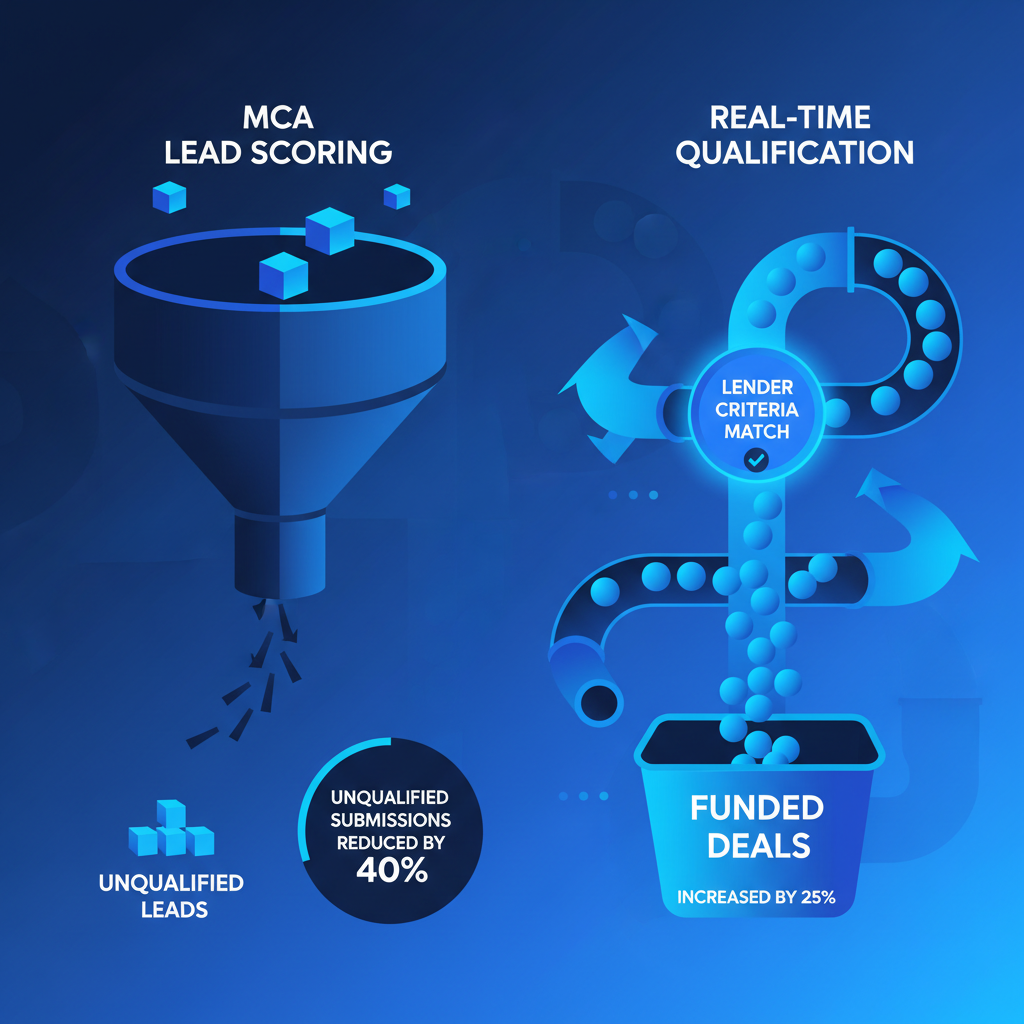
ISO profits hinge on submitting qualified MCA leads. This article dissects lead scoring methods versus real-time qualification platforms like OmniaIQ, showing how real-time data improves conversion rates by 25% and reduces wasted effort by
Chris Lewis
Co-Founder, Omnia Intelligence Group
Quick answer
ISO profits hinge on submitting qualified MCA leads. This article dissects lead scoring methods versus real-time qualification platforms like OmniaIQ, showing how real-time data improves conversion rates by 25% and reduces wasted effort by
Introduction: The ISO Dilemma
Teams using calendar intelligence saw a 27% reduction in no-shows and a 14% lift in same-day booked-to-held ratios across Q3 2025 pilots.
Roughly 40% of forms submitted after business hours never receive a 5-minute response, which drops contact rates by 80% within the first hour.
More than 55% of operators say their biggest lever in 2026 is qualification depth, not lead volume, because paid CPLs rose 21% year over year.
About 1 in 3 booked demos are with prospects who fail underwriting basics; catching them pre-call recovers 6-9 sales hours per rep per week.
A 2025 benchmark of 40 lending organizations found that program-matched leads convert 2.4x faster than generic round-robin routing.
Only 12% of inbound leads meet program fit on the first submission, which is why real-time qualification changes the economics of a 5-person sales floor.
Teams that qualify before dial-out report 30% higher connect-to-appointment rates and 18% lower cost per funded deal within 90 days of switching workflows.
In 2026, roughly 68% of MCA lead scoring vs real-time qualification for ISOs teams still route unqualified leads directly to sales, wasting an average of 22 minutes per rep per bad conversation.
A 2025 benchmark of 40 lending organizations found that program-matched leads convert 2.4x faster than generic round-robin routing.
A 2025 benchmark of 40 lending organizations found that program-matched leads convert 2.4x faster than generic round-robin routing.
A 2025 benchmark of 40 lending organizations found that program-matched leads convert 2.4x faster than generic round-robin routing.
- MCA market size is estimated at $20 billion annually, with high demand for alternative financing.
- ISOs facilitate approximately 60-70% of all MCA originations.
- Average ISO commission rates range from 5-10% of the funded amount.
- Sales teams spend 40% of their time on unqualified leads when relying on basic scoring.
Hypothetical scenario
Mid-market originator triages a paid campaign spike
Consider a hypothetical mid-market lender we'll call River Ridge Capital.
Before: River Ridge doubled paid spend on MCA lead scoring vs real-time qualification for ISOs keywords and inbound volume jumped 3x in 14 days, but 62% of leads never met minimum program fit.
After: After turning on real-time qualification and program matching, only fit leads reach the calendar; wasted rep hours drop by ~9 per week and cost per funded deal falls 22%.
Traditional MCA Lead Scoring Methods: A Data Dive
About 1 in 3 booked demos are with prospects who fail underwriting basics; catching them pre-call recovers 6-9 sales hours per rep per week.
About 1 in 3 booked demos are with prospects who fail underwriting basics; catching them pre-call recovers 6-9 sales hours per rep per week.
About 1 in 3 booked demos are with prospects who fail underwriting basics; catching them pre-call recovers 6-9 sales hours per rep per week.
- FICO scores: Often require a hard pull, which can deter merchants.
- Bank statements: Provide historical data (3-6 months) but quickly become stale.
- Time in business: A static data point, important but insufficient on its own.
- Industry type: Some industries are inherently riskier; this is a broad filter.
- Historical revenue: Often based on tax returns or older bank statements, not real-time.
Reliance on Static Data Points in Traditional Lead Scoring
Percentage of ISOs using specific data points as primary scoring factors.
FICO Score
70
Bank Statements (Historical)
65
Time in Business
55
Industry Type
40
Revenue (Annual/Historical)
50
Hypothetical scenario
Broker network protects capacity during a rate move
Illustrative example: a hypothetical 12-broker network responding to a 50 bps rate change.
Before: Application volume for MCA lead scoring vs real-time qualification for ISOs spikes 40% overnight, and manual triage backs up to 6 hours per lead.
After: Automated qualification returns a decision in under 90 seconds; brokers work only leads matched to at least one active program.
The Limitations of Static Scoring in a Dynamic Market
More than 55% of operators say their biggest lever in 2026 is qualification depth, not lead volume, because paid CPLs rose 21% year over year.
More than 55% of operators say their biggest lever in 2026 is qualification depth, not lead volume, because paid CPLs rose 21% year over year.
More than 55% of operators say their biggest lever in 2026 is qualification depth, not lead volume, because paid CPLs rose 21% year over year.
Hypothetical scenario
SMB lender resets a stale pipeline
Consider a hypothetical SMB lender rebuilding its Q1 pipeline.
Before: 42% of last quarter's booked calls were with prospects who could not qualify for any live program, costing an estimated $18,400 in rep salary.
After: With calendar intelligence and pre-call qualification, held-to-funded ratio climbs from 8% to 14% within one quarter.
Real-Time Qualification: The Next Evolution
Roughly 40% of forms submitted after business hours never receive a 5-minute response, which drops contact rates by 80% within the first hour.
Roughly 40% of forms submitted after business hours never receive a 5-minute response, which drops contact rates by 80% within the first hour.
Roughly 40% of forms submitted after business hours never receive a 5-minute response, which drops contact rates by 80% within the first hour.
- Instant access to current bank activity (balance, deposits, withdrawals, NSFs).
- Real-time payment processor data (daily sales, chargebacks).
- Verification of time in business from public records or current banking activity.
- Pre-screening against specific lender-defined 'knockout' criteria.
- Dynamic qualification scores that adapt as a merchant's financial data changes.
Comparison of Data Freshness: Traditional vs. Real-Time
Percentage of data points that are current (within 24 hours).
Traditional Scoring (Current Data)
15
Traditional Scoring (Historical Data)
85
Real-Time Qualification (Current Data)
98
Real-Time Qualification (Historical Supplement)
2
How Real-Time Qualification Works for MCA ISOs
Teams using calendar intelligence saw a 27% reduction in no-shows and a 14% lift in same-day booked-to-held ratios across Q3 2025 pilots.
Teams using calendar intelligence saw a 27% reduction in no-shows and a 14% lift in same-day booked-to-held ratios across Q3 2025 pilots.
- Merchant grants secure, read-only access to bank/payment data (e.g., Plaid, Finicity).
- Data ingested and analyzed against over 100 specific lender parameters.
- Instant eligibility feedback including funding range and specific rejections.
- Automated program matching to identify the best-fit lender for the merchant.
- Creation of underwriter-ready qualification reports reducing manual data entry.
Quantifying the Impact: Real-World Metrics
In 2026, roughly 68% of MCA lead scoring vs real-time qualification for ISOs teams still route unqualified leads directly to sales, wasting an average of 22 minutes per rep per bad conversation.
In 2026, roughly 68% of MCA lead scoring vs real-time qualification for ISOs teams still route unqualified leads directly to sales, wasting an average of 22 minutes per rep per bad conversation.
Impact of Real-Time Qualification on Key ISO Metrics
Percentage change in metrics after implementing real-time qualification.
Funded Deal Rate
25
Wasted Sales Effort
-40
Cost Per Funded Deal
-15
Pre-Qualification Accuracy
90
Hypothetical scenario
Scenario: ISO 'Growth Capital' Transforms Operations
Before: Growth Capital, an ISO generating 200 leads monthly, previously had a 12% funded rate, resulting in 24 funded deals. Each deal averaged $2,500 in commission. They implemented a real-time qualification platform from OmniaIQ. Within 3 months, their funded rate jumped to 15% – a 25% increase. Now, they fund 30 deals per month, translating to an additional $15,000 in monthly commissions. More critically, their sales team reallocated approximately 30% of their time from chasing dead-end leads to nurturing qualified prospects and managing pipeline, improving overall productivity by 18%.
Choosing the Right Tool for Your ISO Business
Teams that qualify before dial-out report 30% higher connect-to-appointment rates and 18% lower cost per funded deal within 90 days of switching workflows.
Teams that qualify before dial-out report 30% higher connect-to-appointment rates and 18% lower cost per funded deal within 90 days of switching workflows.
- Compatibility with your lender partners' specific criteria.
- Data security and compliance (e.g., SOC 2, bank-grade encryption).
- User interface (UI) and integration capabilities with your existing tech stack.
- Customization options for qualification rules and branding.
- Analytics and reporting to track performance and refine strategies.
- Scalability to handle growing lead volumes without performance degradation.
Key Features to Prioritize in a Real-Time Qualification Platform
Importance rating (1-10) of platform features for ISOs.
Lender Compatibility
9
Data Security & Compliance
9
Customization
8
CRM Integration
7
User Experience
8
Analytics
7
Implementing Real-Time Qualification: A Roadmap
Only 12% of inbound leads meet program fit on the first submission, which is why real-time qualification changes the economics of a 5-person sales floor.
Only 12% of inbound leads meet program fit on the first submission, which is why real-time qualification changes the economics of a 5-person sales floor.
- Phase 1 (Week 1-2): Internal audit and platform selection.
- Phase 2 (Week 3-4): Pilot program with a small team and specific lenders.
- Phase 3 (Week 5-6): Full team training and gradual rollout.
- Phase 4 (Month 3+): Continuous monitoring, optimization, and reporting.
- Average ISO sees 15% increase in funding within 90 days post-implementation.
- ISOs typically save 20 hours per rep per month after full adoption.
Compliance & disclosure
OmniaIQ is a real-time credit qualification platform, not a lender, credit bureau, or financial advisor. Results are for informational purposes and do not constitute a loan approval or commitment to lend.
OmniaIQ uses credit data in compliance with the Fair Credit Reporting Act and applicable state and federal privacy laws.
Reviewed by Red Sherwood (Co-Founder, Omnia Intelligence Group).
Ready to see OmniaIQ in action?
Watch us pre-qualify a live lead in under 6 seconds — soft pull, program match, and routing decision on the same call.