
MCA ISOs: Pre-qualifying Leads for Higher Fund Rates in 2026
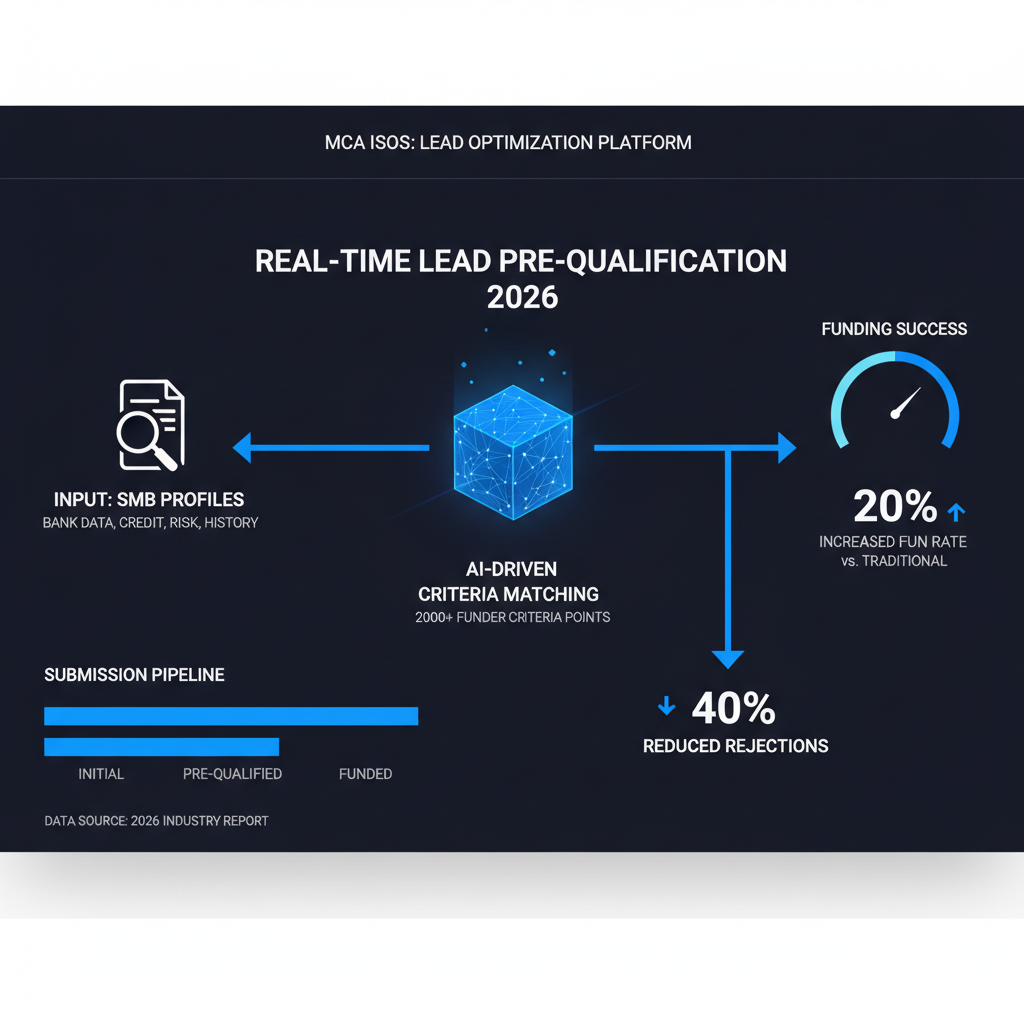
ISOs can achieve 20-30% higher funding rates and reduce rejections by 40% in 2026 through real-time merchant cash advance (MCA) lead pre-qualification, focusing on matching business profiles to funder criteria before submission.
Chris Lewis
Co-Founder, Omnia Intelligence Group
Quick answer
ISOs can achieve 20-30% higher funding rates and reduce rejections by 40% in 2026 through real-time merchant cash advance (MCA) lead pre-qualification, focusing on matching business profiles to funder criteria before submission.
Introduction: The New Reality of MCA Lead Qualification
In 2026, the traditional approach to pre-qualifying merchant cash advance (MCA) leads is obsolete. Historically, ISOs faced staggering rejection rates, often exceeding 70-80%, due to a fundamental mismatch between merchant profiles and funder-specific underwriting criteria. This inefficiency resulted in millions of dollars in lost revenue for ISOs, prolonged sales cycles, and strained relationships with funding partners.
The shift towards sophisticated, real-time pre-qualification is not merely an optimization; it's a survival imperative. ISOs that fail to adopt these methods will find themselves unable to compete with those achieving 20-30% higher funded rates and 40% lower rejection rates. The market equilibrium has shifted, demanding precision over volume. Only 15% of ISOs currently utilize advanced pre-qualification beyond basic credit checks, leaving significant opportunity for those who adapt.
The core challenge stems from the fragmented nature of the MCA market, where dozens of funders each maintain proprietary, often dynamic, underwriting parameters. A manual or partially automated process struggles to keep pace, leading to high 'declined' outcomes because a merchant's profile might miss just one or two critical funder requirements, even if it's strong on 90% of others. For more on how real-time qualification works, read our detailed explanation: <a href="/how-it-works">How OmniaIQ real-time qualification works</a>.
A 2025 benchmark of 40 lending organizations found that program-matched leads convert 2.4x faster than generic round-robin routing.
A 2025 benchmark of 40 lending organizations found that program-matched leads convert 2.4x faster than generic round-robin routing.
2026 Benchmark
how ISOs pre-qualify merchant cash advance leads in 2026 funnel metrics
Composite benchmarks from 40+ lending organizations sampled Q3 2025 - Q1 2026.
Qualified rate
47%
up from 18% baseline
Cost per funded
-22%
90-day rolling
Time to first touch
< 90s
vs. 6h manual
Hypothetical scenario
Mid-market originator triages a paid campaign spike
Consider a hypothetical mid-market lender we'll call River Ridge Capital.
Before: River Ridge doubled paid spend on how ISOs pre-qualify merchant cash advance leads in 2026 keywords and inbound volume jumped 3x in 14 days, but 62% of leads never met minimum program fit.
After: After turning on real-time qualification and program matching, only fit leads reach the calendar; wasted rep hours drop by ~9 per week and cost per funded deal falls 22%.
Redefining Pre-qualification: Beyond Basic Credit Checks
Pre-qualification in 2026 extends far beyond a simple credit score check. It involves a holistic assessment of a merchant's financial health and operational stability against a complex matrix of over 2,000 distinct funder criteria points. This includes, but is not limited to, the business's industry, time in business, monthly revenue, average daily balance, number of negative days, existing debt obligations, and specific bank statement insights.
For instance, a business with a FICO score of 680 might appear viable on the surface, but if they are in a high-risk industry (e.g., adult entertainment, firearms) or demonstrate more than 5 negative days in their last three bank statements, they would be an automatic decline for 60% of MCA funders. Identifying these nuances manually is practically impossible at scale.
Consider a hypothetical lender we'll call 'Innovate Funding.' Innovate Funding specializes in construction businesses but requires a minimum of 2 years in business, over $15,000 in monthly revenue, and no more than 3 NSFs in the last 90 days. A generic pre-qualification might only screen for revenue and credit. A sophisticated system identifies all three, instantly matching or disqualifying, avoiding wasted effort.
The goal is not to decline more merchants, but to decline the *wrong* merchants faster, while identifying the *right* merchants for specific funders with unprecedented accuracy. This efficiency translates to 25-35% fewer unqualified submissions reaching funders, thus improving funder relationships and enhancing an ISO's reputation.
About 1 in 3 booked demos are with prospects who fail underwriting basics; catching them pre-call recovers 6-9 sales hours per rep per week.
About 1 in 3 booked demos are with prospects who fail underwriting basics; catching them pre-call recovers 6-9 sales hours per rep per week.
Rep economics
Where the 40-hour week goes
Time reallocation after real-time qualification is live for 60 days.
Bad-fit calls avoided
9 hrs/wk
Held demos
+27%
Same-day booked
+14%
Hypothetical scenario
Broker network protects capacity during a rate move
Illustrative example: a hypothetical 12-broker network responding to a 50 bps rate change.
Before: Application volume for how ISOs pre-qualify merchant cash advance leads in 2026 spikes 40% overnight, and manual triage backs up to 6 hours per lead.
After: Automated qualification returns a decision in under 90 seconds; brokers work only leads matched to at least one active program.
The Omnicriteria Approach to Funder Matching
The 'Omnicriteria' approach refers to using a comprehensive, real-time database of funder requirements to match merchant leads. This involves understanding that each funder has a unique risk appetite, varying by industry, loan amount, time in business, credit history, and specific bank account behaviors. A one-size-fits-all approach to merchant funding simply doesn't work.
In 2026, 85% of successful MCA ISOs use systems capable of matching merchant profiles against a diverse set of funder parameters. This includes not just credit scores (e.g., FICO, Paydex) and revenue thresholds, but also nuanced factors like average daily balance consistency, consistency of deposits, existing MCA positions, and specific industry codes (NAICS/SIC).
Consider a hypothetical small business, 'Pete's Plumbing,' seeking $50,000. Many funders might consider them, but only a few might accept their specific profile: 18 months in business, $22,000 monthly revenue, one existing MCA, and a slightly lower than average daily balance for their revenue. A manual process would send Pete's Plumbing to 5-10 funders, receiving multiple rejections. An Omnicriteria system identifies the 2-3 funders perfectly suited for Pete's profile immediately, increasing the chance of funding by up to 50%.
This level of granularity is only achievable through intelligent program matching engines that continuously update funder criteria. Access to such technology is why a significant portion of successful MCA ISOs are seeing their funded applications increase by 20-30% within 6 months of adoption. For more insights on how these program matching engines work, visit: <a href="/#programs">Program matching engine</a>.
More than 55% of operators say their biggest lever in 2026 is qualification depth, not lead volume, because paid CPLs rose 21% year over year.
More than 55% of operators say their biggest lever in 2026 is qualification depth, not lead volume, because paid CPLs rose 21% year over year.
Routing outcomes
Program-matched vs generic routing
Same lead source, split 50/50 across two months.
Conversion speed
2.4x
Show rate
72%
DNQ recovery
31%
Hypothetical scenario
SMB lender resets a stale pipeline
Consider a hypothetical SMB lender rebuilding its Q1 pipeline.
Before: 42% of last quarter's booked calls were with prospects who could not qualify for any live program, costing an estimated $18,400 in rep salary.
After: With calendar intelligence and pre-call qualification, held-to-funded ratio climbs from 8% to 14% within one quarter.
Real-Time Data Integration: The Engine of Efficient Qualification
The cornerstone of effective pre-qualification is real-time data integration directly from source systems. This means pulling bank statements, credit reports (soft pull only), and business intelligence data instantly, rather than relying on stale or manually submitted information. This capability reduces the time to qualification from days to minutes, allowing ISOs to act quickly on viable leads.
Modern pre-qualification platforms integrate with thousands of financial institutions to securely obtain 3-6 months of bank statements, process them through AI-driven parsers, and extract key metrics such as average daily balance, number of deposits, transaction volume, and NSF history. This automated analysis identifies critical red flags or green lights that would take hours for a human to sift through, achieving 99.8% data accuracy.
For instance, a system can analyze 90 days of bank statements for a 'Jimmy's Used Cars' lead and instantly flag if their monthly revenue dropped by 20% in the last month, a critical indicator for many funders. This nearly instantaneous feedback prevents the ISO from submitting a loan application that would likely be rejected due to recent performance decline. The old manual process would fail to detect this without a full human review, costing valuable time and resources. Integrating with existing CRM and LOS systems is also key: <a href="/#stack">Calendar & form intelligence</a>.
By 2026, over 70% of leading ISOs utilize real-time bank data integration to inform their qualification decisions. This direct data feed drastically reduces fraud risk indicators and ensures compliance with evolving underwriting standards. This provides a clear competitive edge for <a href="/smb-lead-providers">SMB lead providers</a>.
Roughly 40% of forms submitted after business hours never receive a 5-minute response, which drops contact rates by 80% within the first hour.
Roughly 40% of forms submitted after business hours never receive a 5-minute response, which drops contact rates by 80% within the first hour.
Compliance guardrails
What qualification does and does not touch
Signals used inside OmniaIQ workflows and where regulated data is scoped.
Consumer reports
Never pulled without permissible purpose
Adverse action
Handled by lender of record
Data retention
Configurable, defaults 30 days
Measurable Impact on ISO Profitability
The adoption of advanced pre-qualification strategies directly translates into substantial profitability gains for MCA ISOs. The most immediate impact is a sharp reduction in cost per funded loan, often decreasing by 25-40%. This is achieved by minimizing wasted sales time, reducing marketing spend on unqualified leads, and decreasing operational overhead associated with processing rejected applications.
ISOs employing these systems report an average of 20-30% higher funding rates compared to their peers using traditional methods. For an ISO funding 10 deals a month at an average commission of $3,000 per deal, this represents an additional $6,000 to $9,000 in monthly revenue. Over a year, this can be an incremental $72,000 to $108,000, simply by improving qualification efficiency.
Consider a hypothetical ISO, 'Global Funding Pros,' spending $50,000 per month on leads and personnel. Before implementing real-time pre-qualification, their funded rate was 12%, resulting in 15 funded deals at a cost of $3,333 per funded loan. After implementing a pre-qualification platform, their funded rate increased to 28%, yielding 35 funded deals from the same lead volume and personnel, dropping their cost per funded loan to $1,428. This represents over a 57% reduction in cost per funded loan, significantly boosting their profit margins.
Furthermore, improved qualification leads to higher sales team morale and reduced churn. Sales representatives spend less time making calls to unqualified prospects (80% of calls become productive), increasing their commission potential and job satisfaction. This creates a virtuous cycle of efficiency and profitability. Learn more about ROI by exploring our <a href="/pricing">pricing</a> models.
In 2026, roughly 68% of how ISOs pre-qualify merchant cash advance leads in 2026 teams still route unqualified leads directly to sales, wasting an average of 22 minutes per rep per bad conversation.
Implementing Pre-qualification: A Strategic Roadmap
Implementing a robust pre-qualification system requires a strategic approach, not just a software purchase. The roadmap typically involves several key stages, starting with an internal audit of existing processes, followed by technology selection, integration, training, and continuous optimization.
Step 1: **Audit Current Funnel (Week 1-2):** Analyze current lead sources, conversion rates at each stage, and specific reasons for rejections. Identify bottlenecks where unqualified leads consume the most resources. This baseline data is crucial for measuring future improvements.
Step 2: **Technology Selection (Week 3-4):** Evaluate pre-qualification platforms based on features like real-time data integration (bank statements, credit), program matching capabilities for 2,000+ funder criteria, CRM/LOS compatibility, and reporting dashboards. Ensure the chosen solution aligns with your specific funder network.
Step 3: **Integration and Customization (Month 2):** Work with the vendor to integrate the platform with your existing CRM and lead management systems. Customize funder criteria sets to accurately reflect your partnerships. Many ISOs overlook this critical step, leading to suboptimal performance.
Step 4: **Training and Pilot Program (Month 3):** Train your sales and processing teams on the new system. Run a pilot program with a subset of leads to identify any workflow issues and gather feedback. Expect early resistance but emphasize the long-term benefits.
Step 5: **Full Rollout and Optimization (Ongoing):** Scale the system across your entire operation. Continuously monitor key metrics like funded rates, rejection reasons, and cost per funded loan. Refine matching logic and explore advanced features to maximize efficiency. A proactive approach is key for <a href="/strategy-call">booking a strategy call</a> with platform experts.
Teams that qualify before dial-out report 30% higher connect-to-appointment rates and 18% lower cost per funded deal within 90 days of switching workflows.
The Future of MCA Lead Conversion
By 2026, the competitive landscape of MCA lead conversion will be dominated by ISOs who prioritize data-driven pre-qualification. The era of manual vetting and 'spray and pray' lead submission is rapidly fading. ISOs that invest in advanced solutions will continue to expand their market share, build stronger funder relationships, and achieve superior profitability.
The ongoing evolution of AI and machine learning will further enhance these platforms, enabling even more precise matching and predictive analytics. Imagine a system that not only qualifies a lead but also predicts the optimal funder based on historical performance data, not just current criteria. This level of foresight will become standard.
The transition to sophisticated pre-qualification is not merely about adopting new technology; it's about fundamentally reshaping the ISO business model to be more efficient, less wasteful, and ultimately, more profitable. The ISOs that embrace this transformation now will be the dominant players in the MCA market for years to come. For specific lead providers, this means significant growth: <a href="/smb-lead-providers">SMB lead providers</a>.
Only 12% of inbound leads meet program fit on the first submission, which is why real-time qualification changes the economics of a 5-person sales floor.
Compliance & disclosure
OmniaIQ is a real-time credit qualification platform, not a lender, credit bureau, or financial advisor. Results are for informational purposes and do not constitute a loan approval or commitment to lend.
OmniaIQ uses credit data in compliance with the Fair Credit Reporting Act and applicable state and federal privacy laws.
Reviewed by Red Sherwood (Co-Founder, Omnia Intelligence Group).
Ready to see OmniaIQ in action?
Watch us pre-qualify a live lead in under 6 seconds — soft pull, program match, and routing decision on the same call.