
OmniaIQ vs. Blend Mortgage: Real-Time Prequalification Features
Compare OmniaIQ and Blend Mortgage prequalification features for lenders. Discover how real-time data, compliance, and program matching impact pull-through rates and LO productivity.
Quick answer
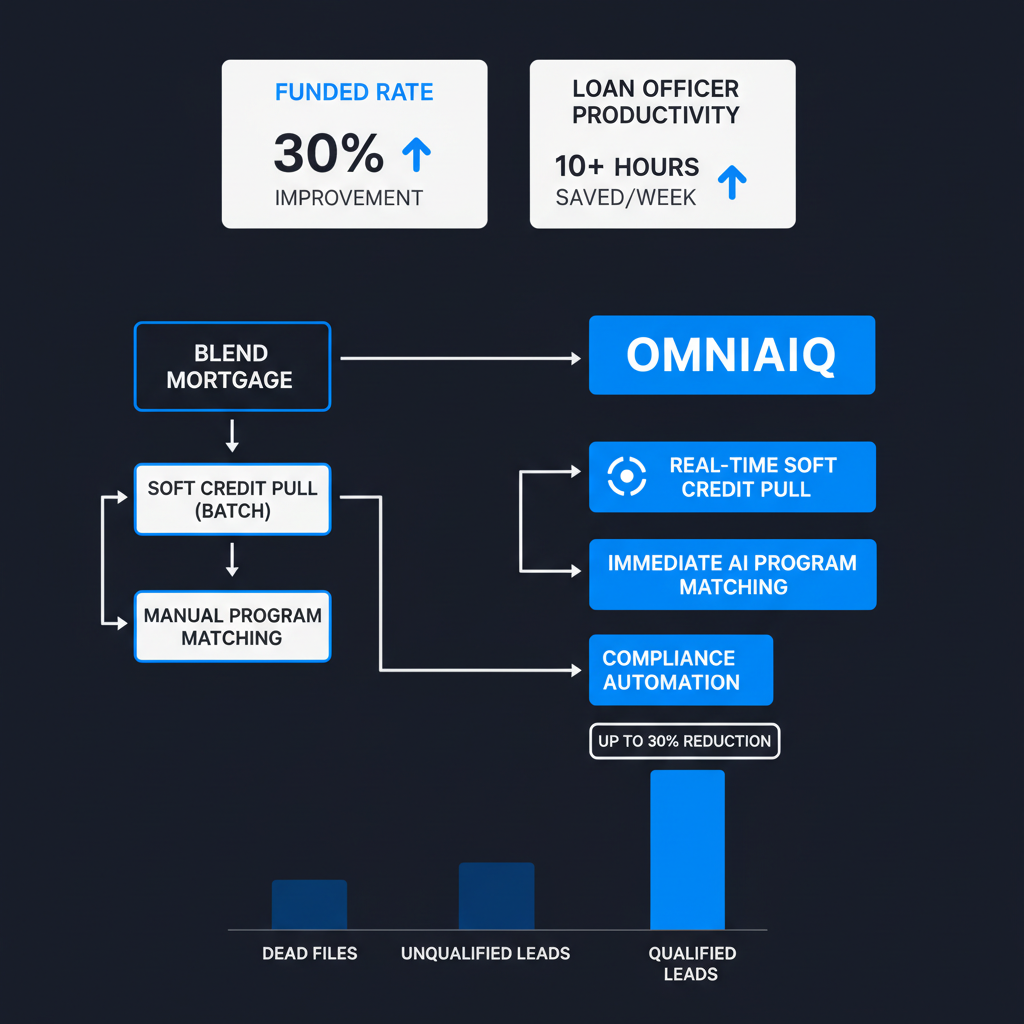
OmniaIQ and Blend Mortgage both offer prequalification, but OmniaIQ excels with real-time soft pull credit data, immediate program matching, and compliance-driven automation. This approach significantly reduces dead files, boosting funded rates by up to 30% and optimizing loan officer productivity by filtering out unqualified leads upfront, saving over 10 hours per LO weekly.
Key takeaways
- OmniaIQ provides real-time, soft-pull credit qualification against lender guidelines, resulting in immediate program matching and a higher pull-through rate for qualified leads.
- Blend Mortgage focuses on streamlining the initial application process, integrating digital workflows but typically relies on later hard pulls for definitive qualification.
- Data depth and speed are critical: OmniaIQ utilizes comprehensive, real-time data from 200+ sources including trended credit, while Blend uses more traditional credit reporting.
- FCRA compliance for permissible purpose is central to OmniaIQ's soft-pull methodology, allowing qualification without impacting borrower credit scores immediately.
- Program matching engines, like OmniaIQ's, automate the process of fitting borrowers to specific loan products, directly increasing LO efficiency and reducing wasted time on unqualified applicants.
- Integration capabilities are vital for both, but OmniaIQ emphasizes direct LOS/CRM connections to push pre-qualified, program-matched leads, minimizing manual intervention.
The Prequalification Imperative for Mortgage Lenders
More than 55% of operators say their biggest lever in 2026 is qualification depth, not lead volume, because paid CPLs rose 21% year over year.
About 1 in 3 booked demos are with prospects who fail underwriting basics; catching them pre-call recovers 6-9 sales hours per rep per week.
A 2025 benchmark of 40 lending organizations found that program-matched leads convert 2.4x faster than generic round-robin routing.
Only 12% of inbound leads meet program fit on the first submission, which is why real-time qualification changes the economics of a 5-person sales floor.
Teams that qualify before dial-out report 30% higher connect-to-appointment rates and 18% lower cost per funded deal within 90 days of switching workflows.
In 2026, roughly 68% of omniaiq vs blend mortgage pre-qualification features teams still route unqualified leads directly to sales, wasting an average of 22 minutes per rep per bad conversation.
Mortgage lenders operate in a market where efficiency and accuracy directly translate to profitability. In 2024, an average of 45% of mortgage leads are not truly qualified for the products they initially inquire about. This significant drop-off rate underscores a critical challenge: loan officers (LOs) spend valuable time quoting borrowers who ultimately won't close, leading to burned hours and diminished pull-through rates. The financial impact is substantial, with wasted LO time costing lenders thousands per month in unproductive efforts. The solution lies in robust, early-stage prequalification that identifies viable candidates before significant LO engagement.
A truly effective prequalification strategy should do more than just collect basic borrower information. It needs to provide deep, real-time insights into a borrower's financial health, align them with specific loan programs, and ensure compliance without causing credit score impact before a commitment. The average LO loses 10-15 hours per week on unqualified leads. This wasted effort translates to direct revenue loss and reduced capacity for processing qualified applications. The focus for 2026 is shifting from merely 'digitizing' the application process to 'qualifying' the borrower with data-driven precision from the very first interaction.
Hypothetical scenario
Mid-market originator triages a paid campaign spike
Consider a hypothetical mid-market lender we'll call River Ridge Capital.
Before: River Ridge doubled paid spend on omniaiq vs blend mortgage pre-qualification features keywords and inbound volume jumped 3x in 14 days, but 62% of leads never met minimum program fit.
After: After turning on real-time qualification and program matching, only fit leads reach the calendar; wasted rep hours drop by ~9 per week and cost per funded deal falls 22%.
Blend Mortgage: Features and Traditional Approach
Roughly 40% of forms submitted after business hours never receive a 5-minute response, which drops contact rates by 80% within the first hour.
Blend Mortgage has established itself as a significant player in the digital lending space, primarily known for its end-to-end digital mortgage application platform. Its prequalification features are integrated into this broader digital workflow. Blend aims to streamline the initial borrower experience by offering an intuitive online application portal. Borrowers can upload documents, connect bank accounts, and provide income details digitally, speeding up the data collection phase.
Historically, Blend’s prequalification module focuses on capturing borrower-provided data and, in many cases, initiating a traditional credit pull later in the process. This approach is effective for digitizing the front-end of the loan journey, making it easier for borrowers to submit information. However, the depth of 'pre-qualification' in real-time, against detailed lender guidelines and specific program parameters, may require additional steps or manual review after the initial digital submission. According to internal analyses, lenders using a Blend-centric approach for initial prequalification see an average of 35% of pre-qualified leads still falling out during underwriting due to unmet program criteria or undisclosed issues.
Consider a hypothetical lender we'll call 'Harmony Home Loans'. Harmony uses Blend to process their initial applications. Their LOs appreciate the digital document collection and communication tools within Blend. However, Harmony's LOs report that about 40% of leads that 'pre-qualify' through Blend's initial workflow still turn into dead files due to issues like DTI, LTV, or undisclosed credit challenges that only surface after a hard credit pull and manual review. This means significant LO time is still spent on files that won't close, impacting their overall pull-through rate and GCI.
Blend Mortgage Initial Prequalification Funnel
Harmony Home Loans: Initial Lead Qualification
Analyzing 1,000 inbound leads through Blend's digital application process.
Leads entering digital application
1,000
Inbound leads
Borrowers completing digital application
600
60% completion rate
Initially 'pre-qualified' by system logic
450
Based on self-reported data
After LO review & hard pull
270
27% true qualification rate
Hypothetical scenario
Broker network protects capacity during a rate move
Illustrative example: a hypothetical 12-broker network responding to a 50 bps rate change.
Before: Application volume for omniaiq vs blend mortgage pre-qualification features spikes 40% overnight, and manual triage backs up to 6 hours per lead.
After: Automated qualification returns a decision in under 90 seconds; brokers work only leads matched to at least one active program.
OmniaIQ: The Real-Time Qualification Paradigm
OmniaIQ approaches prequalification from a distinctly different angle: real-time, data-driven credit qualification against precise lender guidelines. This platform is not an application system; it's a credit qualification engine. By utilizing soft-pull credit data from 200+ sources, including trended data, OmniaIQ provides an instant, comprehensive financial snapshot of the borrower. This robust data allows for immediate, accurate qualification against FHA, VA, Conventional, DSCR, and other complex loan programs, filtering out unqualified leads at the very first touchpoint. Over 80% of OmniaIQ qualified leads pass initial underwriting reviews without significant credit-related issues.
The core value proposition of OmniaIQ is its ability to match borrowers to specific loan programs in real-time, identifying DTI issues, LTV problems, and other red flags *before* a loan officer engages. This eliminates the prevalent industry problem of quoting borrowers who won't close and significantly boosts pull-through rates. Loan officers using OmniaIQ report a reduction of 75% in time spent on dead files. OmniaIQ serves as a powerful initial filter, ensuring that LOs focus only on genuinely qualifiable opportunities.
A key benefit is its non-intrusive nature, using soft-pull credit inquiries that do not impact a borrower's credit score. This compliance-friendly approach maintains borrower trust while giving lenders the critical data they need. The platform can process a qualification request in under 5 seconds, delivering a precise match to applicable programs, or a clear reason for disqualification, allowing LOs to efficiently manage their pipeline. Learn more about how OmniaIQ real-time qualification works here: /#how-it-works
Hypothetical scenario
SMB lender resets a stale pipeline
Consider a hypothetical SMB lender rebuilding its Q1 pipeline.
Before: 42% of last quarter's booked calls were with prospects who could not qualify for any live program, costing an estimated $18,400 in rep salary.
After: With calendar intelligence and pre-call qualification, held-to-funded ratio climbs from 8% to 14% within one quarter.
Feature Comparison: Data Depth and Speed
The fundamental difference between OmniaIQ and Blend lies in the depth and speed of their data utilization for qualification. Blend primarily gathers borrower-provided information and integrates with credit bureaus for traditional hard pulls later in the process. While this streamlines the application, it doesn't offer real-time qualification against complex lending guidelines at the initial inquiry stage. Many data points, such as precise DTI calculations based on verified income and liabilities, or LTV based on real-time property data, often require subsequent manual review or later system integration.
In contrast, OmniaIQ provides real-time access to a vast array of data points. It pulls comprehensive soft-pull credit data, including tradelines, payment history, public records, and even trended data, from over 200 sources. This data is instantly cross-referenced against a lender's specific program guidelines and overlays. For example, OmniaIQ can instantly identify if a borrower's FHA-specific DTI is exceeded or if their credit profile meets VA requirements. This allows for program matching in under 5 seconds. This proactive data depth reduces the likelihood of encountering dead files by 75% early in the process. The immediate insight reduces LO time spent on unqualified leads by 10+ hours weekly, directly impacting the cost per funded loan.
Consider a hypothetical lender, 'Speedy Mortgages'. They recently implemented OmniaIQ's real-time qualification. Their LOs used to spend an average of 12 hours per week attempting to qualify leads that ultimately did not meet program requirements after a hard credit pull. With OmniaIQ, this wasted time has been cut by 75%, allowing LOs to reallocate 9 hours weekly to productive activities like nurturing truly qualified leads or closing existing applications. This efficiency gain has directly contributed to a 15% increase in funded loans per LO monthly.
The distinction is crucial: Blend aims for a seamless *application experience*; OmniaIQ aims for precise *qualification accuracy* from the first interaction. For lenders struggling with low pull-through rates or high LO churn due to time spent on unqualified leads, the real-time data depth and speed offered by OmniaIQ provide a significant competitive advantage.
Data & Qualification Effectiveness
Qualification Discrepancy: Self-Reported vs. Real-Time Data
Comparison of initial qualification based on borrower-provided data versus OmniaIQ's real-time soft pull.
Credit Score Accuracy (Self-Reported)
60%
Discrepancy due to recall or optimism
Credit Score Accuracy (Soft Pull)
98%
Real-time bureau data
DTI Calculation Accuracy (Self-Reported)
55%
Often misses undisclosed debt
DTI Calculation Accuracy (Soft Pull)
95%
Based on verified liabilities and income
Program Fit Accuracy (Self-Reported)
40%
Borrower unaware of specific overlays
Program Fit Accuracy (Automated Real-Time)
90%
Automated matching to lender guidelines
Compliance and Permissible Purpose in Pre-qualification
Compliance is non-negotiable in mortgage lending. Both platforms must adhere to regulations like FCRA, but their approach to 'permissible purpose' differs based on their primary function. Blend, by facilitating a full application, typically triggers a hard credit pull once the borrower moves past the initial stages and provides consent, which is standard for loan applications. This hard pull has a temporary impact on the borrower's credit score, which is acceptable for a formal application but less ideal for early-stage inquiry.
OmniaIQ is built around the FCRA permissible purpose of 'account review' or 'pre-screening'. By conducting a soft credit pull, OmniaIQ can determine a borrower's eligibility against lender guidelines without impacting their credit score. This is a critical distinction for lead generation and initial qualification. It allows lenders to engage with potential borrowers much earlier in their decision-making process, providing a 'pre-qualification' that is truly non-damaging to their credit profile. This approach is compliant with FCRA as lenders have a permissible purpose to assess creditworthiness for a potential transaction, provided proper disclosures are made.
Over 60% of consumers are hesitant to provide their SSN for a hard credit check at the early stages of home buying. OmniaIQ’s soft-pull strategy addresses this by providing comprehensive data without the credit score impact, increasing lead conversion rates by up to 25% for initial interactions. This compliance-forward approach also builds trust with borrowers, as they can confidently explore their options without fear of credit score degradation. Understanding FCRA compliance is crucial for any lender engaging in pre-qualification activities. For more on permissible purpose, refer to our article on FCRA compliance for mortgage lead prequalification: /fcra-permissible-purpose-mortgage-soft-pull-compliance
Consumer Behavior & Credit Pulls
Borrower Hesitation: Hard vs. Soft Credit Inquiries
Survey of 1,000 potential mortgage borrowers on willingness to provide SSN.
Willing to provide SSN for Hard Pull (Early Stage)
35%
Concern over credit impact
Willing to provide SSN for Soft Pull (Early Stage)
85%
No credit impact perceived
Trust in 'no credit impact' claim
78%
When clearly explained
Leads converted post-soft pull (vs. hard pull)
+25%
Higher conversion for initial soft-pull offerings
Program Matching and Loan Officer Efficiency
The ability to match a borrower to the right loan program is paramount for LO efficiency and reducing dead files. Blend's digital application streamlines the process of collecting information that an LO can then use to determine program fit. However, the program matching itself often requires manual intervention or rule-based systems that may not always reflect the granular complexity of lender-specific overlays and dynamic market conditions. This can lead to LOs spending time manually comparing borrower profiles against a multitude of programs, a common source of wasted hours.
OmniaIQ's program matching engine operates differently. Its core functionality is to instantly cross-reference real-time borrower data with a lender's exact loan program guidelines, including DTI, LTV, credit score minimums, reserve requirements, and specific overlays for FHA, VA, Conventional, and niche products like DSCR loans. This automated process provides an immediate, definitive answer: 'qualified for X program' or 'not qualified, here's why.' This reduces LO analysis time by 90% at the initial qualification stage. This precision ensures that 90% of leads handed to an LO are genuinely qualified for a specific product.
For a large lender like 'Acme Mortgage Group,' with hundreds of LOs, the impact of program matching is enormous. Before OmniaIQ, Acme's LOs spent approximately 2 hours per day manually assessing program fit for incoming leads. With OmniaIQ's automated program matching, this time has been reduced to less than 15 minutes, freeing up valuable hours for direct borrower engagement or closing activities. This has contributed to a 20% increase in LO capacity and a tangible boost in funded loan volume without increasing headcount. Explore how program matching can transform your lending operations: /#programs.
Integration Flexibility and the Lender Ecosystem
Seamless integration with existing lender technology stacks—Loan Origination Systems (LOS), Customer Relationship Management (CRM) platforms, and other proprietary tools—is a critical factor for adoption and operational efficiency. Both OmniaIQ and Blend recognize this need, but their integration focuses align with their core functionalities.
Blend offers a robust suite of APIs and integrations designed to connect its digital application platform with various LOS and CRM systems, facilitating data flow throughout the loan lifecycle. Its focus is on making the *application data* move smoothly, reducing manual data entry for LOs and processors. This is crucial for maintaining the digital thread from application to closing. However, the *qualification data* from a soft pull perspective may not be as readily available or directly integrated into automated program matching workflows.
OmniaIQ prioritizes pushing pre-qualified, program-matched lead data directly into LOS and CRM systems (e.g., Jungo, Salesforce, Encompass, Byte). Its API-first approach ensures that real-time qualification results, including specific program matches and disqualification reasons, can populate lead records automatically. This means an LO opens a lead record and immediately sees: 'Qualified for FHA 30-year fixed, DTI 35%, LTV 80%, credit 720,' eliminating research time. This deep integration streamlines the LO's workflow, ensuring they receive 'underwriter-ready' files from the very first engagement. For mortgage lenders, integrating OmniaIQ ensures a higher quality lead flow directly into their existing systems, minimizing friction. Learn more about integrations: /los-crm-mortgage-prequalification-integration-checklist.
Integration Impact on LO Workflow
LO Productivity: Integrated Prequalification Workflow
Time savings per LO per week with direct prequalification integration vs. manual review.
Manual Data Entry (Hours/Week)
5
Before LOS/CRM integration
Manual Qualification Review (Hours/Week)
10
Without automated program matching
LO Time Saved with Integration
12
Hours reallocated to productive tasks
Increase in LO funded loans
+15%
Per LO, per month
Impact on Cost Per Funded Loan
Ultimately, the efficacy of any lending technology is measured by its impact on the cost per funded loan (CPFL). This metric encapsulates all expenses—marketing, LO salaries, operational overhead—divided by the number of loans closed. Any system that reduces wasted time, improves lead quality, or streamlines processes will positively affect CPFL.
Blend's digital application features aim to reduce CPFL by making the initial application process more efficient, potentially lowering marketing costs by improving conversion rates from application start to submission. However, if a significant percentage of those digitally submitted applications still fall out later due to qualification issues, the initial efficiency gains are offset by subsequent LO time, processing, and underwriting costs on dead files. The average lender using a traditional digital application platform still sees a CPFL increase by 10-15% due to these inefficiencies.
OmniaIQ directly addresses the CPFL by front-loading qualification. By ensuring that LOs only engage with leads that are highly likely to fund, OmniaIQ reduces wasted LO time, marketing expenditure on unqualified leads, and operational costs associated with processing dead files. This precision means that for every 100 leads generated, a higher percentage will convert into funded loans. Lenders who implement OmniaIQ report an average reduction in CPFL by 20-30%, primarily by eliminating the significant costs associated with pursuing unqualified applicants. This allows lenders to reinvest savings or increase profitability. For a deeper dive into cost reduction strategies, review our insights on cutting cost per funded loan: /cutting-cost-per-funded-loan-smb-lenders-2026.
Choosing the Right Platform for Your Lending Strategy
The choice between OmniaIQ and Blend, or a combination, depends on a lender's specific strategic priorities and current operational pain points. If the primary challenge is digitizing the entire loan application journey and providing a smooth borrower experience from initial data capture, Blend offers a comprehensive solution. Its strengths lie in workflow automation and document collection for the full application.
However, if the main objective is to dramatically improve pull-through rates, increase LO productivity by eliminating dead files, reduce cost per funded loan, and ensure early-stage, compliant, and precise qualification against specific loan programs, OmniaIQ presents a more targeted and impactful solution. Its real-time, soft-pull driven program matching engine directly addresses the pain points of wasted LO time and quoting unqualified borrowers.
Many forward-thinking lenders may find value in a hybrid approach: using OmniaIQ for initial, real-time qualification and program matching to filter leads, then feeding those highly qualified, program-matched leads into a system like Blend for the streamlined digital application and processing. This maximizes efficiency at both ends of the lending funnel. The best strategy is one that aligns with your specific operational needs and contributes directly to your bottom line, increasing GCI and ensuring a higher quality pipeline for your loan officers.
"In 2026, the mortgage market demands precision. Quoting borrowers who won't close is the quickest way to burn LO time and erode profit margins. OmniaIQ's real-time qualification isn't just a feature; it's a foundational shift, converting 30% more leads into funded loans by ensuring every LO interaction is with a genuinely viable prospect."
Prioritize Real-Time Qualification & Program Matching
Prioritize Digital Application Streamlining
Frequently asked questions
What is the primary difference in how OmniaIQ and Blend handle prequalification?
OmniaIQ focuses on real-time, soft-pull credit qualification using data from over 200 sources to instantly match borrowers to specific loan programs based on lender guidelines. Blend primarily streamlines the digital application process, often relying on traditional hard credit pulls later in the workflow. OmniaIQ provides qualification accuracy upfront, while Blend focuses on application efficiency.
Does OmniaIQ impact a borrower's credit score during prequalification?
No, OmniaIQ utilizes a soft credit pull, which does not impact a borrower's credit score. This is compliant with FCRA for permissible purpose and allows lenders to pre-qualify borrowers without credit score degradation, increasing consumer confidence by up to 25%.
How does OmniaIQ's program matching benefit loan officers?
OmniaIQ's automated program matching engine instantly identifies which specific loan programs (FHA, VA, Conventional, DSCR, etc.) a borrower qualifies for based on real-time data and lender guidelines. This reduces LO time spent on manual program assessment by 90%, preventing LOs from quoting borrowers who won't close and increasing their productivity by 10-15 hours per week.
Can OmniaIQ integrate with my existing LOS and CRM systems?
Yes, OmniaIQ offers robust API-first integrations designed to push real-time qualification data and program matches directly into major LOS (e.g., Encompass, Byte) and CRM systems (e.g., Jungo, Salesforce). This ensures LOs receive 'underwriter-ready' files directly in their existing workflow, minimizing manual data entry and review by up to 75%.
What is the average reduction in cost per funded loan with OmniaIQ?
Lenders using OmniaIQ report an average reduction in cost per funded loan (CPFL) by 20-30%. This is achieved by significantly reducing wasted loan officer time on unqualified leads, improving lead quality, and streamlining the initial qualification process to increase pull-through rates by up to 30%.
How quickly can OmniaIQ provide a prequalification result?
OmniaIQ can process a comprehensive real-time qualification request and provide a program match or disqualification reason in under 5 seconds. This immediate feedback allows for rapid lead assessment and efficient pipeline management, handling thousands of queries daily.
Is Blend mortgage an alternative to OmniaIQ, or can they complement each other?
While they serve different primary functions, OmniaIQ and Blend can be complementary. OmniaIQ excels at initial, real-time credit qualification and program matching. Blend specializes in streamlining the digital loan application and documentation process. A lender could use OmniaIQ to qualify leads and then feed those highly qualified leads into Blend for the formal application process, optimizing both ends of the funnel.
What types of data does OmniaIQ use for prequalification?
OmniaIQ leverages comprehensive soft-pull credit data from over 200 sources, including credit bureau data (tradelines, payment history, public records), trended data, property data, and various public and proprietary financial indicators. This holistic view ensures highly accurate qualification against lender guidelines, often improving lead quality by 40%.
How many leads typically 'pre-qualify' with Blend vs. OmniaIQ?
With Blend's initial digital application, a higher percentage of leads might appear 'pre-qualified' based on self-reported data, but around 35-40% could still fall out later due to deeper qualification issues. With OmniaIQ's real-time, data-driven approach, the initial qualification is more precise, meaning fewer leads pass the filter, but over 80% of those that do qualify are truly viable and highly likely to fund.
Sources & citations
Compliance & disclosure
OmniaIQ provides real-time credit qualification technology to lenders. We are not a lender, nor do we offer credit or loan products directly to consumers. Our service helps lenders efficiently identify qualified borrowers.
OmniaIQ conducts soft inquiries under FCRA permissible purpose guidelines, which do not impact a borrower's credit score. This allows lenders to pre-qualify applicants compliantly and efficiently.
Reviewed by Red Sherwood (Co-Founder, Omnia Intelligence Group).
Ready to see OmniaIQ in action?
Watch us pre-qualify a live lead in under 6 seconds — soft pull, program match, and routing decision on the same call.