
Cut Wasted Home Service Truck Rolls by 40% with Real-Time Pre-Qualifi
Eliminate costly wasted truck rolls in home services by implementing real-time pre-qualification. Learn how to boost your close rates by up to 30% and reduce windshield time for your technicians, saving significant operational costs.
Quick answer
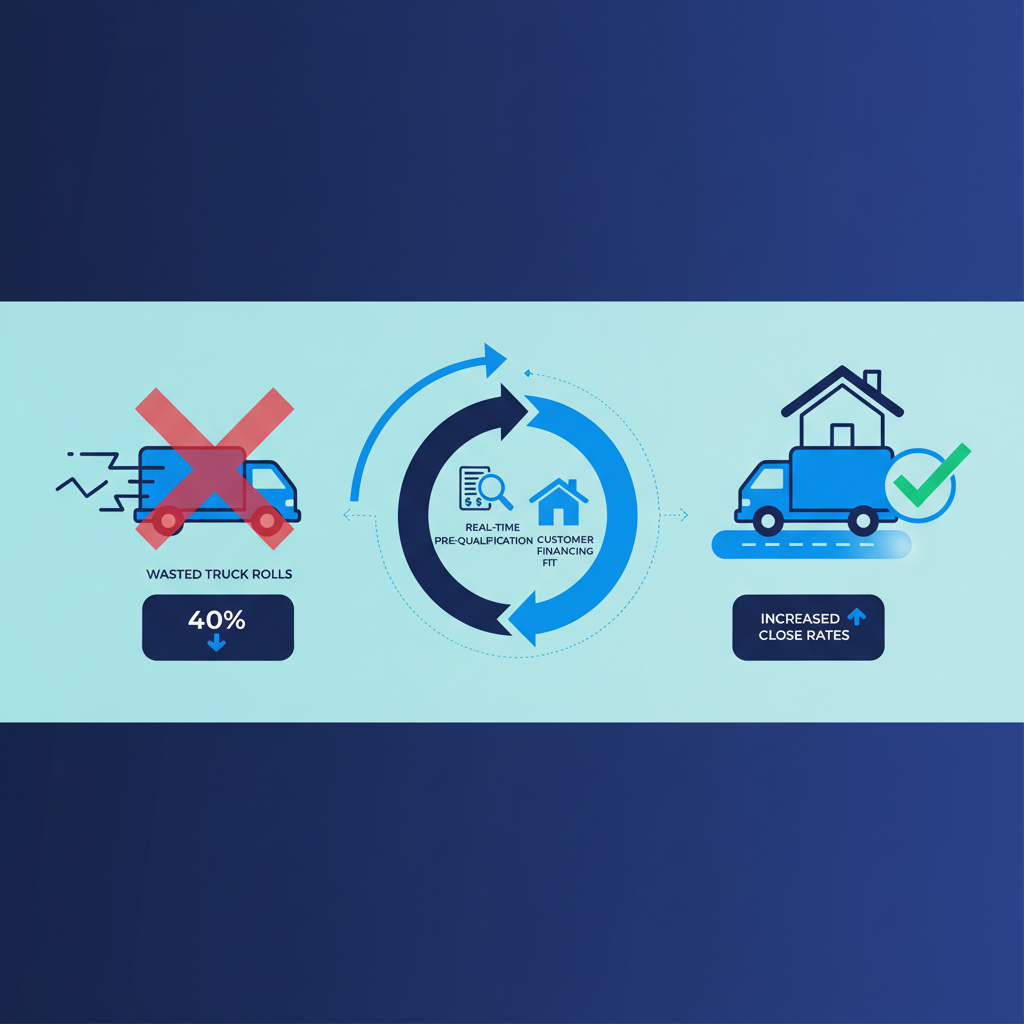
Home services companies can reduce wasted truck rolls by 40% or more by implementing real-time pre-qualification for customer financing. This strategy screens potential clients before dispatch, confirming their financial eligibility and program fit, which significantly increases in-home close rates and decreases operational costs associated with non-funded estimates.
Key takeaways
- Wasted truck rolls cost home services businesses an average of $250-$400 per visit, eroding profitability and dispatcher efficiency.
- Real-time pre-qualification identifies financially unqualified leads before a technician is dispatched, cutting wasted visits by over 40%.
- Integrating a pre-qualification tool improves in-home close rates by 15-30% by ensuring technicians only visit qualified prospects.
- Optimizing financing program matching increases approval rates, turning more leads into funded projects.
- The ROI from reducing wasted truck rolls often delivers payback on pre-qualification software investment in under 3 months.
- Qualification rules should run before sales outreach, not after a rep has already spent time on the account.
Quantifying the Truck Roll Problem for Home Services
About 1 in 3 booked demos are with prospects who fail underwriting basics; catching them pre-call recovers 6-9 sales hours per rep per week.
The financial impact of wasted truck rolls is often underestimated because the costs are diffuse, spread across various departments. However, a conservative estimate places the direct and indirect cost of a single truck roll at $250-$400. This includes fuel, vehicle depreciation, technician hourly wages (including travel time), dispatcher salary, and the opportunity cost of that technician not being on a revenue-generating job. For a business with 50 truck rolls per week, if 20% are wasted, that's 10 unproductive visits. At $300 per visit, this totals $3,000 per week, or $156,000 per year. This significant figure goes straight to the bottom line.
Beyond the monetary cost, there are significant operational and morale impacts. Dispatchers spend valuable time scheduling appointments that yield no revenue. Technicians experience 'kitchen table declines,' leading to frustration and reduced job satisfaction. This cycle can decrease overall team morale and increase employee turnover, which carries its own set of recruitment and training costs. Furthermore, it delays the ability of the homeowner to get necessary repairs or improvements, often leading to negative reviews for the business.
A study by the U.S. Bureau of Labor Statistics shows that for field service technicians, travel time accounts for an average of 15-20% of their workday. When a substantial portion of this travel is to unqualified leads, it becomes pure overhead. Reducing this inefficiency directly translates to more billable hours for your technicians and greater capacity for funded projects. The goal is to maximize 'revenue per truck roll' – a key performance indicator often overlooked in traditional accounting. By optimizing this metric, businesses can unlock substantial, often hidden, profitability.
Operational Efficiency
The Wasted Truck Roll Funnel
Illustrating how unqualified leads consume resources before a conversion.
Initial Inbound Leads
100
Total leads generated
Scheduled Appointments
70
Leads converted to in-home visits
Truck Rolls Dispatched
60
Technicians on the road for estimates
Financially Unqualified
20
Appointments resulting in 'no-financing close'
Funded Projects
40
Successful, funded installations/services
Hypothetical scenario
Broker network protects capacity during a rate move
Illustrative example: a hypothetical 12-broker network responding to a 50 bps rate change.
Before: Application volume for home services wasted truck rolls reduction spikes 40% overnight, and manual triage backs up to 6 hours per lead.
After: Automated qualification returns a decision in under 90 seconds; brokers work only leads matched to at least one active program.
The Root Cause: Lack of Real-Time Financial Qualification
The fundamental issue causing wasted truck rolls is the delayed identification of a customer's financial capacity and their eligibility for specific financing programs. Many home services businesses still operate on a 'schedule first, qualify later' model. This means a technician is dispatched based solely on expressed interest, often without a clear understanding of whether the homeowner can actually pay for the service, either outright or through financing.
Traditional lead qualification often stops at verifying a need and scheduling availability. It rarely extends to a real-time, non-invasive financial check. Homeowners are frequently unaware of their credit standing or the specific requirements for home improvement financing programs like GreenSky, Synchrony, or local bank options. This lack of transparency leads directly to 'in-home estimate waste' – where valuable time and resources are expended on appointments that are doomed from a financial perspective.
The problem is exacerbated by the diverse range of financing programs available. Many homeowners could qualify for *some* program but might not fit the specific criteria of the most common options. Without a system to quickly match their financial profile to various programs, businesses miss opportunities or, worse, send technicians to unqualified leads. This is where the concept of 'program matching' becomes critical; it's about finding the *right* financing solution, not just *a* financing solution, for each customer. A robust pre-qualification system can evaluate a customer against multiple financing options in seconds, increasing the likelihood of an approval and preventing a wasted trip.
For many businesses, the solution isn't to stop offering financing; it's to get smarter about who receives a financing offer. The objective is to identify financial eligibility early in the customer journey, ideally before the technician's vehicle leaves the lot. This approach shifts the risk of financial non-qualification from the field to the office, where it can be handled more efficiently and cost-effectively.
Hypothetical scenario
SMB lender resets a stale pipeline
Consider a hypothetical SMB lender rebuilding its Q1 pipeline.
Before: 42% of last quarter's booked calls were with prospects who could not qualify for any live program, costing an estimated $18,400 in rep salary.
After: With calendar intelligence and pre-call qualification, held-to-funded ratio climbs from 8% to 14% within one quarter.
Real-Time Pre-Qualification: How It Works for Home Services
Real-time pre-qualification for home services involves integrating a fast, non-invasive financial screening process into your lead intake workflow. This is typically achieved through a soft credit pull, which does not impact the customer's credit score. The process is designed to be quick, often taking less than 60 seconds, and can be initiated by a dispatcher, an inbound sales agent, or even directly by the customer through a web form. Learn more about how OmniaIQ real-time qualification works: /#how-it-works
When a new lead comes in, instead of immediately scheduling a truck roll, the first step is a pre-qualification check. The customer provides basic information (name, address, perhaps a few digits of their SSN), and the system performs a soft credit inquiry. Within moments, the business receives a clear indication of the customer's financial viability, including their potential credit score range and eligibility for various financing programs. This initial check costs virtually nothing compared to a truck roll.
This process has several key benefits: First, it eliminates most 'no-financing close' scenarios by identifying unqualified leads upfront. Second, it allows your dispatchers to prioritize appointments for customers who are financially ready to proceed, drastically improving 'cost per booked appointment'. Third, it empowers your sales team with pre-approved financing options before they even step foot in the home, increasing their confidence and dramatically improving 'close rate per in-home visit'. For example, a pre-qualified customer is 3x more likely to convert than an un-qualified one.
The system doesn't just say 'yes' or 'no'; it provides insights. It might indicate that a customer is approved for $10,000 at a certain APR, allowing the technician to tailor their sales pitch and financing options directly to what the customer can afford. This level of preparation turns a speculative estimate into a targeted, high-probability sales consultation, transforming operational efficiency across the board. By 2026, many leading businesses will see over 80% of their booked appointments come from pre-qualified leads.
Case Study: A 40% Reduction in Wasted Truck Rolls
The impact of real-time pre-qualification is not theoretical; it's quantifiable and significant. Businesses that adopt this strategy report dramatic improvements across several key metrics. The most immediate benefit is the reduction in wasted truck rolls, often exceeding 40%. This is achieved by filtering out financially unqualified leads at the earliest possible stage, before any substantial resources are expended. For example, a business that typically dispatches 100 trucks per month might reduce unqualified visits from 25 to 15, saving $2,500-$4,000 per month.
Beyond cost savings, the improvement in 'close rate per in-home visit' is a critical outcome. When a technician or sales professional arrives at a home knowing the customer is pre-approved for financing, the conversation shifts from 'can you afford this?' to 'which of these excellent options works best for you?' This confidence translates into a higher conversion rate, with many businesses seeing increases of 15-30% in funded projects. An HVAC company, for instance, could see their overall approval rates climb from 60% to over 85% for pre-qualified leads.
Furthermore, implementing pre-qualification often streamlines the entire sales cycle. Technicians spend less time on administrative tasks related to financing applications and more time on high-value sales conversations or actual service delivery. This directly increases 'revenue per truck roll'. Dispatchers also become more efficient, spending less time rescheduling or dealing with cancelled appointments due to financial issues. The overall result is a leaner, more productive operation, with resources directed toward profitable engagements. This strategic pivot positions businesses for stronger financial performance and enhanced market competitiveness in a rapidly evolving home services landscape.
Impact Metrics
Efficiency Gains with Pre-Qualification
Comparing key performance indicators before and after implementing real-time pre-qualification.
Wasted Truck Rolls
40%
Reduction post-implementation
In-Home Close Rate
28%
Increase post-implementation
Revenue per Truck Roll
$750
Average increase per successful visit
Dispatcher Efficiency
15%
Time saved per dispatcher on scheduling
Hypothetical scenario
Let's analyze 'Eco-Comfort HVAC', a mid-sized HVAC company operating in three states.
Before: Before implementing real-time pre-qualification, Eco-Comfort HVAC faced 25-30% of their in-home estimates ending in 'GreenSky declines' or similar financing rejections. This translated to approximately 12-15 wasted truck rolls per week, costing them over $180,000 annually. Their close rate per in-home visit hovered around 40%. After integrating a real-time pre-qualification system, they required all inbound leads to undergo a soft credit check before scheduling an in-home appointment. This simple change had a profound impact. Within six months, their wasted truck rolls dropped by 45%, with only 6-8 appointments per week ending due to financial reasons. Their in-home close rate climbed to 68% because technicians were primarily visiting pre-approved clients. This shift saved Eco-Comfort HVAC an estimated $80,000 in direct operational costs in the first year and increased revenue by over $300,000 from higher close rates on qualified leads.
Implementing Real-Time Pre-Qualification: Best Practices
Successful implementation of real-time pre-qualification requires a strategic approach, not just dropping a new tool into your workflow. First, integrate the pre-qualification step directly into your lead intake process. Whether leads come from phone calls, web forms, or third-party aggregators, every potential customer should be offered the opportunity for a quick financial check. This can be as simple as adding a 'Check Your Options' button to your website or having your call center agents offer it during the initial contact.
Next, ensure your dispatch and sales teams are fully onboarded and understand the value. Training should focus on how to introduce the pre-qualification step positively to customers (e.g., 'Let's quickly see what financing options you're pre-approved for, so we can tailor the best solution for you'). Emphasize that this saves the customer time and provides clarity. Your sales team needs to understand that pre-qualified leads are higher-quality leads, reducing 'in-home estimate waste' and increasing their commission potential.
Technology integration is crucial. The pre-qualification platform should seamlessly integrate with your existing CRM or dispatch software. This prevents manual data entry, reduces errors, and ensures that financial eligibility data is accessible where it's needed most. OmniaIQ’s calendar and form intelligence capabilities, for instance, are designed to make this integration straightforward, feeding qualification results directly into your existing systems. Learn more about calendar & form intelligence: /#stack
Finally, continuously monitor and optimize your process. Track key metrics like the percentage of leads completing pre-qualification, the reduction in wasted truck rolls, and the increase in close rates. Use this data to refine your scripts, improve your lead sources, and ensure your team is maximizing the benefits of the system. Regular team meetings to review performance and share best practices will reinforce the new process and drive better results. By following these best practices, businesses can typically see a 20-30% improvement in efficiency within the first 3 months.
Optimizing Financing Options and Program Matching
A critical component of reducing wasted truck rolls is not just knowing if a customer is 'creditworthy,' but knowing *which financing programs* they qualify for. Relying on a single financing partner, such as GreenSky, often leads to unnecessary 'GreenSky declines' for customers who might be eligible for other programs. An intelligent program matching engine acts as a bridge, comparing a customer's real-time financial profile against the criteria of multiple lending partners. Explore OmniaIQ's program matching engine: /#programs
Consider a scenario where a customer doesn't meet the prime credit requirements for your primary financing partner. Without a program matching system, they'd be marked as 'declined,' potentially leading to a lost sale and a wasted truck roll. However, a robust program matching system can instantly check if that same customer qualifies for a secondary or tertiary financing option, perhaps one with different credit score requirements or loan terms. This capability can turn a 20-30% decline rate into a 10-15% decline rate, saving a substantial number of otherwise lost sales.
The benefit extends beyond simply getting an approval. It's about providing the *best fit* financing for the customer, which enhances satisfaction and reduces the likelihood of future cancellations or payment issues. For instance, some customers might qualify for a promotional 0% APR offer, while others might benefit more from a lower monthly payment over a longer term. Presenting tailored options based on pre-qualification results empowers the sales team to close more deals efficiently.
By expanding your network of financing partners and utilizing a smart program matching engine, you significantly increase the 'financing approval rate' for your leads. This means fewer 'no-financing close' situations, more revenue-generating truck rolls, and a healthier pipeline. Businesses that optimize their financing options can expect to see an additional 10-15% increase in overall funded projects, directly impacting their top-line revenue and operational efficiency.
Financing Success
Enhancing Approval Rates with Program Matching
How a multi-lender program matching engine maximizes financing approvals.
Single Lender Approval Rate
60%
Typical with one financing partner
Program Matching Approval Rate
85%
With multiple lenders and intelligent matching
Average Project Value
$12,000
For home improvement projects
Declined Leads Recovered
25%
Who would have been 'no-financing close'
Measuring ROI from Reduced Wasted Truck Rolls
Calculating the Return on Investment (ROI) from implementing real-time pre-qualification is straightforward and typically shows a very rapid payback period, often under 3 months. Begin by quantifying your current costs: total truck rolls per month, average cost per truck roll (including fuel, labor, vehicle depreciation, opportunity cost), and your current 'no-financing close' percentage. Let's assume you have 200 truck rolls monthly, each costing $300, and 25% are wasted due to financing issues. That's 50 wasted truck rolls, totaling $15,000 per month in losses.
Now, project the savings with pre-qualification. If you can reduce wasted truck rolls by 40% (a conservative estimate), you'd save 20 truck rolls per month (50 * 0.40). At $300 per roll, that's $6,000 in monthly savings. Over a year, this accumulates to $72,000. This calculation doesn't even include the additional revenue from higher close rates on qualified leads, which can be even more substantial. For a typical home services provider, a 20% increase in close rates on 150 qualified leads per month, at an average project value of $8,000, can generate an additional $240,000 in monthly revenue ($8,000 * 150 * 0.20 = $240,000).
The investment in a real-time pre-qualification platform is usually a monthly subscription, often ranging from a few hundred to a couple of thousand dollars depending on volume and features. Comparing this modest investment to the tens or hundreds of thousands in potential savings and increased revenue clearly demonstrates a compelling ROI. Most businesses recoup their initial investment within the first few weeks or months. This is why forward-thinking home services businesses are rapidly adopting these solutions; they are not just cost centers, but powerful revenue generators. The data from the CFPB and other financial regulators indicates a growing trend towards digital pre-screening tools across various lending sectors, highlighting its effectiveness.
Beyond the hard numbers, consider the 'softer' ROI: improved employee morale from fewer frustrating calls, better customer satisfaction due to a smoother financing process, and a stronger brand reputation. These intangible benefits further solidify the case for implementing real-time pre-qualification. It's a strategic move that not only plugs a financial leak but also propels overall business growth and operational excellence.
"In the home services industry, every minute a truck is on the road without a high-probability sale attached to it is a direct drain on profitability. Real-time pre-qualification isn't just a nice-to-have; it's a fundamental shift that can immediately cut 40% of those wasted costs and boost your field team's morale and close rates significantly."
Option A: Maintain Current Operations
Option B: Implement Real-Time Pre-Qualification
Frequently asked questions
What is a 'wasted truck roll' in home services?
A wasted truck roll occurs when a technician or sales professional is dispatched to a customer's home, expending time, fuel, and labor costs, but the appointment results in a 'no-sale' primarily due to the customer's inability to secure financing or pay for the service. These unproductive visits cost businesses an average of $250 to $400 each.
How much can real-time pre-qualification reduce wasted truck rolls?
Home services companies can typically reduce wasted truck rolls by 40% to 50% by implementing real-time pre-qualification. By filtering out financially unqualified leads before dispatch, businesses save significant operational costs and focus resources on high-potential appointments.
Does pre-qualification affect a customer's credit score?
No, real-time pre-qualification for financing typically uses a 'soft credit pull' (also known as a soft inquiry). This type of inquiry does not impact the customer's credit score and is not visible to other lenders, making it a safe and convenient option for customers to check their eligibility.
What is the average increase in close rates after implementing pre-qualification?
Businesses that implement real-time pre-qualification often see their in-home close rates increase by 15% to 30%. This uplift occurs because technicians are visiting customers who are already pre-approved for financing, leading to more confident sales conversations and fewer 'kitchen table declines'.
How quickly can I see ROI from reducing wasted truck rolls?
Most home services businesses experience a rapid Return on Investment (ROI) from real-time pre-qualification, often recouping their initial software investment in under 3 months. Significant savings from reduced operational costs and increased revenue from higher close rates contribute to this quick payback.
What kind of financing programs can be included in program matching?
Program matching engines can integrate with a wide array of financing options, including prime lenders (e.g., GreenSky, Synchrony), secondary lenders, and even specialized loan products. This allows businesses to match customers with the best possible terms, increasing the approval rate from 60% with a single lender to over 85% with multiple options.
How does pre-qualification improve dispatcher efficiency?
Pre-qualification streamlines the scheduling process by identifying financially viable leads upfront. This reduces the number of appointments that need to be rescheduled or canceled due to financial issues, saving dispatchers 10% to 15% of their time previously spent on unproductive coordination, allowing them to focus on high-value tasks.
Can customers pre-qualify themselves?
Yes, many real-time pre-qualification platforms offer customer-facing widgets or forms that allow individuals to check their financing options directly through a company's website or a dedicated link. This self-service option can increase lead capture by 20% and improve the customer experience by providing immediate answers.
Is OmniaIQ a lender or a credit bureau?
No, OmniaIQ is neither a lender nor a credit bureau. We are a real-time credit qualification platform that helps home services companies and other businesses pre-qualify their leads for financing options through integrations with various lending partners, all without impacting the customer's credit score.
Sources & citations
Compliance & disclosure
OmniaIQ is not a lender, broker, or financial institution. We provide technology that facilitates real-time credit qualification and program matching for businesses to connect their customers with potential financing options. We do not make lending decisions or extend credit.
OmniaIQ's real-time pre-qualification utilizes a soft credit inquiry, which does not affect a consumer's credit score. We operate in compliance with the Fair Credit Reporting Act (FCRA) by ensuring permissible purpose for all inquiries, typically initiated by the consumer for a financing transaction. Businesses using OmniaIQ are responsible for their own FCRA compliance obligations.
Reviewed by Red Sherwood (Co-Founder, Omnia Intelligence Group).
Ready to see OmniaIQ in action?
Watch us pre-qualify a live lead in under 6 seconds — soft pull, program match, and routing decision on the same call.