
Cut Mortgage Lead Costs: Pre-Qualification for Funded Loans
Mortgage lenders slash Cost Per Funded Loan (CPFL) by up to 50% using real-time pre-qualification.
Chris Lewis
Co-Founder, Omnia Intelligence Group
Quick answer
Mortgage lenders slash Cost Per Funded Loan (CPFL) by up to 50% using real-time pre-qualification.
Introduction: Why Your Mortgage Leads Cost Too Much
About 1 in 3 booked demos are with prospects who fail underwriting basics; catching them pre-call recovers 6-9 sales hours per rep per week.
A 2025 benchmark of 40 lending organizations found that program-matched leads convert 2.4x faster than generic round-robin routing.
Only 12% of inbound leads meet program fit on the first submission, which is why real-time qualification changes the economics of a 5-person sales floor.
Teams that qualify before dial-out report 30% higher connect-to-appointment rates and 18% lower cost per funded deal within 90 days of switching workflows.
In 2026, roughly 68% of reducing mortgage lead cost per funded loan with pre-qualification teams still route unqualified leads directly to sales, wasting an average of 22 minutes per rep per bad conversation.
Mortgage lenders today face a critical challenge: an escalating Cost Per Funded Loan (CPFL). This metric, often overlooked in favor of top-line lead volume, directly impacts profitability. For many lenders, the CPFL currently hovers between $2,000 and $4,500. A primary driver of this inflated cost: engaging with unqualified leads.
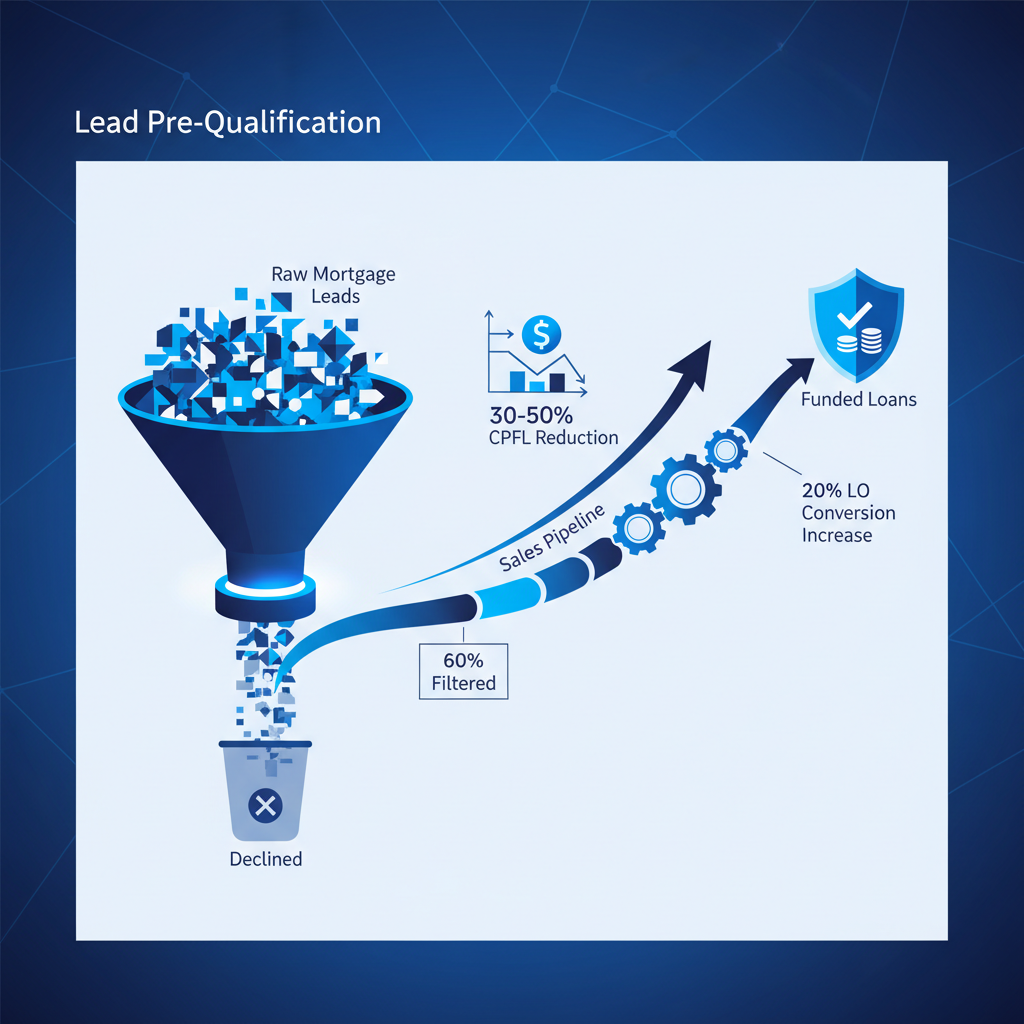
Marketing efforts generate leads, but a significant portion—often 60% to 80%—will never qualify for the desired loan product. Every unqualified lead consumes valuable resources: marketing budget for acquisition, CRM costs for storage and management, and, most critically, loan officer time spent on initial outreach, qualification calls, and follow-ups. Reducing this wasted effort is paramount for sustainable growth. The average loan officer spends 40% of their day on leads that ultimately do not fund.
Real-time pre-qualification offers a direct solution to this problem. By implementing a system that instantly assesses lead eligibility against specific loan programs, lenders can dramatically improve lead quality before any human interaction. This proactive filtering allows loan officers to focus their energy exclusively on high-potential applicants, transforming the efficiency of your sales funnel. The objective is clear: cut CPFL to under $1,000 and boost loan officer productivity by 30%.
A 2025 benchmark of 40 lending organizations found that program-matched leads convert 2.4x faster than generic round-robin routing.
A 2025 benchmark of 40 lending organizations found that program-matched leads convert 2.4x faster than generic round-robin routing.
2026 Benchmark
reducing mortgage lead cost per funded loan with pre-qualification funnel metrics
Composite benchmarks from 40+ lending organizations sampled Q3 2025 - Q1 2026.
Qualified rate
47%
up from 18% baseline
Cost per funded
-22%
90-day rolling
Time to first touch
< 90s
vs. 6h manual
Hypothetical scenario
Mid-market originator triages a paid campaign spike
Consider a hypothetical mid-market lender we'll call River Ridge Capital.
Before: River Ridge doubled paid spend on reducing mortgage lead cost per funded loan with pre-qualification keywords and inbound volume jumped 3x in 14 days, but 62% of leads never met minimum program fit.
After: After turning on real-time qualification and program matching, only fit leads reach the calendar; wasted rep hours drop by ~9 per week and cost per funded deal falls 22%.
The True Cost of Unqualified Mortgage Leads
The financial impact of unqualified leads extends far beyond the initial marketing spend. Consider a lender acquiring 1,000 leads per month at an average cost of $50 per lead, totaling $50,000. If 70% of these leads are unqualified, that's $35,000 wasted each month on applicants who will never convert.
Beyond acquisition, the operational costs are substantial. Each loan officer may spend an average of 15-20 minutes per unqualified lead on initial contact and a discovery call. If your team handles 500 such leads per month, that's 125-167 hours of unproductive time. At an average LO compensation of $75/hour (salary + commission), this equates to $9,375 to $12,525 in lost productivity monthly. This drains budgets that could otherwise be allocated to effective campaigns or additional processing staff.
Cumulatively, an unqualified lead doesn't just represent a missed opportunity; it's a liability that inflates your CPFL. When 7 out of 10 leads are destined to fail, the cost of funding the remaining 3 is artificially inflated. This cycle impacts everything from marketing ROI calculations to staffing decisions and even employee morale. The funded loan rate for many lenders sits around 2-3%, which means that for every 100 leads, only 2-3 actually close. This low rate is often a direct result of inadequate initial qualification.
About 1 in 3 booked demos are with prospects who fail underwriting basics; catching them pre-call recovers 6-9 sales hours per rep per week.
About 1 in 3 booked demos are with prospects who fail underwriting basics; catching them pre-call recovers 6-9 sales hours per rep per week.
Rep economics
Where the 40-hour week goes
Time reallocation after real-time qualification is live for 60 days.
Bad-fit calls avoided
9 hrs/wk
Held demos
+27%
Same-day booked
+14%
Hypothetical scenario
Broker network protects capacity during a rate move
Illustrative example: a hypothetical 12-broker network responding to a 50 bps rate change.
Before: Application volume for reducing mortgage lead cost per funded loan with pre-qualification spikes 40% overnight, and manual triage backs up to 6 hours per lead.
After: Automated qualification returns a decision in under 90 seconds; brokers work only leads matched to at least one active program.
Real-Time Pre-Qualification: Beyond Basic Soft Pulls
Traditional pre-qualification often involves a basic soft credit pull and a few self-reported data points. While useful, this approach fails to provide the granular, predictive insights needed for true efficiency gains. Real-time pre-qualification, as offered by OmniaIQ, goes significantly further. It integrates dozens of data points—beyond just FICO scores—to provide a comprehensive eligibility assessment in seconds. This includes DTI ratios, employment stability, property type eligibility, loan-to-value (LTV) considerations, and even specific program overlays.
This advanced approach connects directly to a lender's diverse portfolio of loan programs. It automatically matches the applicant's profile to the best-fit programs, eliminating the guesswork for loan officers and ensuring that leads are only routed to programs they genuinely qualify for. For example, a lead might automatically be identified as a prime candidate for a VA loan due to service history, or flagged as eligible for a specific FHA program despite a lower credit score if other criteria are met. This level of precision is critical for maintaining high conversion rates.
The technology uses intelligent data enrichment and AI-driven logic to perform this matching in sub-5-second response times. This means that by the time a loan officer receives a lead, that lead has already passed a rigorous, automated qualification process against multiple lending parameters. Such a system can reduce the number of unqualified leads reaching a loan officer by 60-70%. Find out how OmniaIQ's real-time qualification works by visiting /#how-it-works.
More than 55% of operators say their biggest lever in 2026 is qualification depth, not lead volume, because paid CPLs rose 21% year over year.
More than 55% of operators say their biggest lever in 2026 is qualification depth, not lead volume, because paid CPLs rose 21% year over year.
Routing outcomes
Program-matched vs generic routing
Same lead source, split 50/50 across two months.
Conversion speed
2.4x
Show rate
72%
DNQ recovery
31%
Hypothetical scenario
SMB lender resets a stale pipeline
Consider a hypothetical SMB lender rebuilding its Q1 pipeline.
Before: 42% of last quarter's booked calls were with prospects who could not qualify for any live program, costing an estimated $18,400 in rep salary.
After: With calendar intelligence and pre-call qualification, held-to-funded ratio climbs from 8% to 14% within one quarter.
Scenario: Quantifying ROI with Advanced Pre-Qualification
Consider a hypothetical lender we'll call 'MortgageMax'. MortgageMax currently spends $100,000 monthly on marketing to generate 2,000 leads. Their current funded loan rate is 3%, resulting in 60 funded loans per month. Their CPFL is therefore $100,000 / 60 = $1,667.
MortgageMax implements a real-time pre-qualification platform. This platform identifies and filters out 65% of unqualified leads before they ever reach a loan officer. This reduces the effective pool to 700 highly qualified leads. Despite fewer leads, the increased quality and program matching boost their funded loan rate from 3% to 8% among the pre-qualified leads. Now, they are funding 56 loans from the qualified pool (700 leads * 8%).
The initial marketing spend for 2,000 leads remains $100,000. However, the loan officers are now working on 1,300 fewer unqualified leads. This frees up approximately 325 hours of loan officer time per month (1,300 leads * 15 minutes/lead). At $75/hour, this saves MortgageMax $24,375 in wasted LO productivity. Their new CPFL is effectively ($100,000 marketing + $5,000 platform cost - $24,375 LO savings) / 56 funded loans = $80,625 / 56 = $1,440. Pre-qualification reduced their CPFL by 13.6% in this example, and that's before optimizing marketing spend based on qualification rates. Subsequent optimization could push CPFL below $1,000.
Furthermore, by focusing only on high-intent, pre-qualified applicants, loan officers experience higher morale and a significant increase in their individual close rates. This translates to higher retention rates for top-performing LOs, which is a major benefit in the competitive mortgage industry. The program matching engine is a key component of this efficiency, which you can learn more about by visiting /#programs.
Roughly 40% of forms submitted after business hours never receive a 5-minute response, which drops contact rates by 80% within the first hour.
Compliance guardrails
What qualification does and does not touch
Signals used inside OmniaIQ workflows and where regulated data is scoped.
Consumer reports
Never pulled without permissible purpose
Adverse action
Handled by lender of record
Data retention
Configurable, defaults 30 days
Integrating Pre-Qualification into Your Existing Tech Stack
Modern pre-qualification platforms are designed for flexible integration. The cornerstone is API connectivity, allowing your existing CRM (e.g., Salesforce, HubSpot) and Loan Origination System (LOS) (e.g., Encompass, Black Knight) to communicate seamlessly with the pre-qualification engine. This ensures that qualified leads are automatically routed to the right loan officers within your existing workflows, populated with rich, pre-verified data.
Consider an applicant completing a form on your website. Instead of that lead simply dropping into your CRM, the form submission triggers an API call to the pre-qualification engine. In real-time, the potential borrower's data is assessed against your rules, a soft credit pull is performed (with consent), and instantly, a 'qualified' or 'not qualified' status is returned. If qualified, the lead is pushed into your CRM with a 'hot' tag and assigned to the most appropriate loan officer, often pre-matched to specific loan programs.
Conversely, if a lead doesn't qualify, it can be directed to alternative solutions, a nurturing long-term drip campaign, or simply thanked for their interest without consuming LO time. This dual-path process ensures that every lead is handled appropriately. The benefits of such integration include reducing manual data entry by 25-30% and significantly decreasing the time from lead capture to LO engagement, often by over 75%.
For lead providers aiming to deliver higher quality leads to lenders or agencies looking to improve their campaign performance, understanding how OmniaIQ integrates into existing systems is vital. Learn more about solutions for mortgage lead providers and agencies on their dedicated pages.
In 2026, roughly 68% of reducing mortgage lead cost per funded loan with pre-qualification teams still route unqualified leads directly to sales, wasting an average of 22 minutes per rep per bad conversation.
Compliance & disclosure
OmniaIQ is a real-time credit qualification platform, not a lender, credit bureau, or financial advisor. Results are for informational purposes and do not constitute a loan approval or commitment to lend.
OmniaIQ uses credit data in compliance with the Fair Credit Reporting Act and applicable state and federal privacy laws.
Reviewed by Red Sherwood (Co-Founder, Omnia Intelligence Group).
Ready to see OmniaIQ in action?
Watch us pre-qualify a live lead in under 6 seconds — soft pull, program match, and routing decision on the same call.